Edgar DEGAS
(Paris 1834 - Paris 1917)
Ballet Dancer at Rest (Buste de danseuse)
Pastel on brown paper, laid down on board.
Stamped with the Degas vente stamp (Lugt 658) in red ink at the lower left.
355 x 550 mm. (14 x 21 5/8 in.) [sight]
Stamped with the Degas vente stamp (Lugt 658) in red ink at the lower left.
355 x 550 mm. (14 x 21 5/8 in.) [sight]
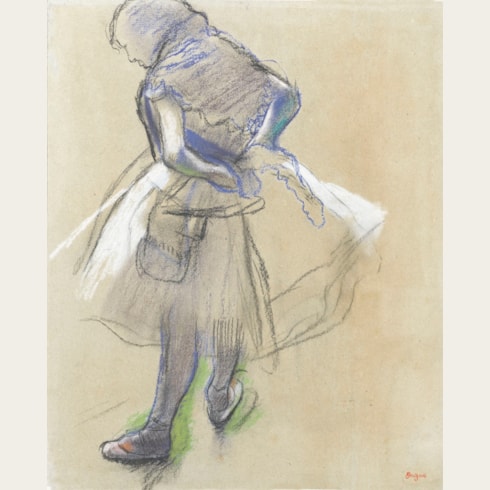
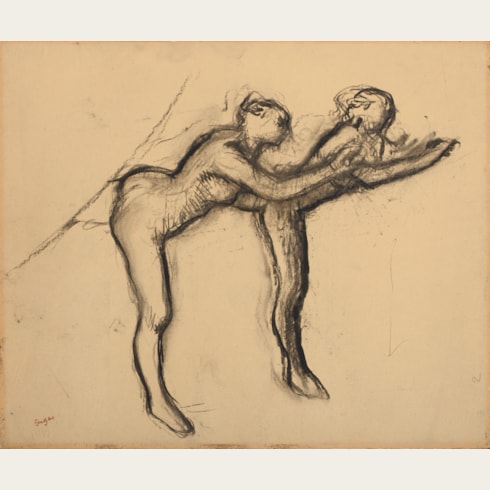
Ballet subjects account for about half of Edgar Degas’ total oeuvre as an artist. The ballet was a theme he first began to treat regularly in the early 1870s, and which he continued to study in hundreds of paintings, drawings, pastels, sculptures, prints and photographs right up until the very end of his long career. In his drawings of dancers, Degas developed a huge repertoire of poses, which he used and reused in his paintings and sculptures. These drawings were made behind the scenes at the Opéra itself and, more frequently, from the model posed in his studio. The artist appears to have been much less interested in the actual performances than in the dancers themselves, who are often portrayed at rest or exercising behind the scenes. Degas seems to have had a natural affection for these little dancers, known colloquially as ‘rats’; girls from poor families who entered the Opéra at the ages of seven or eight and spent ten or more years in classes, training for the corps de ballet. He studied and drew their long and arduous hours of practice and seems to have sympathized with them and admired their dedication. As one scholar has noted, ‘The dancer became Degas’s means of ruthlessly exploring the human figure. His probing analysis of bodily rhythms and tensions produced a seemingly limitless vocabulary of poses.’
A late work by Degas, the present sheet may be dated the last years of the 19th century or the very beginning of the 20th century. As the scholars Jill DeVonyar and Richard Kendall have written, ‘Degas’ preoccupation with dancers increased inexorably in the course of his long working life, until it almost overwhelmed the art of his old age. Some three-quarters of his total output of pictures in the 1890s and early 1900s were concerned with ballet themes, only his images of the female bather approaching them in sustained originality and commitment. Often this distinction became blurred, in a strange transitional world of nude women who executed arabesques and adjusted their imaginary tights...And we know that dancers from the Opéra still visited his apartment and studio until at least 1910, to pose both unclothed and in the dusty tutus kept there for the purpose.’
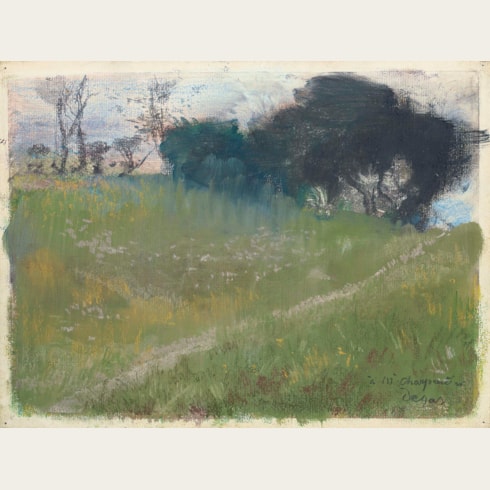
By the 1880s pastel drawings by Degas accounted for almost two-thirds of his output, with the artist creating fully-fledged pictures and large-scale compositions in the pastel medium. Christopher Lloyd has noted that ‘Even the ablest practitioners such as Cassatt, Forain, Redon, and Renoir, who each made numerous pastels, were not as committed to the medium to the same extent as Degas, nor were they as open to exploring the many ways it could be used.’ From about 1895 onwards Degas seems to have worked almost exclusively in pastel, largely as a result of his failing eyesight. In all, some seven hundred pastel drawings by Degas are known, depicting most of his preferred subjects; ballet dancers, bathers and racing scenes, as well as landscapes.
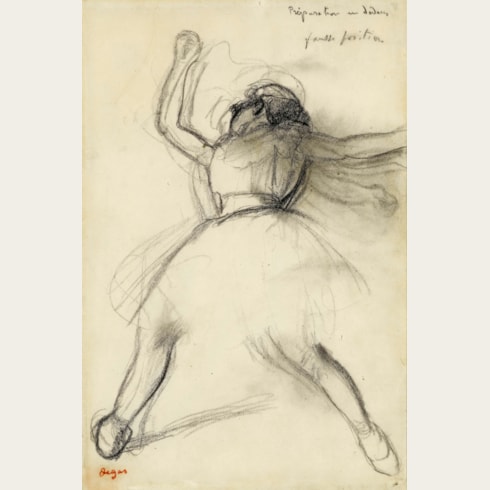
This splendid late pastel by Degas shows a dancer at rest, probably seated on a bench with one knee raised to support her left arm. This was an attitude that Degas studied in a handful of drawings and pastels of dancers caught in a moment of repose. As has been pointed out, ‘In hundreds of such studies Degas’s dancers are rarely found idle, preferring to stretch their limbs, adjust their hair, shoes or costumes, or massage a tired joint. With their professional lives defined by jetées and pirouettes, these anonymous girls retain their vital humanity even when resting.’
A preparatory charcoal drawing for the present sheet, similar in scale, was included in the third sale of the contents of Degas’s studio, held in April 1919. A seated dancer in an almost identical pose, albeit in reverse, is found in a very large charcoal and pastel drawing by Degas, datable to c.1905, in the Museum of Modern Art in New York, as well as in a closely related finished pastel of Two Dancers of c.1898 in the Saint Louis Art Museum. A handful of other drawings by Degas of dancers or nudes adopting a similar pose are known, such as a late pastel of a nude dancer seen from behind – in some respects almost a mirror image of the present sheet - in the Burrell Collection in Glasgow.
This exceptional pastel, which has remained in a Swiss private collection for almost eighty years, has only been exhibited once, in Basel in 1951-1952.
Provenance
The Atelier Degas, Paris
The second Vente Degas, Paris, Galerie Georges Petit, 11-13 December 1918, lot 145 (‘Buste de danseuse’, sold for 1,000 francs to Barthélemy)
Barthélemy collection, Paris, in 1946
Galerie Rosengart, Lucerne
Private collection, Basel, by 1951
Thence by descent to a private collection, Switzerland.
The second Vente Degas, Paris, Galerie Georges Petit, 11-13 December 1918, lot 145 (‘Buste de danseuse’, sold for 1,000 francs to Barthélemy)
Barthélemy collection, Paris, in 1946
Galerie Rosengart, Lucerne
Private collection, Basel, by 1951
Thence by descent to a private collection, Switzerland.
Literature
Paul-André Lemoisne, Degas et son oeuvre, Paris, 1946, Vol.III, pp.726-727, no.1246 (‘Buste de danseuse’), where dated c.1896.
Exhibition
Bern, Berner Kunstmuseum, Degas, 1951-1952, no.57 (‘Buste de danseuse. Um 1896’, lent from a private collection, Basel).