Edgar DEGAS
(Paris 1834 - Paris 1917)
Fishing Boat at the Entrance to the Port of Dives-sur-mer (Bateau de pêche à l’entrée du port de Dives)
Pastel on brown paper.
Inscribed by the artist ‘rendu le mise à échouement(?) du courant’ in pencil at the lower left, and ‘bateau échoué renfloué par le flux qui monte / dans le port de Dives grand courant’ in pencil at the lower right.
Stamped with the Degas vente stamp (Lugt 658) in red ink at the lower left.
214 x 322 mm. (8 3/8 x 12 5/8 in.)
Inscribed by the artist ‘rendu le mise à échouement(?) du courant’ in pencil at the lower left, and ‘bateau échoué renfloué par le flux qui monte / dans le port de Dives grand courant’ in pencil at the lower right.
Stamped with the Degas vente stamp (Lugt 658) in red ink at the lower left.
214 x 322 mm. (8 3/8 x 12 5/8 in.)
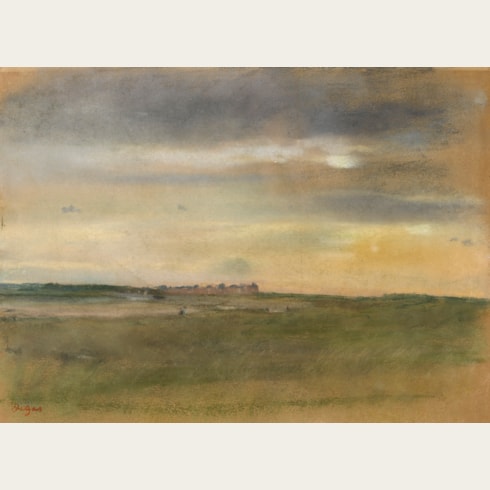
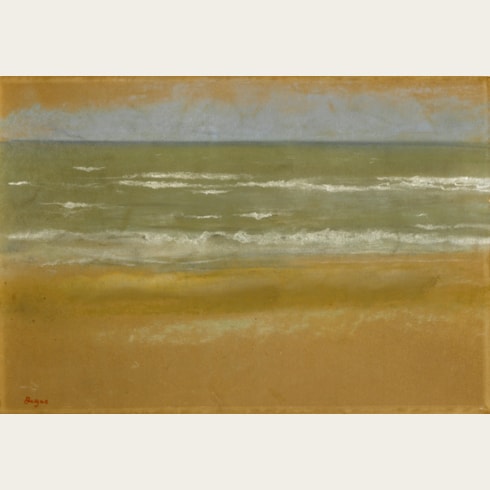
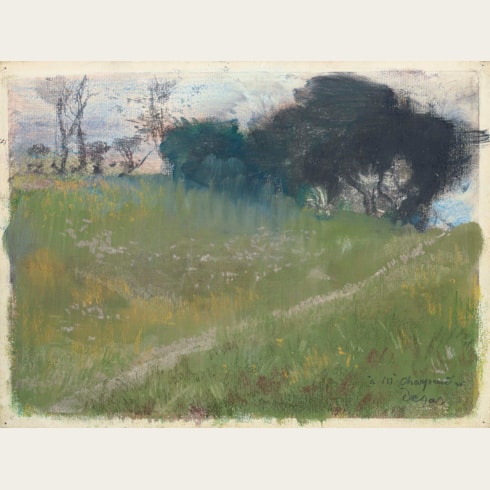
The present sheet is part of a series of more than forty pastel studies of landscapes and seascapes, probably done en plein air, which were drawn by Edgar Degas on the Channel coast in the summer and autumn of 18695. Degas spent much of the summer of 1869 at the village of Beuzeval, near Houlgate and Dives-sur-Mer on the Normandy coast. He spent his time making pastel landscape drawings along the small stretch of coastline between Houlgate, Dives-sur-Mer and Villers-sur-Mer to the norrtheast. (He also paid a visit to Edouard Manet, who was spending the summer at Boulogne-sur-Mer.) In these works, Degas may have been inspired by the early seascapes of his friend James Whistler, as well as the pastel landscapes of Eugène Delacroix, whose work he avidly collected.
Paul-André Lemoisne, the author of the seminal catalogue raisonné of the artist’s works, noted of these Normandy scenes that ‘As he looks at them, Degas’s keen eye also registers the appearance of the countryside, the pale sea-green shore fringed with foam, the curve of a bank of golden sand, the outline of hills, a velvety meadow, the color of the sky. Later, back in the studio, the artist delights in recreating some of these places from memory, attempting to reproduce the colors and outlines with his sticks of pastel.’ More recently, Christopher Lloyd has noted of these pastel landscapes that, ‘Degas concentrates on different times of day, changing atmospheric effects and varied meteorological conditions – sunlight, dampness, light breezes and sudden gusts of wind. The handling of the pastel is amazingly adroit – smoothly applied with delicate nuances in some areas and roughly treated in others. Above all, there is an eloquent sense of space and an aching feeling of emptiness.’
Although until recently regarded by scholars as having been done in Degas’s Paris studio, Richard Kendall has convincingly argued that a number of these 1869 pastels are topographically accurate and depict actual sites on the Normandy coast, and that most, if not all, of these works must have been done on the spot. A note in one of Degas’s notebooks of this period underlines the artist’s close observation of his surroundings: ‘Villers-sur-Mer, sunset, cold and dull orange-pink, whitish green, neutral, sea like a sardine’s back and clearer than the sky…Line of the seashore brown, the first pools of water reflecting the orange, the second reflecting the upper sky; in front, coffee-coloured sand, rather sombre.’ As Jean Sutherland Boggs has noted of the 1869 pastels, ‘In these works, Degas used pastel to capture an effect that was illusive and transitory.’
As Kendall has noted of the present sheet in particular, ‘From his chosen site at Dives-sur-Mer, Degas could study the fishing boats as they used the harbour, the comings and goings of the tide, and the distant views of estuary ad surrounding countryside. A number of pastels were clearly based in such perceptions:…[two] represent nearby jetties and boats at anchor, while at least three works show vessels beached on the shore; one of the latter, Fishing Boat at the Entrance to the Port of Dives…carries the name of the harbour in an inscription by the artist along its lower edge.’
At the fourth vente Degas of July 1919, at which all of the 1869 pastel landscapes were sold, each fetched very high prices that were often several times the estimates. As the expert Joseph Durand-Ruel noted in a letter written the day after the auction, ‘We had the greatest success with the small pastels of landscapes, which we had appraised at around 1,000 francs each because of the current overpricing of Degas’s works and which, to our great surprise, sold for between 3,000 and 20,000 francs. These prices are sheer folly.’
Kendall has written of such works as this that ‘it is notable that almost all the seascapes and beach scenes are depicted under cloudy, overcast skies. None of them, however, is generalized, and each proposes a subtle variation on the theme of sea-mist, sun-lit haze or impending rain. Seen in this way, the pastels are as much a part of Degas’ documentary project as his land-based motifs, and even at their most vaporous must be seen as particularized accounts of local circumstances, rather than the efflorescences of a city-dweller’s mind.’
Paul-André Lemoisne, the author of the seminal catalogue raisonné of the artist’s works, noted of these Normandy scenes that ‘As he looks at them, Degas’s keen eye also registers the appearance of the countryside, the pale sea-green shore fringed with foam, the curve of a bank of golden sand, the outline of hills, a velvety meadow, the color of the sky. Later, back in the studio, the artist delights in recreating some of these places from memory, attempting to reproduce the colors and outlines with his sticks of pastel.’ More recently, Christopher Lloyd has noted of these pastel landscapes that, ‘Degas concentrates on different times of day, changing atmospheric effects and varied meteorological conditions – sunlight, dampness, light breezes and sudden gusts of wind. The handling of the pastel is amazingly adroit – smoothly applied with delicate nuances in some areas and roughly treated in others. Above all, there is an eloquent sense of space and an aching feeling of emptiness.’
Although until recently regarded by scholars as having been done in Degas’s Paris studio, Richard Kendall has convincingly argued that a number of these 1869 pastels are topographically accurate and depict actual sites on the Normandy coast, and that most, if not all, of these works must have been done on the spot. A note in one of Degas’s notebooks of this period underlines the artist’s close observation of his surroundings: ‘Villers-sur-Mer, sunset, cold and dull orange-pink, whitish green, neutral, sea like a sardine’s back and clearer than the sky…Line of the seashore brown, the first pools of water reflecting the orange, the second reflecting the upper sky; in front, coffee-coloured sand, rather sombre.’ As Jean Sutherland Boggs has noted of the 1869 pastels, ‘In these works, Degas used pastel to capture an effect that was illusive and transitory.’
As Kendall has noted of the present sheet in particular, ‘From his chosen site at Dives-sur-Mer, Degas could study the fishing boats as they used the harbour, the comings and goings of the tide, and the distant views of estuary ad surrounding countryside. A number of pastels were clearly based in such perceptions:…[two] represent nearby jetties and boats at anchor, while at least three works show vessels beached on the shore; one of the latter, Fishing Boat at the Entrance to the Port of Dives…carries the name of the harbour in an inscription by the artist along its lower edge.’
At the fourth vente Degas of July 1919, at which all of the 1869 pastel landscapes were sold, each fetched very high prices that were often several times the estimates. As the expert Joseph Durand-Ruel noted in a letter written the day after the auction, ‘We had the greatest success with the small pastels of landscapes, which we had appraised at around 1,000 francs each because of the current overpricing of Degas’s works and which, to our great surprise, sold for between 3,000 and 20,000 francs. These prices are sheer folly.’
Kendall has written of such works as this that ‘it is notable that almost all the seascapes and beach scenes are depicted under cloudy, overcast skies. None of them, however, is generalized, and each proposes a subtle variation on the theme of sea-mist, sun-lit haze or impending rain. Seen in this way, the pastels are as much a part of Degas’ documentary project as his land-based motifs, and even at their most vaporous must be seen as particularized accounts of local circumstances, rather than the efflorescences of a city-dweller’s mind.’
Provenance
The Atelier Degas, Paris
The fourth Vente Degas, Paris, Galerie Georges Petit, 2-4 July 1919, lot 33a (‘Bateau de pêche à l’entrée du port de Dives’), sold with another pastel for 4,900 francs
Nunès et Fiquet, Paris
André Schoeller, Paris
Acquired from him on 18 March 1937 by Alex. Reid and Lefevre, London
Acquired from them on 15 June 1939 by Galerie Etienne Bignou, Paris
Probably Carroll Carstairs Gallery, New York
Galerie Raphaël Gérard, Paris
Sold on 1 August 1941 to De La Chapelle
Private collection, Germany
Anonymous sale, London, Sotheby’s, 20 June 2006, lot 106
Private collection, Europe.
The fourth Vente Degas, Paris, Galerie Georges Petit, 2-4 July 1919, lot 33a (‘Bateau de pêche à l’entrée du port de Dives’), sold with another pastel for 4,900 francs
Nunès et Fiquet, Paris
André Schoeller, Paris
Acquired from him on 18 March 1937 by Alex. Reid and Lefevre, London
Acquired from them on 15 June 1939 by Galerie Etienne Bignou, Paris
Probably Carroll Carstairs Gallery, New York
Galerie Raphaël Gérard, Paris
Sold on 1 August 1941 to De La Chapelle
Private collection, Germany
Anonymous sale, London, Sotheby’s, 20 June 2006, lot 106
Private collection, Europe.
Literature
‘Corot to Gauguin: 19th-Century French Painting Shown in London’, The Illustrated London News, 10 July 1937, illustrated p.83 (captioned ‘Degas as a Marine Painter: “Bateau echoué à l’entrée du port de Dives”’, and described as ‘a “plain statement of fact”, a boat stranded against a placid background, which shows quite a different side of this versatile painter’s art.’); Paul-André Lemoisne, Degas et son oeuvre, Paris, 1946, Vol.II, pp.118-119, no.246 (‘Bateau de pêche à l’entrée du port de Dives’), where dated c.1869; Franco Russoli and Fiorella Minervino, L’opera completa di Degas, Milan, 1970, pp.100-101, no.316; Richard Kendall, Degas Landscapes, New Haven and London, 1993, pp.92-93 (as location unknown); Stephan Wolohojian and Ashley E. Dunn, Manet / Degas, exhibition catalogue, New York, 2023-2024, p.211, pl.109.
Exhibition
London, Alex. Reid and Lefevre Ltd., The 19th Century French Masters, July-August 1937, no.10; Montreal, W. Scott & Sons, French Masters of the 19th and 20th Century, September-October 1937, no.16; Bristol, Royal Hotel, French Painting of the 19th and 20th Centuries, November 1938, no.12; New York, Metropolitan Museum of Art, Manet / Degas, 2023-2024, pl.109.