Horst JANSSEN
(Hamburg 1929 - Hamburg 1995)
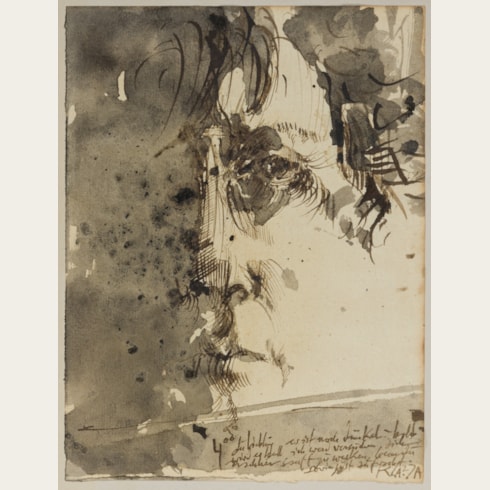
Portrait of a Magistrate (Erich Meyer-Schomann)
Sold
Pastel, coloured chalks and pencil.
Signed with the artist’s monogram HJ, inscribed Amtsrichter / Erich Meyer-Schomann and dated 20 5 89 in black ink at the lower centre.
504 x 342 mm. (19 7/8 x 13 1/2 in.)
Signed with the artist’s monogram HJ, inscribed Amtsrichter / Erich Meyer-Schomann and dated 20 5 89 in black ink at the lower centre.
504 x 342 mm. (19 7/8 x 13 1/2 in.)
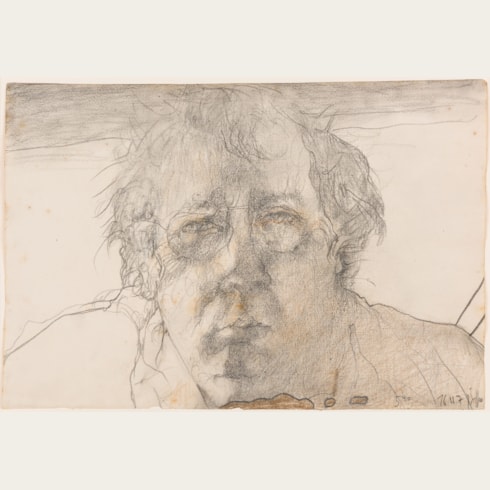
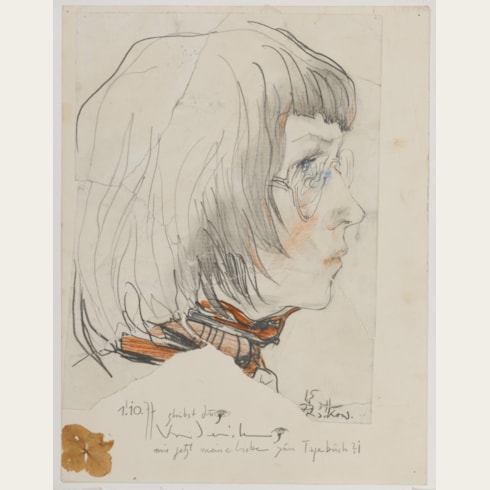
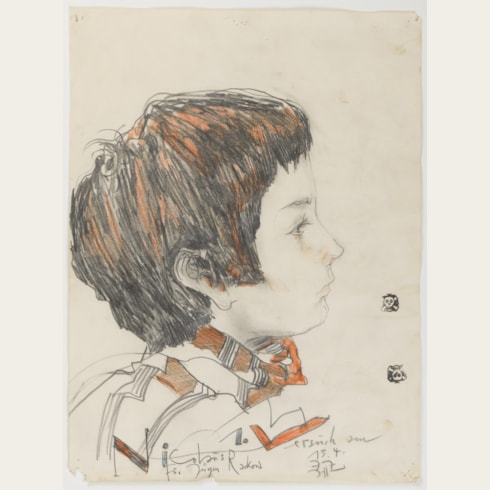
Horst Janssen was a superb portrait draughtsman. He produced numerous drawings of lovers, friends and family members, as well as portraits of writers, artists, musicians and other contemporaries, and a series of imaginary portraits of historical figures. As one German scholar has noted, ‘Janssen made graphical techniques and in particular drawing popular in Germany (again). His astonishing ability to capture the characteristics of a person in just a few glances and portray them with just a few strokes, to make the person recognisable while at the same time documenting his own style in every stroke, delights one time and again.’ Another writer has commented that, ‘Janssen drew and breathed new life into a whole range of people – the intellectual heroes of bygone epochs, friends past and present, himself and others – because he is first and foremost and always has been the darling of himself. In other words, he was able to love (and hate) others deeply because he loved (and hated) himself deeply…Anyone who met Janssen, will be able to testify to this. He was always extreme in his desire for love, and equally extreme in his desire to wound, to destroy love, those who loved, those whom he loved most.’
The present sheet is a portrait of the artist’s close friend Erich Meyer-Schomann (1941-2009), who served for many years as a magistrate in Oldenburg. Meyer-Schomann first met the artist in 1966, when, having been impressed with his work, he paid a spontaneous visit to Janssen’s home in Hamburg. (Apparently at first the artist thought he was the postman.) The magistrate and the artist soon became good friends and met in Hamburg many times over the next three decades. In 1978 Meyer-Schomann organized the first exhibition of Janssen’s work in the artist’s childhood hometown of Oldenburg, a show of posters at the Stadtmuseum, which was followed by an exhibition of the artist’s postcards three years later. Meyer-Schomann was an avid and longstanding collector of Janssen’s work, and much of his extensive collection was shown in an exhibition at the Horst-Janssen-Museum in Oldenburg in 2008.
In a posthumous volume of reminiscences of Janssen, published in 1999, Erich Meyer-Schomann stated that ‘Horst Janssen has always been something of an enigma to me, and that has not changed to this day, although my view of him has naturally crystallized in a certain direction after 30 years of friendship. Even attempting to interpret another person is an endeavour that is, by its very nature, doomed to failure. This is especially true of Janssen with all his facets, which cover the entire spectrum of human behaviour right down to the extremes. It probably took me a good 15 years to find a way of getting along with him. Until then – the 160 km. distance between Oldenburg and Hamburg had its advantages…I have never met anyone who combined intelligence, knowledge, memory, wit and imagination to such a remarkable degree and – driven by a manic creativity – constantly juggled all these qualities at once.’
Another portrait drawing of Erich Meyer-Schomann by Janssen, dated 28 October 1988, is in the collection of the sitter. Janssen also drew a portrait of Meyer-Schomann’s sixteen-year old son Lars, dated 23 December 1985.
The German draughtsman, illustrator and printmaker Horst Janssen was raised in the city of Oldenburg by his mother and grandparents, and never knew his father. Between 1946 and 1951 he studied at the Landeskunstschule in Hamburg, where his teacher was the painter and engraver Alfred Mahlau. (He was later offered a professorship at the Hamburg academy, but turned down the opportunity.) In 1948 he published a children’s book and in the early 1950s began developing his skills as a printer and lithographer.
Hugely prolific, Janssen produced a large number of drawings, etchings, lithographs, woodcuts and wood engravings characterized by dreamlike and often erotic imagery, creating a distinctive body of work – landscapes, still life subjects, portraits and self-portraits, often incorporating literary references and texts - that was quite unusual within the context of postwar European art. In the early part of his career he rarely exhibited his work outside Hamburg, and if he sold a print or drawing it was usually for a relatively modest amount – between 50 and 100 Marks for a print and between 200 and 850 Marks for a drawing – to a small coterie of collectors whom he knew. As he said at around this time, ‘I want to know who has my pictures. Out of vanity. Besides, I love them.’
Janssen’s first retrospective exhibition of almost 180 drawings and prints was held in 1965 at the Kestner-Gesellschaft in Hanover, leading the director of that institution, Wieland Schmied, to describe the artist as ‘the greatest draughtsman apart from Picasso. But Picasso is a different generation.’ The exhibition later travelled to several cities in Germany and also to Basel, and led to Janssen’s work becoming much more widely known outside Hamburg.
His output never slackened, and his intensely personal vision continued to find new avenues of expression. He also often created drawings and prints inspired by foreign works of art, and in 1972 published an appreciation of the printed landscapes of the 19th century Japanese artist Hokusai. During his lifetime, Janssen won several important prizes and awards – including the first prize for graphic art at the Venice Biennale of 1968 - and his drawings and prints were widely exhibited throughout Europe, as well as in America, Russia and Japan. Significant exhibitions of his work were held in Mannheim in 1976, at the Documenta VI in Kassel the following year, at the Art Institute of Chicago in 1980 and the Albertina in Vienna in 1982. Janssen died in Hamburg in 1995, at the age of sixty-five. Five years later the Horst Janssen Museum in the artist’s hometown of Oldenburg, dedicated to the artist’s work, was inaugurated.
Provenance
Galerie Claude Bernard, Paris and New York
Acquired from them in 1989 by William Louis-Dreyfus, Mount Kisco, New York
By descent to The William Louis-Dreyfus Foundation, Mount Kisco, New York.
Acquired from them in 1989 by William Louis-Dreyfus, Mount Kisco, New York
By descent to The William Louis-Dreyfus Foundation, Mount Kisco, New York.
Exhibition
Washington D.C., Four Seasons Hotel, 2000-2010 [on loan].