Odilon REDON
(Bordeaux 1840 - Paris 1916)
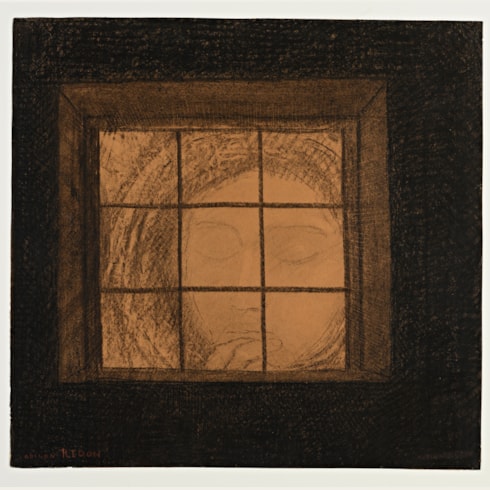
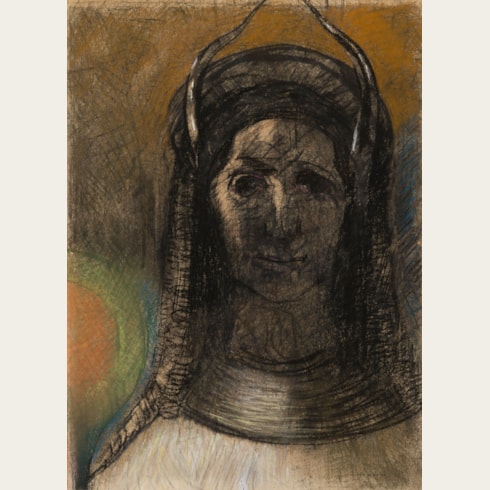
A Large Sculpted Bust Observed by a Veiled Figure (Grand buste et profil au voile)
Charcoal and black chalk on brown paper.
Signed ODILON REDON in black chalk at the lower left.
423 x 340 mm. (16 5/8 x 13 3/8 in.)
Signed ODILON REDON in black chalk at the lower left.
423 x 340 mm. (16 5/8 x 13 3/8 in.)
During the 1870s and 1880s Odilon Redon worked mainly on, and developed a particular reputation for, his so-called ‘noirs’; large charcoal drawings that are ‘dark in both mood and tone’, in rthe words of one scholar. The subjects of these drawings were often fantastical or visionary, with dreamlike imagery to the fore. Redon’s ‘noir’ drawings are heavily worked, with rich black charcoal covering every inch of the paper. As the artist famously wrote, in a letter to André Mellerio in 1898, ‘I am terrified of a sheet of white paper. It disagrees with me and makes me sterile, and takes away my enthusiasm to work...A sheet of paper shocks me so much that I am obliged, as soon as it is on the easel, to scribble on it with charcoal, chalk, or some other material, and this action gives it life.’ It has also been noted, however, that ‘though the noirs may first appear monochromatic, Redon often allowed the tinted papers he used to show through in places, and he sometimes toned the surface with a resinous substance that gave the image a Rembrandtesque patina.’
In another well-known letter, written in 1894 and published in L’Art Moderne the same year, Redon recalled his discovery of charcoal, or fusain, as a drawing medium: ‘Around 1875 my inspiration came only in crayon, in charcoal, that volatile, impalpable powder that flees under the hand. And the medium, because it offered me a better means of expression, remained with me. This lacklustre material, which has no inherent beauty, was a great help in my explorations of chiaroscuro and the invisible...It should be said, however, that charcoal leaves no room for lightness; it is full of gravity and one can only use it successfully in the same spirit. Nothing that does not stimulate the mind can produce worthwhile results in charcoal. It is on the verge of something unpleasant, something ugly.’
Like many of Redon’s ‘noir’ drawings, the subject of the present sheet is highly enigmatic. It has been associated by the Redon scholar Alec Wildenstein with a distinctive group of charcoal drawings of severed heads. As Wildenstein writes, ‘...now heads, of all kinds and types, hideous and never cheerful, ageless and genderless, some with a slightly zoomorphic appearance, with bony or plump faces, looking stupid or taciturn, with a mischievous or pensive expression. Heads sometimes in groups but more often solitary, seen from the front or in profile, floating on the water, flying through the air…balanced on a plinth or resting on a platter…winged, wingless, horned, with serpentine tails, ablaze, illuminated, haloed, yet severed. All of them…Moreover, these are not dead heads, but living heads, living their own lives, horribly independent, more alive than Redon’s physically intact figures may ever have been. Their sheer number is unsettling, as is their proliferation throughout Redon’s work, which they invade and contaminate. They emerge from everywhere, even where one least expects them…This multitude of severed heads is a symbol of anguish and death.’ More specifically, this drawing is part of a subset of around twenty ‘noir’ studies of heads placed on columns, pedestals or dishes.
The present sheet once belonged to the American music executive and collector Seymour Stein (1942-2023).
At a very young age, Odilon Redon was sent to live with an old uncle at Peyrelebade, a vineyard and estate surrounded by an abandoned park in a barren area of the Médoc region, northwest of Bordeaux. Here the young boy, who suffered from frail health and epilepsy, was to spend much of his childhood in relative solitude. Indeed, it was not until he was eleven that he was sent to school in Bordeaux, where at fifteen he began to take drawing classes. The most important influence on the young artist was Rodolphe Bresdin, whose studio in Bordeaux he frequented, and who was to prove decisive on his artistic development. It was from Bresdin, for example, that Redon learned the techniques of etching and lithography. Nevertheless, for most of his career Redon worked in something of an artistic vacuum, aware of the work of his contemporaries but generally preferring to follow his own path. His drawings and prints allowed him to express his lifelong penchant for imaginary subject matter, and were dominated by strange and unsettling images of fantastic creatures, disembodied heads and masks, solitary eyes, menacing spiders and other dreamlike forms. For much of the first thirty years of his career Redon worked almost exclusively in black, producing his ‘noirs’ in charcoal and chalk; the drawings he described as ‘mes ombres’, or ‘my shadows’.
It was not until 1881, when he was more than forty years old, that Redon first mounted a small exhibition of his work, to almost complete indifference on the part of critics or the public. The following year, however, a second exhibition of drawings and lithographs brought him to the attention of a number of critics. Redon’s reputation began to grow, and in 1884 he exhibited at the first Salon des Indépendants, which he had helped to organize. Two years later he was invited to show at the eighth and final Impressionist exhibition, and in the same year exhibited with Les XX, a group of avant-garde artists, writers and musicians in Brussels.
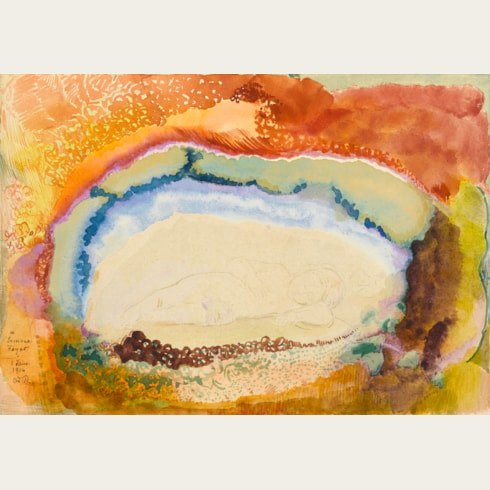
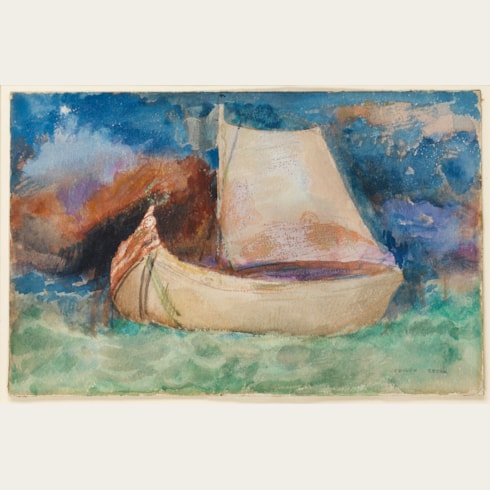
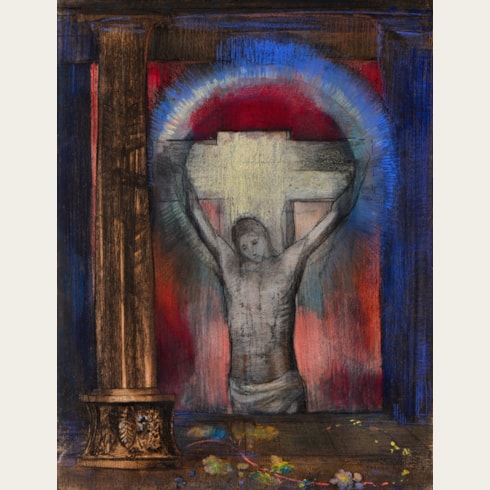
Towards the end of the 19th century Redon began to move away from working mainly in charcoal and black chalk in favour of a new emphasis on colour, chiefly using the medium of pastel but also watercolour, oil paint and distemper. Indeed, after about 1900 he seems to have almost completely abandoned working in black and white. Like his noirs, his pastels of floral still lives and portraits were popular with a few collectors, and several were included in exhibitions at Durand-Ruel in 1900, 1903 and 1906, and in subsequent exhibitions of his work in Paris and abroad. Despite this change in direction, however, Redon’s work remained unpopular with the public at large, and it was left to a few enlightened collectors to support the artist in his later years. Nevertheless, an entire room was devoted to Redon at the seminal Armory Show held in New York in 1913, an honour shared by Cezanne, Gauguin, Matisse and Van Gogh.
Provenance
Robert Schneider, Paris, in 1955
Acquired from him by Herman E. Cooper, New York
Anonymous sale, New York, Sotheby Parke Bernet, 21 May 1975, lot 13 (bt. Stein)
Seymour Stein, London, New York and Los Angeles
Anonymous sale, New York, Sotheby’s, 14 November 1990, lot 125 (unsold)
Stein sale (‘The Collecting Eye of Seymour Stein’), New York, Sotheby’s, 11 December 2003, lot 137
Private collection.
Literature
Alec Wildenstein, Odilon Redon: Catalogue raisonné de l’oeuvre peint et dessiné. Vol.II: Mythes et légendes, Paris, 1994, p.208, no.1151.