Odilon REDON
(Bordeaux 1840 - Paris 1916)
Profils de hollandaises
Sold
Watercolour and pencil.
Signed OdR at the lower left and numbered 12 at the lower right.
178 x 252 mm. (7 x 9 7/8 in.)
Signed OdR at the lower left and numbered 12 at the lower right.
178 x 252 mm. (7 x 9 7/8 in.)
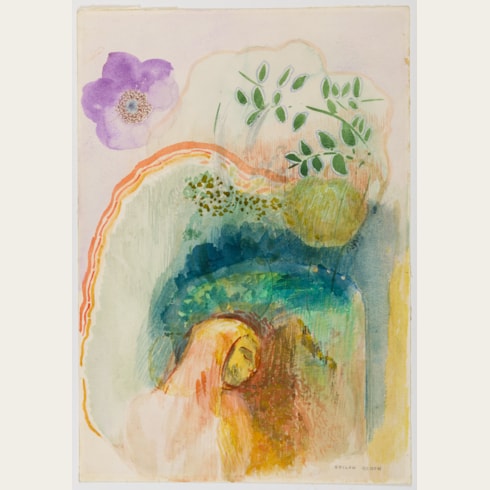
Although Odilon Redon had worked in watercolour as a youth at the beginning of the 1860s, it was not until some thirty years later that he began again to work seriously in the medium. His watercolours, however, reflect a more reserved side of his experiments with colour, and his work in this fluid medium seems to have been done largely for his own pleasure. Redon’s use of the watercolour medium is largely confined to the later years of his career, when, as has been noted, ‘he turned from working primarily in black to enthusiastically embrace color. Indeed, the watercolors seem to have had a somewhat more private role in his oeuvre than his work in other media. Although he discussed his noirs, or fusains (charcoal drawings), his prints, pastels, and paintings in his correspondence – and in his posthumously published writings on art – watercolor is never discussed. The mature watercolors, however, treat themes that concerned the artist throughout his career, and some...are complete and accomplished works of art.’
Redon’s late watercolours were retained by the artist until his death and never exhibited in his lifetime. After his death, a number of examples were sold by his widow to private collectors such as Jacques Zoubaloff. Redon’s watercolours were first seen by the public only in posthumous exhibitions of his work, such as that held at the Galerie Bernheim-Jeune in April 1917, in which the present sheet was included.
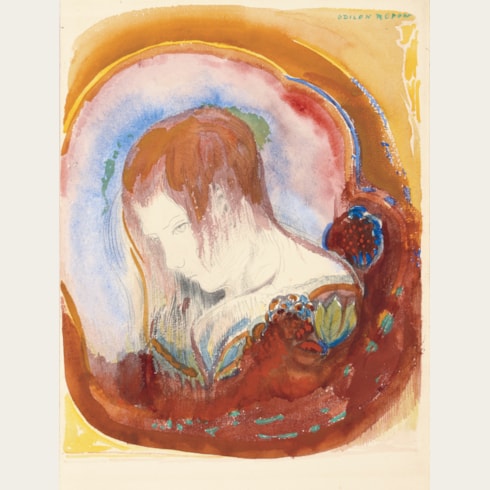
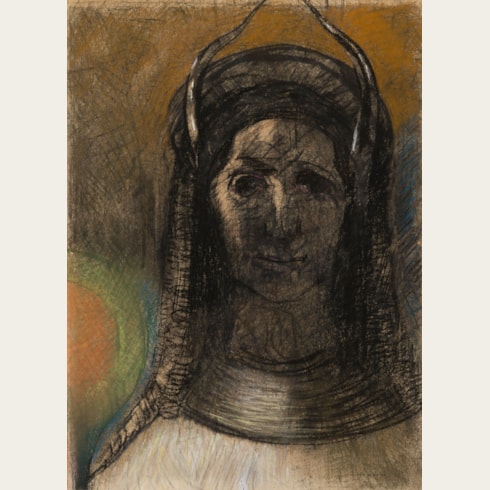
This watercolour may be related to a number of works by Redon, mostly dating to after 1905, in which a female profile wearing a similar cap appears, such as a large pastel of A Woman with a Blue Bonnet in the Louvre. Similar bowed or downcast heads in profile are, however, almost a leitmotif of Redon’s oeuvre, and appear throughout his later work in colour, such as an oil painting of the Virgin in the Musée d’Orsay, on deposit at the Musée des Beaux-Arts in Bordeaux. Very similar heads are also found in such drawings as a Tête Mystique on the art market in London in 1963 and a noir drawing of a Head Wearing a Phrygian Cap, on a Salver of 1881 in the Art Institute of Chicago.
This watercolour was last exhibited in 1931, and has remained unseen by most modern scholars. It may have come from the same sketchbook or sketchbooks as several stylistically comparable watercolours, of similar dimensions, in the collections of the Musée des Beaux-Arts de la Ville de Paris and the Musée d’Orsay.
The first recorded owner of the present sheet was the Belgian violinist and composer Armand Parent (1863-1934), who was among a small group of early collectors of Redon’s work, and eventually came to own around twenty pastels, charcoal drawings and watercolours by the artist. In 1900 Redon drew a portrait of Parent in red chalk, which he dedicated to the sitter several years later, in 1913. Parent’s collection, which also included works by André Derain, Paul Gauguin, Henri Matisse, Amedeo Modigliani, Georges Rouault and Edouard Vuillard, among others, was dispersed between 1920 and 1950. The drawing then entered the collection of the American architect John Augur Holabird (1886-1945).
At a very young age, Odilon Redon was sent to live with an old uncle at Peyrelebade, a vineyard and estate surrounded by an abandoned park in a barren area of the Médoc region, northwest of Bordeaux. Here the young boy, who suffered from frail health and epilepsy, was to spend much of his childhood in relative solitude. Indeed, it was not until he was eleven that he was sent to school in Bordeaux, where at fifteen he began to take drawing classes. The most important influence on the young artist was Rodolphe Bresdin, whose studio in Bordeaux he frequented, and who was to prove decisive on his artistic development. It was from Bresdin, for example, that Redon learned the techniques of etching and lithography. Nevertheless, for most of his career Redon worked in something of an artistic vacuum, aware of the work of his contemporaries but generally preferring to follow his own path. His drawings and prints allowed him to express his lifelong penchant for imaginary subject matter, and were dominated by strange and unsettling images of fantastic creatures, disembodied heads and masks, solitary eyes, menacing spiders and other dreamlike forms. For much of the first thirty years of his career Redon worked almost exclusively in black, producing his ‘noirs’ in charcoal and chalk; the drawings he described as ‘mes ombres’, or ‘my shadows’.
It was not until 1881, when he was more than forty years old, that Redon first mounted a small exhibition of his work, to almost complete indifference on the part of critics or the public. The following year, however, a second exhibition of drawings and lithographs brought him to the attention of a number of critics. Redon’s reputation began to grow, and in 1884 he exhibited at the first Salon des Indépendants, which he had helped to organize. Two years later he was invited to show at the eighth and final Impressionist exhibition, and in the same year exhibited with Les XX, a group of avant-garde artists, writers and musicians in Brussels.
Towards the end of the 19th century Redon began to move away from working mainly in charcoal and black chalk in favour of a new emphasis on colour, chiefly using the medium of pastel but also watercolour, oil paint and distemper. Indeed, after about 1900 he seems to have almost completely abandoned working in black and white. Like his noirs, his pastels of floral still lives and portraits were popular with a few collectors, and several were included in exhibitions at Durand-Ruel in 1900, 1903 and 1906, and in subsequent exhibitions of his work in Paris and abroad. Despite this change in direction, however, Redon’s work remained unpopular with the public at large, and it was left to a few enlightened collectors to support the artist in his later years. Nevertheless, an entire room was devoted to Redon at the seminal Armory Show held in New York in 1913, an honour shared by Cezanne, Gauguin, Matisse and Van Gogh.
Provenance
Armand Parent, Paris, by 192
John Augur Holabird, Chicago, by 1928
Thence by descent until 1990
Anonymous sale, London, Sotheby’s, 5 December 1990, lot 317
Anonymous sale, New York, Christie’s, 7 May 2008, lot 104
Private collection, UK.
Literature
André Mellerio, Odilon Redon: Peintre, Dessinateur et Graveur, Paris, 1923, illustrated in colour between pp.106 and 107; ‘Notable Works of Art Now in the Market’, The Burlington Magazine, June 1963, unpaginated, under pl.XIV; : Klaus Berger, Odilon Redon: Fantasy and Colour, New York, 1965, p.220, no.518; Alec Wildenstein, Odilon Redon: Catalogue raisonné de l’oeuvre peint et dessiné. Vol.I: Portraits et figures, Paris, 1992, p.116, no.272; Marie-Pierre Salé, ‘Redon et ses collectionneurs’, in Rodolphe Rapetti, ed., Odilon Redon: Prince du Rêve, 1840-1916, exhibition catalogue, Paris and Montpellier, 2011, p.51.
Exhibition
Paris, Bernheim-Jeune & Cie., Paysages d’après nature (peinture à l’huile), aquerelles et dessins par Odilon Redon (1840-1916), 1917, no.41 (as Cinq têtes embéguinés); Paris, Musée des Arts Décoratifs, Odilon Redon: Exposition rétrospective de son oeuvre, 1926, part of no.161 (‘Quatre aquarelles, vers 1915. A M. Armand Parent.’); New York, De Hauke & Co. Inc., Exhibition of Paintings, Pastels, Drawings, Water Colours, Lithographs by Odilon Redon, 1928, no.45 (lent by John Holabird); Chicago, Art Institute of Chicago, Paintings, Pastels and Drawings by Odilon Redon 1840-1916, 1928-1929, no.35 (lent by John Holabird); New York, Museum of Modern Art, Tenth Loan Exhibition: Lautrec Redon, 1931, no.83 (as Dutch Girls, lent by John Holabird).