Jean-Auguste-Dominique INGRES
(Montauban 1780 - Paris 1867)
Portrait of Mlle. Marie Reiset, later Vicomtesse Adolphe-Louis-Edgar de Ségur-Lamoignon, Holding a Little Dog
Pencil, with double framing lines in pencil.
Signed Ingres Del. in pencil at the lower right.
276 x 187 mm. (10 7/8 x 7 3/8 in.) [image]
339 x 242 mm. (13 3/8 x 9 1/2 in.) [sheet]
Signed Ingres Del. in pencil at the lower right.
276 x 187 mm. (10 7/8 x 7 3/8 in.) [image]
339 x 242 mm. (13 3/8 x 9 1/2 in.) [sheet]
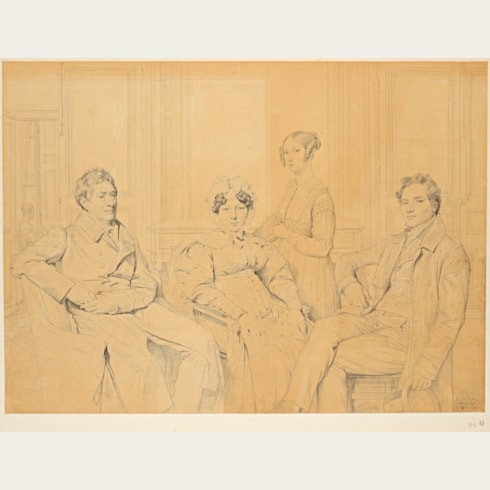
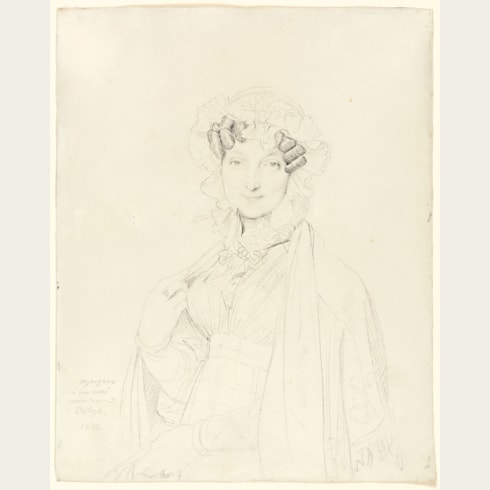
Among Ingres' close friends was the museum curator Frédéric de Reiset (1815-1891), whom he met in 1836 when Reiset was on his honeymoon in Rome, where Ingres was serving as director of the French Academy. When Ingres returned to Paris in 1841 he renewed his friendship with Reiset, and the two men corresponded regularly between 1845 and 1860. The artist became a frequent visitor to the Reiset family’s country home at Enghien, just north of Paris. Frédéric Reiset assembled a fine collection of works by Ingres, including several paintings and some forty drawings, among which were portraits of his family. A noted connoisseur, Reiset was appointed keeper of drawings at the Louvre in 1851 and keeper of paintings nine years later, eventually rising to the position of director of the national museums in 1874. Ingres produced five drawings of the Reiset family, mostly drawn at Enghien in 1844. These included individual portrait drawings of Frédéric Reiset, his wife Hortense and her father Louis Reiset, as well as a double portrait of Hortense with their daughter Marie, all drawn in 1844, together with the present drawing of Marie Reiset alone, executed in 1850. Ingres also painted a bust-length oval portrait of Mme. Hortense Reiset, dated 1846, which is today in the Harvard Art Museums in Cambridge, Massachussetts.
Drawn in 1850, this fine drawing is a portrait of Frédéric and Hortense Reiset’s only child Thérèse-Hortense-Marie Reiset (1836-1899) at the age of around fourteen. Known in her family by the nickname ‘Bibiche’, Marie Reiset had earlier appeared, at the age of eight, in a drawing by Ingres depicting her with her mother, drawn at Enghien in 1844 and now in the collection of the Museum Boijmans-van Beuningen in Rotterdam. As Agnes Mongan and Hans Naef have noted, ‘Mme. [Hortense] Reiset, who often received Ingres as a visitor at their country place in Enghien, was gentle and understanding with the sometime crusty artist. He, on his part, loved the family. These feelings are clearly reflected in his portraits of the Reisets, particularly in the tender and beguiling drawings of mother and daughter.’ In 1857, several years after the date of the present sheet, Marie Reiset married the diplomat Adolphe-Louis-Edgar, Comte de Ségur (later Ségur-Lamoignon). She later inherited the five Ingres drawings of her family, which were in turn left to her three children. As Hans Naef has pointed out, ‘Ingres’s five portraits of members of the Reiset family are visible testimony to a friendship that bound together the nineteenth century’s most famous draftsman and its most discriminating connoisseur of drawings.’
The present sheet was included in the first large-scale exhibition devoted solely to drawings by Ingres, held at the offices of the Société des Arts-Unis in Paris between January and March of 1861. At the time the artist, who was seventy-one years old, was perhaps better known as a painter, and he seems to have been closely involved in the selection of drawings to be shown. The exhibition numbered over ninety drawings - including thirty-two independent portrait drawings, among which were the five sheets depicting members of the Reiset family - all lent from private collections. It was organized by Henri Delaborde, an art historian and curator who published an early monograph on Ingres, the collector and critic Emile Galichon, and Ingres’ close friend, the medal engraver Edouard Gatteaux, who was the most important collector of the artist’s drawings during his lifetime. A second exhibition, containing a further forty-eight drawings by Ingres, was held at the same venue later that same year.
Among the early owners of the present sheet was Henry Lapauze (1867-1925), who has been described as ‘the first great modern scholar of the life and work of Jean-Auguste-Dominique Ingres.’
A student of Jacques-Louis David, Jean-Auguste-Dominique Ingres won the Prix de Rome in 1801, although due to a lack of government funding he was unable to take up his scholarship at the Académie de France in Rome until 1806. Although his pension expired in 1810, he remained in Rome for a further ten years. The city was at this time ruled by the French, and Ingres received commissions for paintings to decorate both the Villa Aldobrandini, the official residence of the French Lieutenant-Governor of Rome, and Napoleon’s palace at Monte Cavallo. He also found patrons among the French officials in the city, whose portraits he painted, as well as members of the royal court in Naples, led by Napoleon’s sister Caroline Murat and her husband Joachim, rulers of the Kingdom of the Two Sicilies. With the French withdrawal from Rome in March 1814 and the fall of Napoleon, however, Ingres found himself bereft of official commissions, and turned to making portrait drawings of French and foreign visitors to the city. These pencil portraits, drawn with minute detail as autonomous works of art, proved very popular and served to confirm Ingres’s reputation, allowing him to survive his difficult, penurious years in Rome.
In 1820 Ingres received a commission for a large canvas of The Vow of Louis XIII, intended for the cathedral of his native Montauban. Painted in Florence and sent to Paris to be exhibited at the Salon of 1824, it won Ingres considerable praise and established his reputation as a painter. He then spent a period of ten years in Paris, where he consolidated his reputation as a history painter and began receiving portrait commissions. This was followed in 1834 by an appointment as director of the Académie de France in Rome, Ingres remaining in the post until his final return to France in 1842. The last fifteen years of his career saw Ingres firmly established as an influential and highly respected figure in artistic circles, and one of the foremost artists in France. For many years an influential professor at the Ecole des Beaux-Arts, Ingres received the honour of a retrospective exhibition at the Exposition Universelle of 1855.
Provenance
Frédéric Reiset, Paris
By descent to his daughter Marie Reiset, Vicomtesse de Ségur-Lamoignon, the sitter, Château de Méry-sur-Oise
By descent to her daughter, Marie-Eugénie-Hortense-Valentine de Ségur-Lamoignon, Marquise de Möy
Georges Bourgarel, Paris
His sale, Paris, Hôtel Drouot, 15-16 June 1922, lot 115 (‘Portrait de la Comtesse de Ségur-Lamoignon, tenant un chien dans ses bras’, bt. Lapauze for 3,900 francs)
Henry Lapauze, Paris
His sale (‘Tableaux et Dessins par J.-A.-D. Ingres composant la Collection de Monsieur Henry Lapauze’), Paris, Hôtel Drouot, 21 June 1929, lot 31 (‘Portrait de la Comtesse de Ségur-Lamoignon tenant un petit chien’, bt. Knoedler for 141,000 francs)
M. Knoedler & Co., New York, in 1951
Richard S. Davis, Wayzata, Minnesota;
M. Knoedler & Co., New York, in 1956
Acquired from them in 1959 by Mrs. Douglas Williams, New York
Anonymous sale, New York, Christie’s, 22 May 1996, lot 48 (sold for $354,500)
Hazlitt, Gooden & Fox, London, in 2003
Acquired from them in April 2003 by a private collection, California
Anonymous sale, London, Christie’s, 6 July 2021, lot 62
Private collection, California.
Literature
Emile Galichon, ‘Dessins de M. Ingres’, Gazette des Beaux-Arts, 1861, p.47; Emile Galichon, ‘Description des dessins de M. Ingres exposés au Salon des Arts-Unis’, Gazette des Beaux-Arts, 15 March 1861, p.361; Henri Delaborde, Ingres: Sa vie, ses travaux, sa doctrine, Paris, 1870, pp.311-312, no.408; Philippe de Chennevières, Souvenirs d’une Directeur des Beaux-Arts, Vol.III, Paris, 1886, pp.91 and 94; Henry Lapauze, Les portraits dessinés de J.-A.-D. Ingres, Paris, 1903, pl.82; Henry Lapauze, Ingres: Sa vie & son oeuvre, Paris, 1911, illustrated p.428; Washington DC, National Gallery of Art, and elsewhere, French Drawings: Masterpieces from Five Centuries, exhibition catalogue, 1952-1953, p.47, under no.117; Brinsley Ford, ‘Ingres’ Portraits of the Reiset Family’, The Burlington Magazine, November 1953, p.356; Daniel Ternois, Inventaire général des dessins des musées de province. Les dessins d’Ingres au Musée de Montauban: Les portraits, Paris, 1959, unpaginated, under no.169; Agnes Mongan and Hans Naef, Ingres Centennial Exhibition 1867-1967: Drawings, Watercolors and Oil Sketches from American Collections, exhibition catalogue, Cambridge [MA], 1967, unpaginated, no.94, also under no.88; Paris, Petit Palais, Ingres, exhibition catalogue, 1967-1968, p.300, under no.233; Marjorie B. Cohn, ‘The Original Format of Ingres Portrait Drawings’, in Alain Godeau et al, Colloque Ingres [Bulletin de Musée Ingres], Montauban, 1969, pp.23-25; Hans Naef, Die Bildniszeichnungen von J.-A.-D. Ingres, Bern, 1979, Vol.III, p.351, fig.6, Vol.V, pp.330-331, no.423; Gary Tinterow and Philip Conisbee, ed., Portraits by Ingres: Images of an Epoch, exhibition catalogue, London and elsewhere, 1999-2000, p.468, under no.151; The Burlington Magazine, October 2003 [advertisement]; Andrew Carrington Shelton, ‘The First Retrospective Exhibition of the Drawings of J.-A.-D. Ingres (1861)’, Nineteenth-Century Art Worldwide, Summer 2022, p.43 and Appendix, Cat.71.
Exhibition
Paris, Salons des Arts-Unis, Dessins tirés de collections d’amateurs, 1861, no.71 (‘Portrait de Mlle***. Collection de M. Reiset.’); Paris, Galerie Georges Petit, Exposition Ingres, 1911, no.161 (‘Portrait de Mlme la Comtesse de Ségur-Lamoignon, tenant un clien dans ses bras…Collection de M. le Marquis de Moÿ.’); Cambridge [MA], Fogg Art Museum, French Drawings and Prints of the Nineteenth Century, 1934, no.48; Cincinnati, Cincinnati Art Museum, and elsewhere, The Place of David and Ingres in a Century of French Painting, 1940 [ex-catalogue]; Cambridge [MA], Fogg Art Museum, French Paintings of the XIX and XX Centuries, 1941 [ex-catalogue]; Toledo, Toledo Museum of Art, French Drawings and Watercolors, 1941, no.73; New York, American British Art Center, Drawings of the 19th and 20th Centuries, 1944, no.3; Pittsburgh, Carnegie Institute, French Painting 1100-1900, 1951, no.157; London, M. Knoedler and Company Ltd., Exhibition of Old Master, Impressionist and Contemporary Drawings, 1958, no.10; Cambridge [MA], Fogg Art Museum, Ingres Centennial Exhibition 1867-1967: Drawings, Watercolors and Oil Sketches from American Collections, 1967, no.94; New York, Metropolitan Museum of Art, Classicism and Romanticism: French Drawings and Prints 1800-1860, 1970, no.56.