Jean-Auguste-Dominique INGRES
(Montauban 1780 - Paris 1867)
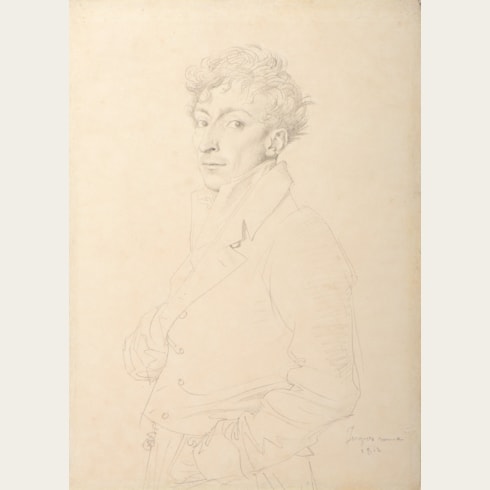
Portrait of Gaspard Bonnet
Pencil. Laid down.
Signed and dated Ingres rome / 1812 in pencil at the lower right.
222 x 161 mm. (8 3/4 x 6 3/8 in.)
Signed and dated Ingres rome / 1812 in pencil at the lower right.
222 x 161 mm. (8 3/4 x 6 3/8 in.)
A splendid example of Ingres’s informal portraiture, this fine sheet was given by the artist to the sitter. It remained completely unknown until its appearance in the 1913 exhibition David et ses élèves in Paris, where it was lent from the collection of the diplomat Comte Alfred-Louis Lebeuf de Montgermont (1841-1918) and identified as a portrait of ‘M. Gaspard Bonnet, directeur des Domaines’. The drawing reappeared six years later, at the posthumous auction of Lebeuf de Montgermont’s collection in 1919, when it was acquired by the painter Bernard Wolff for a private collector, but it was not seen in public again for over seventy years.
In his magisterial catalogue of Ingres’ portrait drawings, Hans Naef, who only knew this drawing from the illustration in the 1919 Lebeuf de Montgermont auction catalogue, commented on the spontaneity of execution and the unique physiognomy of the subject. Although of illegitimate birth, Gaspard Bonnet (1779-1854) had a successful career as a civil servant for more than forty years. At the time that Ingres drew this portrait, Bonnet was serving in Rome as a Vérificateur de l’Enregistrement et des Domaines, or inspector for French Imperial buildings. Ingres must have met him at the same time as he produced drawn or painted portraits of other French officials of the Napoleonic Administration de l’Enregistrement et des Domaines in Rome - including Edme-François-Jean Bochet, Charles-Joseph-Laurent Cordier and the Director of the Department, Hippolyte-François Devillers - between 1811 and 1812. Bonnet left Rome in November 1814, following the downfall of Napoleon, and was transferred to a post in Grasse in the south of France. Over the next thirty years he continued to work for the Administration de l’Enregistrement et des Domaines in various cities throughout France, including Lyon, Toulon, Perpignan and, between 1838 and 1843, Ingres’ hometown of Montauban. Awarded the Legion d’Honneur in 1844, Bonnet died shortly before his 75th birthday, probably at Nîmes.
Two years after the present sheet was drawn, Gaspard Bonnet may have sat to another French artist in Rome, since he is thought to be the subject of a portrait drawing, dated 1814, by Michel-Martin Drolling (1786-1851), which was formerly in the collection of Diane A. Nixon in a in New York and recently appeared at auction. The identification of Drolling’s sitter as Bonnet is based on the similarities of facial features, hairstyle and dress in both drawings.
In his magisterial catalogue of Ingres’ portrait drawings, Hans Naef, who only knew this drawing from the illustration in the 1919 Lebeuf de Montgermont auction catalogue, commented on the spontaneity of execution and the unique physiognomy of the subject. Although of illegitimate birth, Gaspard Bonnet (1779-1854) had a successful career as a civil servant for more than forty years. At the time that Ingres drew this portrait, Bonnet was serving in Rome as a Vérificateur de l’Enregistrement et des Domaines, or inspector for French Imperial buildings. Ingres must have met him at the same time as he produced drawn or painted portraits of other French officials of the Napoleonic Administration de l’Enregistrement et des Domaines in Rome - including Edme-François-Jean Bochet, Charles-Joseph-Laurent Cordier and the Director of the Department, Hippolyte-François Devillers - between 1811 and 1812. Bonnet left Rome in November 1814, following the downfall of Napoleon, and was transferred to a post in Grasse in the south of France. Over the next thirty years he continued to work for the Administration de l’Enregistrement et des Domaines in various cities throughout France, including Lyon, Toulon, Perpignan and, between 1838 and 1843, Ingres’ hometown of Montauban. Awarded the Legion d’Honneur in 1844, Bonnet died shortly before his 75th birthday, probably at Nîmes.
Two years after the present sheet was drawn, Gaspard Bonnet may have sat to another French artist in Rome, since he is thought to be the subject of a portrait drawing, dated 1814, by Michel-Martin Drolling (1786-1851), which was formerly in the collection of Diane A. Nixon in a in New York and recently appeared at auction. The identification of Drolling’s sitter as Bonnet is based on the similarities of facial features, hairstyle and dress in both drawings.
A student of Jacques-Louis David, Jean-Auguste-Dominique Ingres won the Prix de Rome in 1801, although due to a lack of government funding he was unable to take up his scholarship at the Académie de France in Rome until 1806. Although his pension expired in 1810, he remained in Rome for a further ten years. The city was at this time ruled by the French, and Ingres received commissions for paintings to decorate both the Villa Aldobrandini, the official residence of the French Lieutenant-Governor of Rome, and Napoleon’s palace at Monte Cavallo. He also found patrons among the French officials in the city, whose portraits he painted, as well as members of the royal court in Naples, led by Napoleon’s sister Caroline Murat and her husband Joachim, rulers of the Kingdom of the Two Sicilies. With the French withdrawal from Rome in March 1814 and the fall of Napoleon, however, Ingres found himself bereft of official commissions, and turned to making portrait drawings of French and foreign visitors to the city. These pencil portraits, drawn with minute detail as autonomous works of art, proved very popular and served to confirm Ingres’s reputation, allowing him to survive his difficult, penurious years in Rome.
In 1820 Ingres received a commission for a large canvas of The Vow of Louis XIII, intended for the cathedral of his native Montauban. Painted in Florence and sent to Paris to be exhibited at the Salon of 1824, it won Ingres considerable praise and established his reputation as a painter. He then spent a period of ten years in Paris, where he consolidated his reputation as a history painter and began receiving portrait commissions. This was followed in 1834 by an appointment as director of the Académie de France in Rome, Ingres remaining in the post until his final return to France in 1842. The last fifteen years of his career saw Ingres firmly established as an influential and highly respected figure in artistic circles, and one of the foremost artists in France. For many years an influential professor at the Ecole des Beaux-Arts, Ingres received the honour of a retrospective exhibition at the Exposition Universelle of 1855.
Provenance
The sitter, Gaspard Bonnet
By descent to his granddaughter, Mme. Gizolme, née Marguerite Bonnet
By descent to her nephew, Henry Emile Louis Vincens
Sold by him on 19 January 1908 to Arnold & Tripp, Paris
Acquired from them on 29 January 1908 by Comte Alfred-Louis Lebeuf de Montgermont, Paris
His anonymous sale (‘Collection L. de M...’), Paris, Galerie Georges Petit, 16-19 June 1919, lot 120 (‘Portrait de Gaspard Bonnet. A mi-corps, la main gauche dans la poche du pantalon, la droite passée sous le revers de l’habit, il est représenté le visage de trois-quarts vers la gauche, le nez busqué, les cheveux rebelles. Dessin à la mine de plomb. Signé à droite, en bas: Ingres, Rome, 1812. Haut., 21 cent.; larg., 16 cent.’, sold for 15,000 francs to Bernard Wolff for Michelin)
Edouard Michelin, Clermont-Ferrand
By descent to his daughter, Mme. Jean Callies, née Marguerite Michelin
Anonymous sale, Honfleur, 18 July 1993
Galerie Brame et Lorenceau, Paris
Jan Krugier and Marie-Anne Poniatowski, Geneva
Galerie Jan Krugier, Geneva
Acquired from them by a private European collector in 2001
Anonymous sale, London, Sotheby’s, 9 July 2014, lot 99
Stephen Ongpin Fine Art, London, in 2016
Private collection, California.
By descent to his granddaughter, Mme. Gizolme, née Marguerite Bonnet
By descent to her nephew, Henry Emile Louis Vincens
Sold by him on 19 January 1908 to Arnold & Tripp, Paris
Acquired from them on 29 January 1908 by Comte Alfred-Louis Lebeuf de Montgermont, Paris
His anonymous sale (‘Collection L. de M...’), Paris, Galerie Georges Petit, 16-19 June 1919, lot 120 (‘Portrait de Gaspard Bonnet. A mi-corps, la main gauche dans la poche du pantalon, la droite passée sous le revers de l’habit, il est représenté le visage de trois-quarts vers la gauche, le nez busqué, les cheveux rebelles. Dessin à la mine de plomb. Signé à droite, en bas: Ingres, Rome, 1812. Haut., 21 cent.; larg., 16 cent.’, sold for 15,000 francs to Bernard Wolff for Michelin)
Edouard Michelin, Clermont-Ferrand
By descent to his daughter, Mme. Jean Callies, née Marguerite Michelin
Anonymous sale, Honfleur, 18 July 1993
Galerie Brame et Lorenceau, Paris
Jan Krugier and Marie-Anne Poniatowski, Geneva
Galerie Jan Krugier, Geneva
Acquired from them by a private European collector in 2001
Anonymous sale, London, Sotheby’s, 9 July 2014, lot 99
Stephen Ongpin Fine Art, London, in 2016
Private collection, California.
Literature
Hans Naef, Die Bildniszeichnungen von J.-A.-D. Ingres, Bern, 1977, Vol.I, pp.266-267 and Vol.IV, pp.146-147, no.79; Alexander Dückers, ed., Linie, Licht und Schatten: Meisterzeichnungen und Skulpturen der Sammlung Jan und Marie-Anne Krugier-Poniatowski, exhibition catalogue, Berlin, 1999, illustrated p.407; Philip Rylands, ed., The Timeless Eye: Master Drawings from the Jan and Marie-Anne Krugier-Poniatowski Collection, exhibition catalogue, Venice, 1999, illustrated p.406; New York, W. M. Brady & Co., and London, Thomas Williams Fine Art Ltd., Old Master Drawings, 2000, unpaginated, under no.39, fig.18; Margaret Morgan Grasselli et al, Private Treasures: Four Centuries of European Master Drawings, exhibition catalogue, New York and Washington, 2007, p.188, under no.74; Antonio Pinelli, ‘Cinq lettres inédites de Wicar’, in Maria Teresa Caracciolo and Gennaro Toscano, ed., Jean-Baptiste Wicar et son temps, 1762-1834, Villeneuve d’Ascq, 2007, p.266, note 18; New York, Sotheby’s, Master Drawings from the Collection of Diane A. Nixon, 4 February 2026, p.230, under lot 103.
Exhibition
Paris, Palais des Beaux-Arts, David et ses élèves, April-June 1913, no.334 (‘Portrait de M. Gaspard Bonnet, directeur des Domaines. Dessin à la mine de plomb, signé: Ingres, Rome, 1812. Haut., 21 cent.; larg 15 cent. 1/2. Appartient à M. le Comte de Montgermont.’).