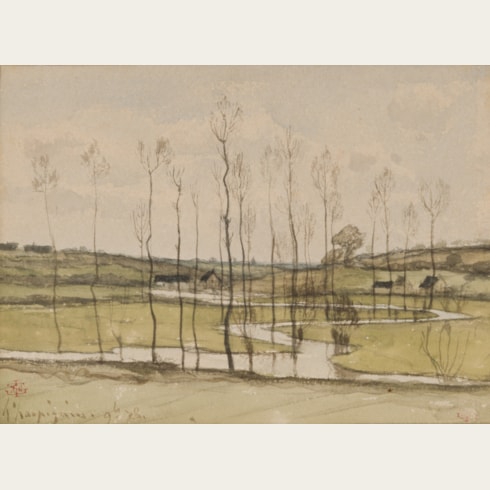
Henri Joseph HARPIGNIES
(Valenciennes 1819 - Saint-Privé 1916)
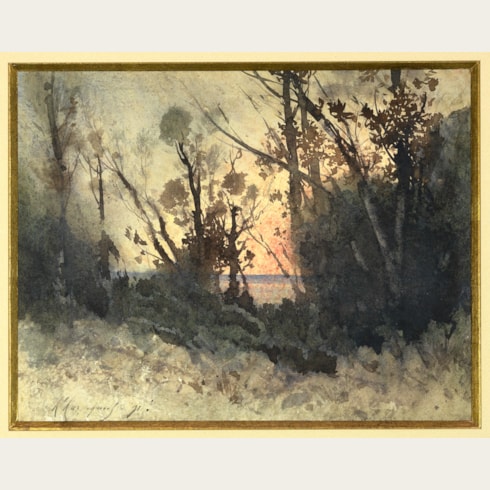
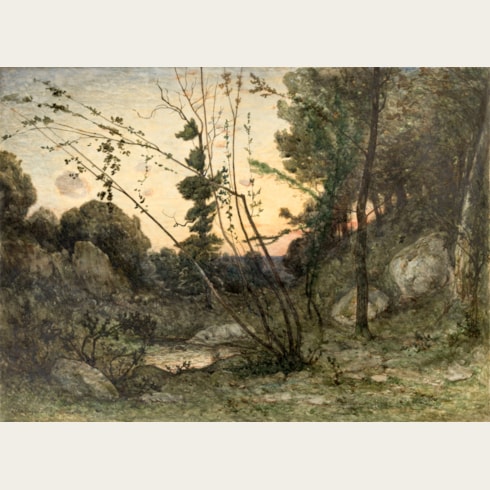
A Hunter in a Forest
Watercolour over a pencil underdrawing. Laid down.
Signed and dated hharpignies . 78 at the lower left.
330 x 250 mm. (13 x 9 7/8 in.)
Signed and dated hharpignies . 78 at the lower left.
330 x 250 mm. (13 x 9 7/8 in.)
Born into a family of Belgian descent, Henri-Joseph Harpignies began drawing at the age of four or five, according to an unpublished autobiographical manuscript. He came to realize his vocation as an artist at a relatively late age, however, and it was not until 1848, when he was in his late twenties, that he decided to abandon a career as a travelling salesman and begin training as an artist in the studio of the landscape painter Jean-Alexis Achard. Two years later he made a trip through Germany, the Netherlands and Italy, returning to France in 1852. Harpignies made his Salon debut the following year, exhibiting views of Capri and Valenciennes, and he continued to show regularly at the Salons throughout his very long and productive career, until 1912. His luminous landscape paintings, depicting both rural and urban views, were inspired by his first meetings with Camille Corot in the early 1850s. (Corot, whom Harpignies idolized, purchased two of the young artist’s watercolours in order to encourage him in his work.) In 1863 three of his entries to the Salon were rejected and were instead shown at the Salon des Refusés. The same year he made his second visit to Italy, living in Rome and Capri and remaining there until 1865; this sojourn was also to have a significant effect on his later work.
Harpignies won medals at the Salons of 1866, 1868 and 1869, and was awarded the Legion of Honour in 1875. During much of the 1870s he summered in the village of Hérisson in the Allier region of France, where he was at the centre of a small local school of landscape artists, but in 1879 he bought a house in Saint-Privé, near Bléneau on the river Yonne, and spent his summers there from then on. From 1883 onwards he began to sell his work through the Paris art dealers Arnold & Tripp, from whom he also received commissions that earned him some 70,000 francs per year, on average. This arrangement afforded the artist a level of financial security that allowed him to concentrate on his work, and led to an increase in his output. He began spending his winters in the South of France, and there gave lessons in drawing to a number of wealthy amateurs, such as the Princesse d’Arenberg. Harpignies provided mural decorations for the Hôtel de Ville, the Senate and the Opéra in Paris, and also produced a small group of around thirty-five etchings, most of which date from early in his career, between 1847 and 1853. Harpignies continued to maintain an emphasis on a distinctive manner of tonal landscape, inspired by the example of Corot, in the paintings and drawings that he produced well into the early years of the 20th century. He continued to paint until a week before his death, at the age of ninety-seven, at La Trémellerie, his home at Saint-Privé.
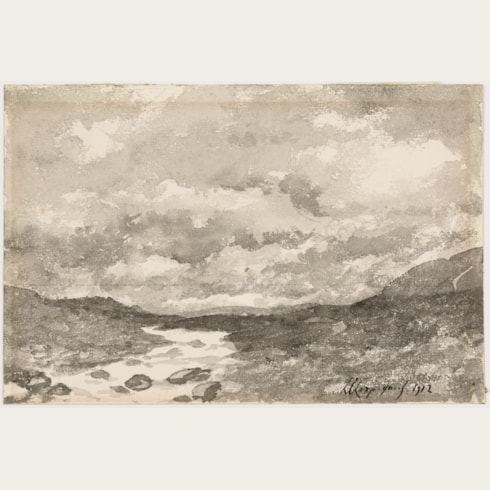
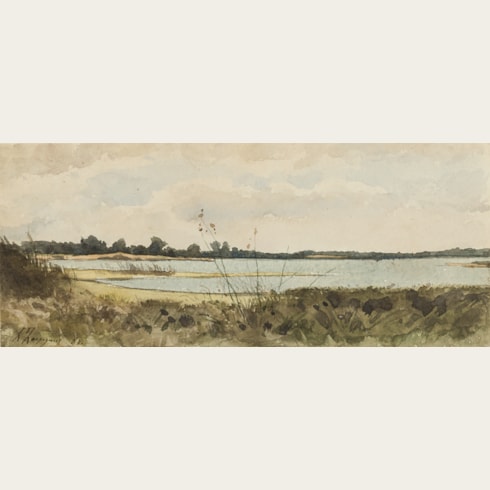
Highly regarded as a landscape painter, Harpignies also developed a speciality of landscape drawings in watercolour, a medium which accounts for much of the artist’s finest work, and was to be the basis of his reputation, particularly outside France. (As a contemporary English critic, writing in 1905, noted, ‘one ventures to prophesy that the day will come, if it has not already arrived, when the water-colours of M. Harpignies will be prized even more dearly than his paintings in oils. As an aquarellist M. Harpignies is practically without a living rival in his own country...’ Another English critic, in an obituary for the artist, wrote of his watercolours, ‘We marvel at the delicate tints his hand, accustomed to the vigorous touch of his oil painting, can produce.’). Harpignies exhibited his first watercolour landscapes at the Salon of 1864, where they were praised by the critic Théophile Thoré. The freshness and luminosity of his watercolours soon gained him a wide audience and led to his taking on a number of private pupils. Harpignies’ reputation as a watercolourist spread to England, and he was invited by Whistler to exhibit at the Royal Institute in London. In 1881 he was elected a member of the Société des Aquarellistes Français, while he also showed at the New Water-Colour Society in London. From the early 1900s onwards, he began to substitute charcoal for watercolour, and his drawings take on a silvery-grey tonality that is perhaps indicative of his failing eyesight.
In 1898 the English art critic Frederic Lees wrote that ‘Harpignies...[has] the power of producing the most powerful effects by teints unies; his sobriety of colour, breadth of treatment, firmness of touch, and precision of drawing placing him in the front rank of water-colour artists.’3 Eighteen years later, in an article published shortly after the artist’s death, the same writer opined that ‘As a water-colour artist, Harpignies was without a rival in France. His work in this branch of art cannot be too highly praised, for whilst attaining pre-eminence he proved himself to be a veritable pioneer. Having worked incessantly at water-colours for fourteen years, he at last decided to exhibit them for the first time at the 1864 Salon, and although only a chosen few may have immediately recognised how beautifully fresh and limpid these little works were – how different from the weak and finicking productions of the water-colourists of the Second Empire – it was not long before others were taking their inspiration from him. As one of the forerunners, if not the founder, of the modern school of water-colour painting in France, his work was much appreciated abroad, especially in England and the United States.’
Despite his increasing fame and success, Harpignies seems to have remained at heart a man of simple tastes, committed to his art. As Agnes Mongan has written, ‘Clearly, his happiness was in recording, whether in drawings, watercolor, or paint, the landscapes he saw around him…his ninety-seven years were productive of a large number of landscapes in a variety of media that have delighted and continue to delight those who enjoy their sensitive and particular artistic qualities.’
Provenance
Possibly Arnold & Tripp, Paris
Possibly sale (‘Tableaux aquarelles et dessins par Harpignies, provenant de l’ancienne collection Arnold et Tripp’) Paris, Hôtel Drouot, 9 February 1934, lot 101 (‘Chasseurs au bois. Aquarelle. Signée et datée en bas à gauche: H. Harpignies 78. Haut. 0 m.32; Larg. 0 m.25’)
Thomas Le Claire, Hamburg, in 2011
Private collection, France.