17th Century BOLOGNESE SCHOOL
Design for a Family Tree
Pen and brown ink, over an underdrawing in black chalk, formerly attached with tabs to an album page.
Inscribed Caraza and Annibale Carracci and numbered S. B. 66. in brown ink on the verso.
Further inscribed S.B. no.75. in brown ink at the bottom of the album page.
507 x 375 mm. (20 x 14 3/4 in.)
Inscribed Caraza and Annibale Carracci and numbered S. B. 66. in brown ink on the verso.
Further inscribed S.B. no.75. in brown ink at the bottom of the album page.
507 x 375 mm. (20 x 14 3/4 in.)
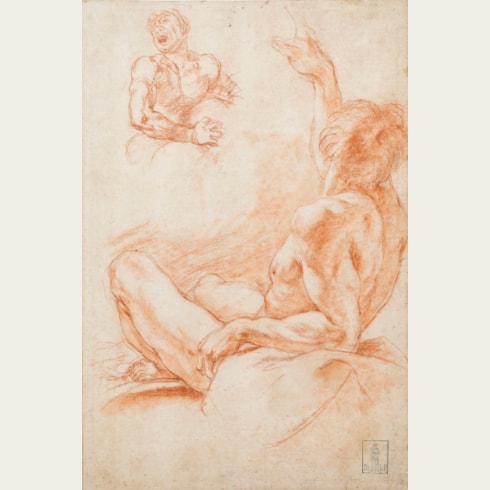
This carefully constructed drawing depicts a tree whose branches fan outwards to fill the sheet almost entirely, each branch supporting one of approximately thirty blank circular medallions. The tree rises from a naturalistic grassy mound at the lower centre. Its thick trunk is built up through parallel and cross-hatched pen strokes that give way to lighter, more fluid handling in the upper branches and foliage. The almost perfect circularity of the medallions suggest they might have been drawn with the help of a compass. These vacant medallions were clearly conceived as spaces to receive the names of family members or even, perhaps, portraits of them.
This drawing aligns with a long and well-established visual and literary tradition of representing genealogy through the metaphor of a tree. In Italian courts and noble households of the 16th and 17th centuries, such arbor consanguinitatis diagrams were commissioned to be used both as objects of display and as records, representing the depth, continuity and reach of a family’s lineage. The task of imagining such family trees required from artists decorative skills that often combined heraldry, portraiture and design.
Within the specific context of Bolognese draughtsmanship, the present sheet may be compared with a similar drawing by Agostino Carracci of the Carracci family tree, formerly in the collection of the 17th century biographer and art historian Carlo Cesare Malvasia and today in the British Museum.
The inscriptions and numbering S. B. 66. on the verso and S.B. no.75 on the backing sheet, as well as the paper tabs attaching the drawing to an album page, identifies it as having once been part of the renowned Sagredo collection of drawings. The provenance of most of the works in the Sagredo family collection - described by one modern scholar as ‘the most important collection of drawings in eighteenth-century Venice as well as one of the richest in Europe’ - can be traced to the great Venetian collector Zaccaria Sagredo (1653-1729). Although the collection had been begun in the middle of the 17th century by his uncle Doge Niccolò Sagredo (1606-1676), it was Zaccaria Sagredo who was responsible for greatly expanding it. As Roger Rearick has noted, ‘Zaccaria was the most voracious of the Sagredo collectors, purchasing numerous drawings from every school and period, and making the Sagredo collection one of the most distinguished and certainly among the largest cabinets in Italy prior to his death in 1729.’ The collection included large groups of drawings by Paolo Veronese and his circle, Jacopo and Domenico Tintoretto, Palma Giovane, Bernardo Strozzi and the Bassano family of artists, was kept in albums, mounted onto sheets of heavy white paper using tabs at each corner of the sheet, as was seen in the present sheet.
Zaccaria Sagredo bequeathed the collection to his nephew and heir, Gherardo Sagredo (1692-1738). At the latter’s death in 1738, an inventory of the collection noted some eight thousand drawings, almost all of which were assembled into fifty-seven albums, as well as more than 22,000 prints. Gherardo’s widow, Cecilia Grimani Sagredo (b.1755), tried to sell the collection en bloc but was only able to dispose of parts of it, while the rest was inherited by her two daughters, Catarina Sagredo Barbarigo and Marina Sagredo Pisani, and thence passed to the former’s two daughters Contarina and Cecilia Barbarigo. At some point in the late 18th or early 19th century some of the Sagredo drawings were acquired by a collector in Lyon, thought to be the Lyonnais landscape draughtsman Jean-Jacques de Boissieu (1736-1810). Large groups of drawings from the collection were later dispersed in Lyon, just after the First World War.
This drawing aligns with a long and well-established visual and literary tradition of representing genealogy through the metaphor of a tree. In Italian courts and noble households of the 16th and 17th centuries, such arbor consanguinitatis diagrams were commissioned to be used both as objects of display and as records, representing the depth, continuity and reach of a family’s lineage. The task of imagining such family trees required from artists decorative skills that often combined heraldry, portraiture and design.
Within the specific context of Bolognese draughtsmanship, the present sheet may be compared with a similar drawing by Agostino Carracci of the Carracci family tree, formerly in the collection of the 17th century biographer and art historian Carlo Cesare Malvasia and today in the British Museum.
The inscriptions and numbering S. B. 66. on the verso and S.B. no.75 on the backing sheet, as well as the paper tabs attaching the drawing to an album page, identifies it as having once been part of the renowned Sagredo collection of drawings. The provenance of most of the works in the Sagredo family collection - described by one modern scholar as ‘the most important collection of drawings in eighteenth-century Venice as well as one of the richest in Europe’ - can be traced to the great Venetian collector Zaccaria Sagredo (1653-1729). Although the collection had been begun in the middle of the 17th century by his uncle Doge Niccolò Sagredo (1606-1676), it was Zaccaria Sagredo who was responsible for greatly expanding it. As Roger Rearick has noted, ‘Zaccaria was the most voracious of the Sagredo collectors, purchasing numerous drawings from every school and period, and making the Sagredo collection one of the most distinguished and certainly among the largest cabinets in Italy prior to his death in 1729.’ The collection included large groups of drawings by Paolo Veronese and his circle, Jacopo and Domenico Tintoretto, Palma Giovane, Bernardo Strozzi and the Bassano family of artists, was kept in albums, mounted onto sheets of heavy white paper using tabs at each corner of the sheet, as was seen in the present sheet.
Zaccaria Sagredo bequeathed the collection to his nephew and heir, Gherardo Sagredo (1692-1738). At the latter’s death in 1738, an inventory of the collection noted some eight thousand drawings, almost all of which were assembled into fifty-seven albums, as well as more than 22,000 prints. Gherardo’s widow, Cecilia Grimani Sagredo (b.1755), tried to sell the collection en bloc but was only able to dispose of parts of it, while the rest was inherited by her two daughters, Catarina Sagredo Barbarigo and Marina Sagredo Pisani, and thence passed to the former’s two daughters Contarina and Cecilia Barbarigo. At some point in the late 18th or early 19th century some of the Sagredo drawings were acquired by a collector in Lyon, thought to be the Lyonnais landscape draughtsman Jean-Jacques de Boissieu (1736-1810). Large groups of drawings from the collection were later dispersed in Lyon, just after the First World War.
Provenance
From one of the so-called ‘Sagredo-Borghese’ albums, with the associated numbering on the verso and album page, and with provenance as follows:
Possibly Doge Nicolò Sagredo, Venice
Zaccaria Sagredo, Venice (Lugt 2103a)
By descent to his nephew, Gherardo Sagredo, Venice
His widow, Cecilia Grimani Sagredo
Thence by descent
Dispersed in a series of sales after 1743
Possibly Jean-Jacques de Boissieu, Lyon, by c.1802, and thence by descent to the Baron de la Chapelle, Mâcon
Dispersed with the rest of the ‘Sagredo-Borghese’ albums in Lyon in c.1919
Private collection.
Possibly Doge Nicolò Sagredo, Venice
Zaccaria Sagredo, Venice (Lugt 2103a)
By descent to his nephew, Gherardo Sagredo, Venice
His widow, Cecilia Grimani Sagredo
Thence by descent
Dispersed in a series of sales after 1743
Possibly Jean-Jacques de Boissieu, Lyon, by c.1802, and thence by descent to the Baron de la Chapelle, Mâcon
Dispersed with the rest of the ‘Sagredo-Borghese’ albums in Lyon in c.1919
Private collection.