Giovanni Domenico TIEPOLO
(Venice 1727 - Venice 1804)
Christ Sent by Pilate to Herod
Pen and brown ink and brown and grey wash, over traces of an underdrawing in black chalk, with framing lines in brown ink.
Inscribed 8 St Marc Ch. XV.1 in a modern hand in pencil on the verso.
459 x 355 mm. (18 x 14 in.) [image]
478 x 374 mm. (18 3/4 x 14 3/4 in.) [sheet]
Inscribed 8 St Marc Ch. XV.1 in a modern hand in pencil on the verso.
459 x 355 mm. (18 x 14 in.) [image]
478 x 374 mm. (18 3/4 x 14 3/4 in.) [sheet]
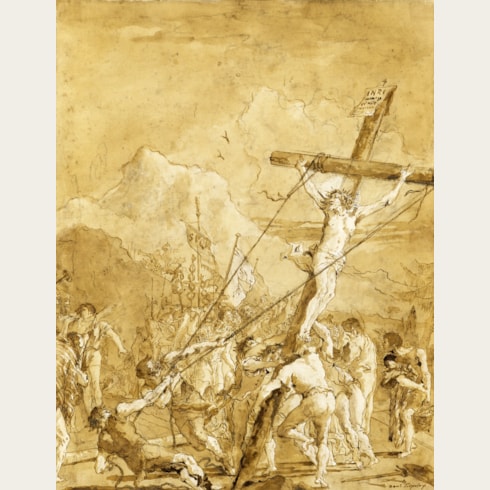
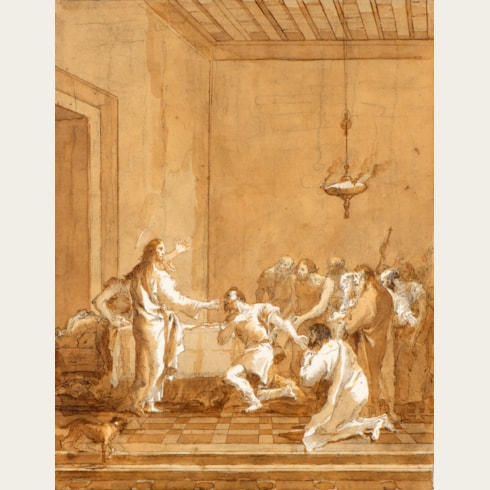
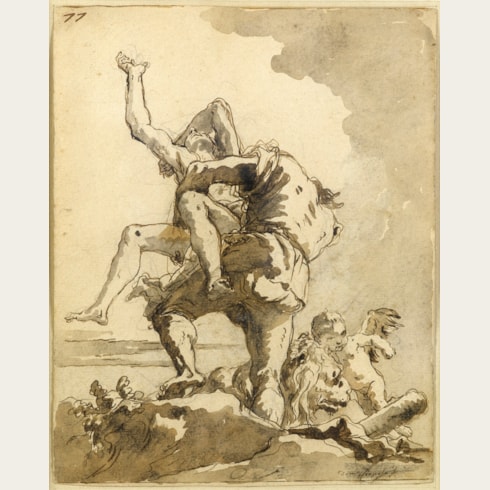
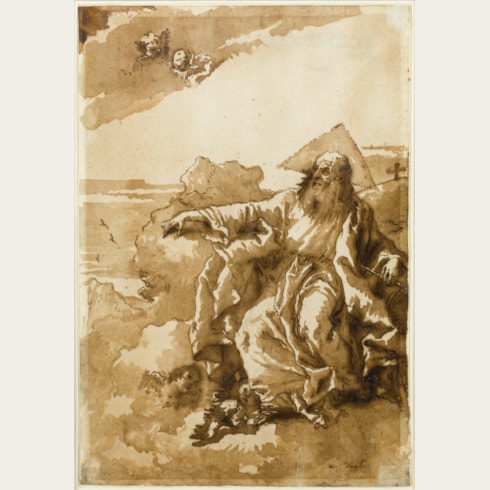
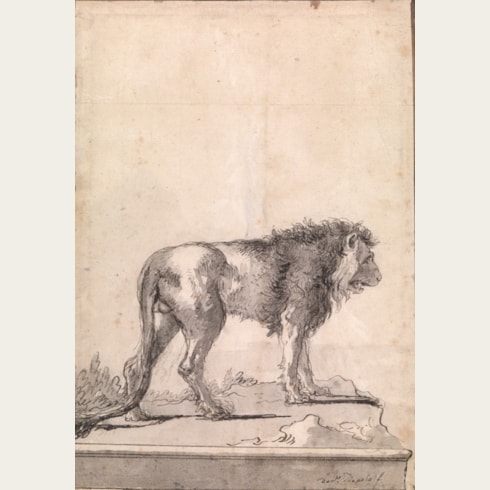
This large sheet is part of a distinctive group of around three hundred and twenty highly finished drawings executed by Domenico Tiepolo over a period of several years following his return from Spain in 1770, and probably through the 1790s. Entitled the ‘Large Biblical Series’ by James Byam Shaw, these sizeable drawings in pen and ink wash – with each image measuring approximately 460 x 350 mm. – depict subjects taken mainly from the New Testament (primarily the Gospels, Parables and the Acts of the Apostles, particularly the lives of Saints Peter and Paul), as well as from fragmentary gospels and the Apocrypha. As one modern scholar has noted of this series, ‘All vertical in format, often with lavish landscape or architectural settings, the drawings are the most exhaustive exploration of biblical subjects by a single eighteenth-century artist. Even in the context of Italy, where the traditions of religious painting remained very much alive despite the impact of the Enlightenment, Domenico’s sustained fascination with biblical subjects is extraordinary, particularly since it is assumed that he drew them primarily to please himself, rather than at the behest of an ecclesiastical patron.’
While it has been proposed that these drawings may have been intended as book illustrations, the fact that many of the compositions are signed in full would suggest instead that they were always regarded by the artist as independent, finished works. Byam Shaw notes that, ‘They are essentially 'album drawings', intended not as studies for painting or etching, but as works of art in their own right; and they belong to a period when drawing, rather than painting, was Domenico’s chief occupation.’
Usually set in elaborate interior or landscape settings, the drawings of the ‘Large Biblical Series’ are among Domenico’s masterpieces as a draughtsman, executed with an assurance of handling and a fluidity of tonal washes that is often quite breathtaking. As George Knox has written, ‘[Domenico Tiepolo’s] most extensive and perhaps his most remarkable work as a draughtsman...The Large Biblical Series is a summation in more ways than one. For the first time, Domenico draws on the full resources of the Tiepolo studio, his own visual memory, his folios of drawings, and the vast accumulation of drawings by his father...Even so, by far the greater part of these compositions are entirely original inventions.’ It is likely that the artist kept the drawings in his studio until his death, as no prints were made of them.
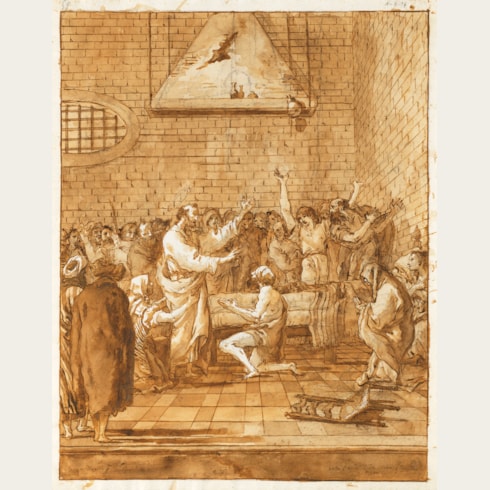
The present sheet depicts an episode that is only found in the gospel of Saint Luke, in which Pilate decides that, since Jesus is from Galilee, he should be tried by Herod: ‘When Pilate heard of Galilee, he asked whether the man were a Galilaean. And as soon as he knew that he belonged unto Herod’s jurisdiction, he sent him to Herod, who himself also was at Jerusalem at that time.’ As Adelheid Gealt and George Knox have described the present sheet, ‘Surrounded by a battalion of heavily armed soldiers, Jesus, his arms still bound, is being led from one judge to another. All eyes, including those of the patriarchal elders who stand by stage right, are fixed on him. Keeping [Saint] Peter in the drama, Domenico (maintaining his emphasis on the first Pope) elects to show Jesus staring across the crowd at Peter, who peers anxiously back at him from the far left. It should be noted that both Matthew (26:57) and Mark (14:54) mentioned that Peter followed him from “far off” to the palace of the High Priest, and there he later denied Jesus. Here again a lamp hangs suspended over Christ’s head, reminding us once more of John 8:12: “I am the light of the world.”…Jesus is led away by a large military escort from an imposing hall of justice, glimpsed on the right…The setting has the character of a scena per angolo, with two coulisses receding on either side, though not very clearly constructed, and a grand staircase rising up on the right side…This is apparently a very late and rather confused design, although the main array of figures, mostly soldiers, moves quite evenly across the scene from right to left.’
Sometime in the first decades of the 19th century the drawings of the ‘Large Biblical Series’ seem to have been divided into two main groups, both of which found their way into French collections. A group of 138 drawings were acquired in 1833 from a shop in the Piazza San Marco in Venice by the French collector Jean Fayet Durand (1806-1889) and were bequeathed to the Louvre at his death in 1889, bound in an album now known as the Recueil Fayet. A further large group of drawings from the series, amounting to around 175 sheets, was purchased in Italy, also in the middle of the 19th century, by Victor Luzarche (1803-1869), at one time the mayor of the city of Tours, and these later entered the collection of Camille Rogier (1805-1893), who had lived in Venice for several years and was a friend of both Fayet and Luzarche. Eighty-two of the ex-Luzarche drawings passed to Roger Cormier (dates unknown), also of Tours. These were dispersed at auction at in Paris in 1921, for a total of 57,850 francs, with the drawings acquired by various private collectors, notably the Duc de Trévise.
In his pioneering book on the drawings of Domenico Tiepolo, published in 1962, James Byam Shaw opined that, ‘it is with the pen and brush, in the second half of his career, that Domenico develops his most characteristic style. It is then that his compositions – in the large Biblical series particularly – become much more pictorial than his father’s, for all the freedom and looseness of his pen work; and it is his peculiar use of the wash, brown or grey or both combined, which contributes most to this effect. These were album-drawings, finished to a margin-line, such as his father seldom produced...Such drawings were intended no doubt for the collector’s portfolio, but many others he kept for his own use.’
While it has been proposed that these drawings may have been intended as book illustrations, the fact that many of the compositions are signed in full would suggest instead that they were always regarded by the artist as independent, finished works. Byam Shaw notes that, ‘They are essentially 'album drawings', intended not as studies for painting or etching, but as works of art in their own right; and they belong to a period when drawing, rather than painting, was Domenico’s chief occupation.’
Usually set in elaborate interior or landscape settings, the drawings of the ‘Large Biblical Series’ are among Domenico’s masterpieces as a draughtsman, executed with an assurance of handling and a fluidity of tonal washes that is often quite breathtaking. As George Knox has written, ‘[Domenico Tiepolo’s] most extensive and perhaps his most remarkable work as a draughtsman...The Large Biblical Series is a summation in more ways than one. For the first time, Domenico draws on the full resources of the Tiepolo studio, his own visual memory, his folios of drawings, and the vast accumulation of drawings by his father...Even so, by far the greater part of these compositions are entirely original inventions.’ It is likely that the artist kept the drawings in his studio until his death, as no prints were made of them.
The present sheet depicts an episode that is only found in the gospel of Saint Luke, in which Pilate decides that, since Jesus is from Galilee, he should be tried by Herod: ‘When Pilate heard of Galilee, he asked whether the man were a Galilaean. And as soon as he knew that he belonged unto Herod’s jurisdiction, he sent him to Herod, who himself also was at Jerusalem at that time.’ As Adelheid Gealt and George Knox have described the present sheet, ‘Surrounded by a battalion of heavily armed soldiers, Jesus, his arms still bound, is being led from one judge to another. All eyes, including those of the patriarchal elders who stand by stage right, are fixed on him. Keeping [Saint] Peter in the drama, Domenico (maintaining his emphasis on the first Pope) elects to show Jesus staring across the crowd at Peter, who peers anxiously back at him from the far left. It should be noted that both Matthew (26:57) and Mark (14:54) mentioned that Peter followed him from “far off” to the palace of the High Priest, and there he later denied Jesus. Here again a lamp hangs suspended over Christ’s head, reminding us once more of John 8:12: “I am the light of the world.”…Jesus is led away by a large military escort from an imposing hall of justice, glimpsed on the right…The setting has the character of a scena per angolo, with two coulisses receding on either side, though not very clearly constructed, and a grand staircase rising up on the right side…This is apparently a very late and rather confused design, although the main array of figures, mostly soldiers, moves quite evenly across the scene from right to left.’
Sometime in the first decades of the 19th century the drawings of the ‘Large Biblical Series’ seem to have been divided into two main groups, both of which found their way into French collections. A group of 138 drawings were acquired in 1833 from a shop in the Piazza San Marco in Venice by the French collector Jean Fayet Durand (1806-1889) and were bequeathed to the Louvre at his death in 1889, bound in an album now known as the Recueil Fayet. A further large group of drawings from the series, amounting to around 175 sheets, was purchased in Italy, also in the middle of the 19th century, by Victor Luzarche (1803-1869), at one time the mayor of the city of Tours, and these later entered the collection of Camille Rogier (1805-1893), who had lived in Venice for several years and was a friend of both Fayet and Luzarche. Eighty-two of the ex-Luzarche drawings passed to Roger Cormier (dates unknown), also of Tours. These were dispersed at auction at in Paris in 1921, for a total of 57,850 francs, with the drawings acquired by various private collectors, notably the Duc de Trévise.
In his pioneering book on the drawings of Domenico Tiepolo, published in 1962, James Byam Shaw opined that, ‘it is with the pen and brush, in the second half of his career, that Domenico develops his most characteristic style. It is then that his compositions – in the large Biblical series particularly – become much more pictorial than his father’s, for all the freedom and looseness of his pen work; and it is his peculiar use of the wash, brown or grey or both combined, which contributes most to this effect. These were album-drawings, finished to a margin-line, such as his father seldom produced...Such drawings were intended no doubt for the collector’s portfolio, but many others he kept for his own use.’
Giovanni Domenico Tiepolo is assumed to have begun his career in the family studio by copying his father’s drawings, although he also created his own drawings as designs for etchings, a practice which occupied much of his time in the 1740s and 1750s. His first independent drawings for paintings are those related to a series of fourteen paintings of the Stations of the Cross for the Venetian church of San Polo, completed when he was just twenty. Between 1750 and 1770, Domenico worked closely with his father as an assistant, notably in Würzburg, at the Villa Valmarana in Vicenza and the Villa Pisani at Strà, and in Madrid. From the late 1740s he also began to be entrusted with his own independent commissions, and the drawings for these display a manner somewhat different from that of his father, with a particular interest in lighthearted genre motifs.
Soon after Giambattista Tiepolo’s sudden death in Madrid in 1770, Domenico returned to his native Venice, where he enjoyed much success as a decorative painter. He continued to expound the grand manner of history painting established by his father - the ‘Tiepolo style’, as it were – and by 1780 his reputation was such that he was named president of the Accademia di Belle Arti in Venice. Within a few years, however, he seems to have largely abandoned painting. In his sixties and living effectively in retirement at the Tiepolo family villa at Zianigo, on the Venetian mainland, he produced a large number of pen and wash drawings that are a testament to his inexhaustible gift for compositional invention.
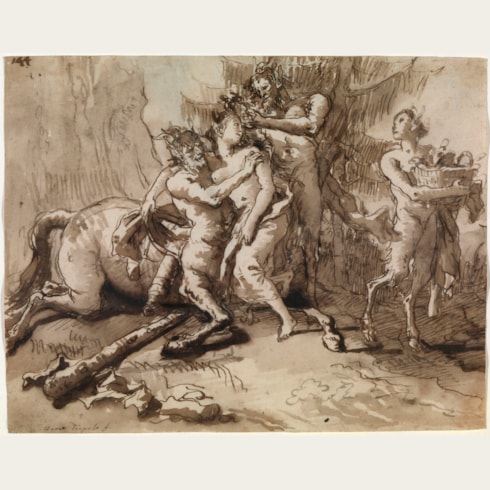
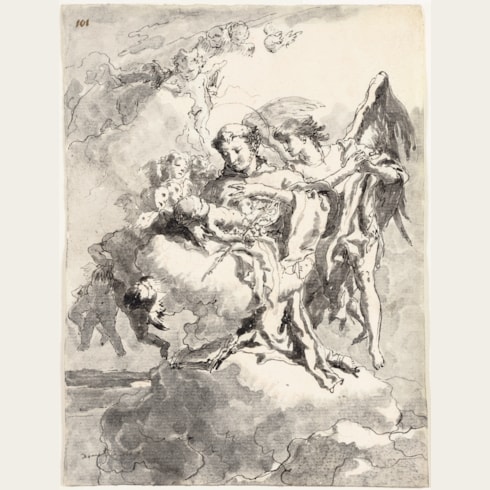
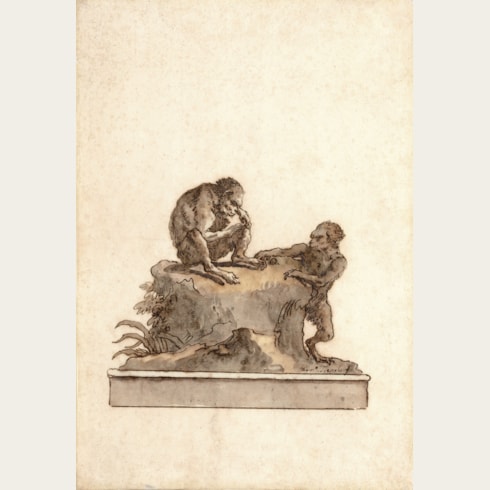
For much of the last twenty years of his career, Domenico Tiepolo seems to have painted only occasionally, and instead worked primarily as a draughtsman, producing a large number of pen and wash drawings that may collectively be regarded as perhaps his finest artistic legacy. These drawings were, for the most part, executed as a series of several dozen or more themed drawings, many of which were numbered. Among these are several series of drawings of religious and mythological subjects, as well as a varied group of genre scenes, numbering around a hundred sheets, generally referred to as the so-called ‘Scenes of Contemporary Life’, and a celebrated series of 104 drawings entitled the Divertimenti per li regazzi, illustrating scenes from the life of Punchinello, a popular character from the Commedia dell’Arte.
Domenico’s highly finished late drawings, almost all of which were signed, were undoubtedly intended as fully realized, autonomous works of art. While it is certainly possible that they were produced as works of art to be offered for sale to collectors, almost none of the drawings appear to have been dispersed in Domenico’s lifetime. The fact, too, that many of the drawings are numbered, possibly by the artist himself, and that most remained together in groups for many years after his death, would also suggest that they were retained in his studio throughout his life, as indeed he also kept numerous albums of drawings by his father. It is most likely, therefore, that these late drawings by Domenico were done simply for his own pleasure. Nevertheless, they have consistently enjoyed immense popularity since the artist’s death, and continue to entice collectors today. As Catherine Whistler has noted, ‘Domenico’s spirited and inventive independent sheets have long been appreciated, particularly by French and American collectors of the late nineteenth and early twentieth centuries; his quirky sense of humor, acutely observant eye, and zestful approach to his subjects lend his drawings a peculiarly modern appeal.’
As Michael Levey has also noted of the artist, ‘Domenico Tiepolo’s drawings provide us with the more private side of him, but they also serve to represent his career at all stages. He drew continually: sometimes very closely in the manner of his father; at the opposite remove, in the late Punchinello drawings for example, his manner and matter could never be mistaken for anyone else’s...The key to Domenico is in drawings: he began as a draughtsman and, one is tempted to say, all his paintings betray the draughtsman.’
Provenance
Among the contents of the artist’s studio in Venice at the time of his death, and by descent to his wife, Margherita Moscheni, Venice
Dispersed on the Venetian art market in the first half of the 19th century
Victor Luzarche, Tours, until 1868
Camille Rogier, Paris
Henri Guerlain, Tours
Roger Cormier, Tours
His sale (‘Collection de M. Cormier de Tours. Dessins par Giovanni-Domenico Tiepolo’), Paris, Galerie Georges Petit, 30 April 1921, probably lot 72 (‘Le Christ entrainé par les soldats. Plume et lavis de sépia. Haut,. 46 cent.; larg., 36 cent.’)
Jean-Pierre Durand-Matthiesen, Geneva, in 1966
Anonymous sale (‘The Property of a Nobleman’), London, Christie’s, 9 December 1986, lot 103 (as The Mocking of Christ)
Private collection, New York.
Dispersed on the Venetian art market in the first half of the 19th century
Victor Luzarche, Tours, until 1868
Camille Rogier, Paris
Henri Guerlain, Tours
Roger Cormier, Tours
His sale (‘Collection de M. Cormier de Tours. Dessins par Giovanni-Domenico Tiepolo’), Paris, Galerie Georges Petit, 30 April 1921, probably lot 72 (‘Le Christ entrainé par les soldats. Plume et lavis de sépia. Haut,. 46 cent.; larg., 36 cent.’)
Jean-Pierre Durand-Matthiesen, Geneva, in 1966
Anonymous sale (‘The Property of a Nobleman’), London, Christie’s, 9 December 1986, lot 103 (as The Mocking of Christ)
Private collection, New York.
Literature
Henri Guerlain, Giovanni Domenico Tiepolo: au temps du Christ. Jésus, la Vierge, les apotres, Tours, 1921, illustrated p.77; Christofer Conrad, Die grossformatigen religiösen Zeichnungen Giovanni Domenico Tiepolos, unpublished Ph.D dissertation, Ruprecht-Karls-Universität, Heidelberg, 1996, no.157; Adelheid M. Gealt and George Knox, Domenico Tiepolo: A New Testament, Bloomington, 2006, p.52, pp.462-463, no.190.