Pierre BONNARD
(Fontenay-aux-Roses 1867 - Le Cannet 1947)
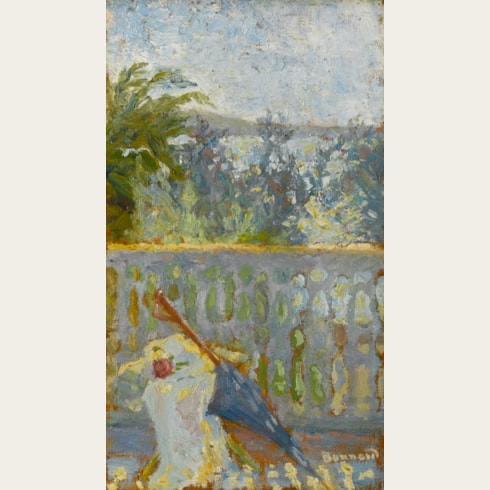
Study for Child with a Pail and Sandcastle
Oil on cardboard.
Stamped with the Bonnard estate stamp on the reverse.
380 x 270 mm. (15 x 10 5/8 in.) at greatest dimensions.
A relatively little-known aspect of the work of the Nabis artists are their designs for the applied and decorative arts, including screens, panels, stained glass and furniture. These often-unrealized designs were rarely exhibited and were instead given to close friends or acquired by discerning collectors. As Bonnard later commented, ‘At that time I personally envisaged a popular art that was of everyday application: engravings, fans, furniture, screens, etc.’ Other such projects included large-scale decorative works commissioned in the 1890s from Bonnard, Vuillard, Denis and Roussel by a handful of private patrons for their homes. These were part and parcel of the Nabis aesthetic; a blurring of the boundaries between the fine and decorative arts, with painting liberated from the easel and allowed to cover walls and large surfaces.
This oil sketch of a child with a checkered apron, seen from behind, is a preparatory study for Bonnard’s painting Child with a Pail and Sandcastle, painted in glue and distemper on canvas, in the collection of the Musée d’Orsay in Paris. This was originally the fourth panel of a folding screen painted around 1894, of which the other three panels, collectively entitled Country Landscape, are today in the Museum of Modern Art in New York. Inspired by Japanese examples that began to be exhibited in Paris, such painted screens, intended for domestic settings, became very popular in France in the second half of the 19th century. Among the artists of the Nabis group, and perhaps as a result of his fascination with Japanese art, Bonnard painted the most multipaneled folding screens during the 1890s, some of which were later developed into larger-scale panneaux décoratifs.
The appearance of the four-panel screen of Country Landscape, before it was broken up, is known through a photograph of Bonnard’s studio in c.1905, where it appears in the background. However, Child with a Pail and Sandcastle should be regarded as a separate and independent composition, since it was detached by the artist from the other three panels of the screen sometime after 1905. As Claire Frèches-Thory has noted, ‘A photograph taken in his studio on the rue de Douai in about 1905 shows Bonnard with the four panels. It is likely that that the artist later noticed a disparity in style and decided to detach the panel now in the Musée d’Orsay from Country Landscape. The sober composition of Child with a Sand-castle (in which we see one of Bonnard’s nephews playing in front of the house) and its Japanese style did not blend with the superabundance of Country Landscape.’ As the same scholar has written elsewhere, ‘The stylistic discordance between the rigour and sobriety of Child with a Sandcastle, qualities worthy of a Quattrocento artist, and the decorative exuberance of the three panels of the Country Landscape led Bonnard to isolate this panel as a piece of pure painting. The technique used in this painting [Child with a Sandcastle], tempera on unprepared canvas leaving many areas bare, is typical of the decorative works of the Nabis in their heyday…Beneath the geometric abstraction of the composition and the pure Japonisme of the child’s silhouette lies the familiar reality experienced by the artist, a process typical of his inspiration...At the height of his art, even in this early period, Bonnard gives this painting, through the methods of Japanese prints, the contemplative resonance of Chinese painting.’
Child with a Pail and Sandcastle appears to depict Bonnard’s nephew Jean Terrasse playing at ‘Le Clos’, the Bonnard family villa and estate at Le Grand-Lemps, near Grenoble in the département of Isère. As one scholar has noted, ‘The orchard and gardens of Le Clos (The Orchard), the family home of Pierre Bonnard in Le Grand-Lemps in the Dauphiné, remained a touchstone for the artist until the estate was sold in 1928…overflowing with relatives, friends, and pets, [it] provided not only a refuge for the artist, but a rich source of subject matter for his art that celebrated private life.’ The artist’s great-nephew later wrote of Bonnard, and of Child with a Pail and Sandcastle in particular, ‘Life…Pierre Bonnard devoted his existence to celebrating it. Marthe gave him no children, which would be one of his sorrows. But children were born to the Claude Terrasse family: Robert, Jean, Charles…And the man they would call “Uncle Pierre” drew them, each and every one…During vacations in the house at Grand-Lemps, he would surprise them at their games…in the garden, picking plums, or petting the cat…The grace or the charm of their movements, the gravity of their gaze, everything captured by his pencil was transmitted, lifelike, onto the canvas, in a series of paintings which form a hymn to the joys of childhood and the joys of painting, when the childhood is a happy one and the painter has the ability to live what he is portraying. This little crouching boy, under his hat, in his checked apron, is he really a little boy, completely caught up in his game? Or is he Pierre Bonnard himself, playing with sand, a shovel and pail in his hands?’
Another scholar writing on Child with a Pail and Sandcastle adds that ‘We can imagine how deeply the painter was moved by the sight of his nephew Jean, whom he was secretly watching, depicting him from behind, sitting on the front steps of the house, wearing a beret that was too large for him, conscientiously filling his bucket. Bonnard’s plastic language is reduced to the essentials in terms of colour and composition. A great serenity emanates from this former screen panel, as well as a dose of humour and tenderness that comes from the extremely pared-down composition, not unlike the Japanese prints that were in his mind at the time…This painting, with its soft magnetic harmony, has come to represent the quintessence of the theme for the artist who oscillates between sobriety and exuberance. Here, the japonisme of the extremely concise composition reduces any sentimentality that might otherwise emanate from this little boy dressed in a chequered apron.'
A preparatory sketch for the child in the painting of Child with a Pail and Sandcastle is part of a sketchbook used by Bonnard in c.1894-1895 that was acquired by the Musée d’Orsay in 2003. Another page from the same sketchbook seems to show Child with a Pail and Sandcastle at the left of the ensemble of four panels that made up the original screen, including the three panels of Country Landscape now in the Museum of Modern Art in New York. The panel of Child with a Pail and Sandcastle also appears in the small painting Interior with a Screen of c.1906 by Bonnard, in the Vicki and Roger Sant Collection at the Phillips Collection in Washington, D.C.
This oil sketch by Bonnard was formerly in the collection of the mathematician and art historian Jean-Bernard Sandler (b.1949), who collected drawings and prints, with a particular emphasis on works by artists from Tours of the 19th and 20th centuries. In 2000 he gifted a group of drawings from his collection to the Musée des Beaux-Arts in Tours.
This oil sketch of a child with a checkered apron, seen from behind, is a preparatory study for Bonnard’s painting Child with a Pail and Sandcastle, painted in glue and distemper on canvas, in the collection of the Musée d’Orsay in Paris. This was originally the fourth panel of a folding screen painted around 1894, of which the other three panels, collectively entitled Country Landscape, are today in the Museum of Modern Art in New York. Inspired by Japanese examples that began to be exhibited in Paris, such painted screens, intended for domestic settings, became very popular in France in the second half of the 19th century. Among the artists of the Nabis group, and perhaps as a result of his fascination with Japanese art, Bonnard painted the most multipaneled folding screens during the 1890s, some of which were later developed into larger-scale panneaux décoratifs.
The appearance of the four-panel screen of Country Landscape, before it was broken up, is known through a photograph of Bonnard’s studio in c.1905, where it appears in the background. However, Child with a Pail and Sandcastle should be regarded as a separate and independent composition, since it was detached by the artist from the other three panels of the screen sometime after 1905. As Claire Frèches-Thory has noted, ‘A photograph taken in his studio on the rue de Douai in about 1905 shows Bonnard with the four panels. It is likely that that the artist later noticed a disparity in style and decided to detach the panel now in the Musée d’Orsay from Country Landscape. The sober composition of Child with a Sand-castle (in which we see one of Bonnard’s nephews playing in front of the house) and its Japanese style did not blend with the superabundance of Country Landscape.’ As the same scholar has written elsewhere, ‘The stylistic discordance between the rigour and sobriety of Child with a Sandcastle, qualities worthy of a Quattrocento artist, and the decorative exuberance of the three panels of the Country Landscape led Bonnard to isolate this panel as a piece of pure painting. The technique used in this painting [Child with a Sandcastle], tempera on unprepared canvas leaving many areas bare, is typical of the decorative works of the Nabis in their heyday…Beneath the geometric abstraction of the composition and the pure Japonisme of the child’s silhouette lies the familiar reality experienced by the artist, a process typical of his inspiration...At the height of his art, even in this early period, Bonnard gives this painting, through the methods of Japanese prints, the contemplative resonance of Chinese painting.’
Child with a Pail and Sandcastle appears to depict Bonnard’s nephew Jean Terrasse playing at ‘Le Clos’, the Bonnard family villa and estate at Le Grand-Lemps, near Grenoble in the département of Isère. As one scholar has noted, ‘The orchard and gardens of Le Clos (The Orchard), the family home of Pierre Bonnard in Le Grand-Lemps in the Dauphiné, remained a touchstone for the artist until the estate was sold in 1928…overflowing with relatives, friends, and pets, [it] provided not only a refuge for the artist, but a rich source of subject matter for his art that celebrated private life.’ The artist’s great-nephew later wrote of Bonnard, and of Child with a Pail and Sandcastle in particular, ‘Life…Pierre Bonnard devoted his existence to celebrating it. Marthe gave him no children, which would be one of his sorrows. But children were born to the Claude Terrasse family: Robert, Jean, Charles…And the man they would call “Uncle Pierre” drew them, each and every one…During vacations in the house at Grand-Lemps, he would surprise them at their games…in the garden, picking plums, or petting the cat…The grace or the charm of their movements, the gravity of their gaze, everything captured by his pencil was transmitted, lifelike, onto the canvas, in a series of paintings which form a hymn to the joys of childhood and the joys of painting, when the childhood is a happy one and the painter has the ability to live what he is portraying. This little crouching boy, under his hat, in his checked apron, is he really a little boy, completely caught up in his game? Or is he Pierre Bonnard himself, playing with sand, a shovel and pail in his hands?’
Another scholar writing on Child with a Pail and Sandcastle adds that ‘We can imagine how deeply the painter was moved by the sight of his nephew Jean, whom he was secretly watching, depicting him from behind, sitting on the front steps of the house, wearing a beret that was too large for him, conscientiously filling his bucket. Bonnard’s plastic language is reduced to the essentials in terms of colour and composition. A great serenity emanates from this former screen panel, as well as a dose of humour and tenderness that comes from the extremely pared-down composition, not unlike the Japanese prints that were in his mind at the time…This painting, with its soft magnetic harmony, has come to represent the quintessence of the theme for the artist who oscillates between sobriety and exuberance. Here, the japonisme of the extremely concise composition reduces any sentimentality that might otherwise emanate from this little boy dressed in a chequered apron.'
A preparatory sketch for the child in the painting of Child with a Pail and Sandcastle is part of a sketchbook used by Bonnard in c.1894-1895 that was acquired by the Musée d’Orsay in 2003. Another page from the same sketchbook seems to show Child with a Pail and Sandcastle at the left of the ensemble of four panels that made up the original screen, including the three panels of Country Landscape now in the Museum of Modern Art in New York. The panel of Child with a Pail and Sandcastle also appears in the small painting Interior with a Screen of c.1906 by Bonnard, in the Vicki and Roger Sant Collection at the Phillips Collection in Washington, D.C.
This oil sketch by Bonnard was formerly in the collection of the mathematician and art historian Jean-Bernard Sandler (b.1949), who collected drawings and prints, with a particular emphasis on works by artists from Tours of the 19th and 20th centuries. In 2000 he gifted a group of drawings from his collection to the Musée des Beaux-Arts in Tours.
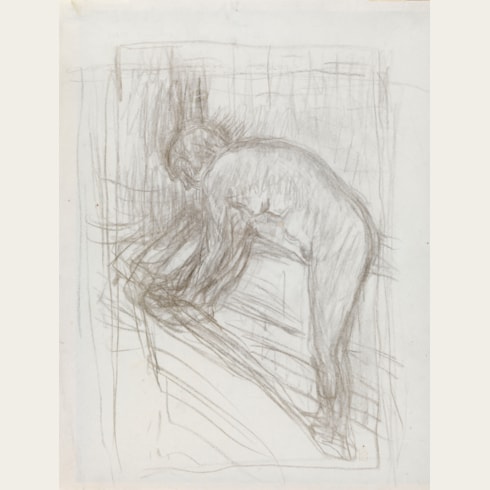
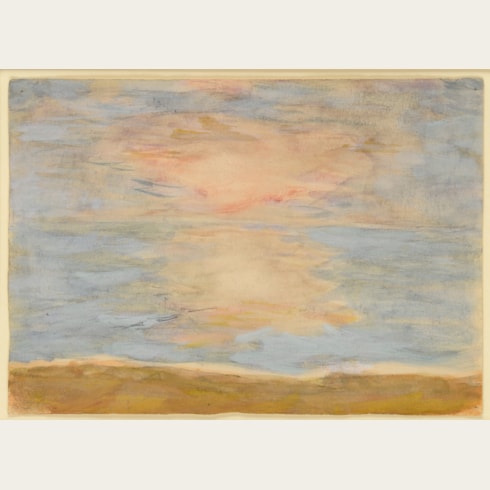
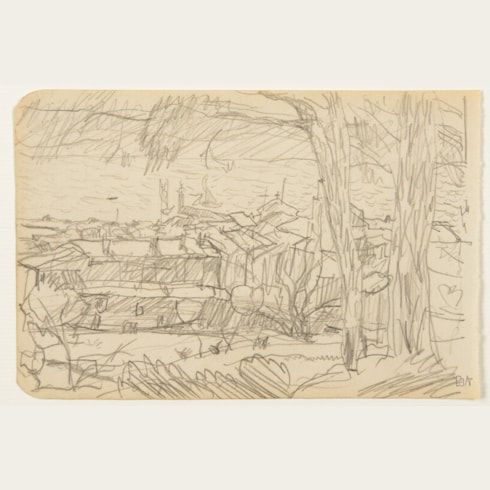
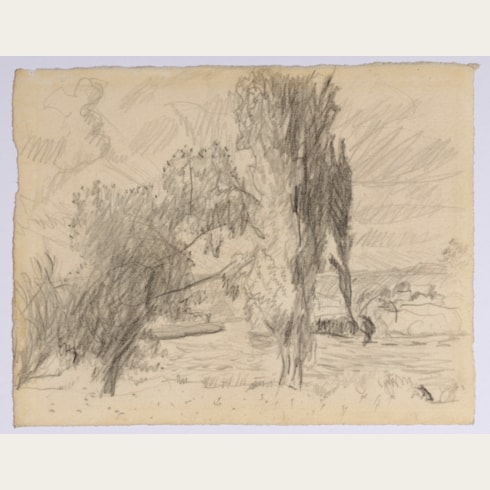
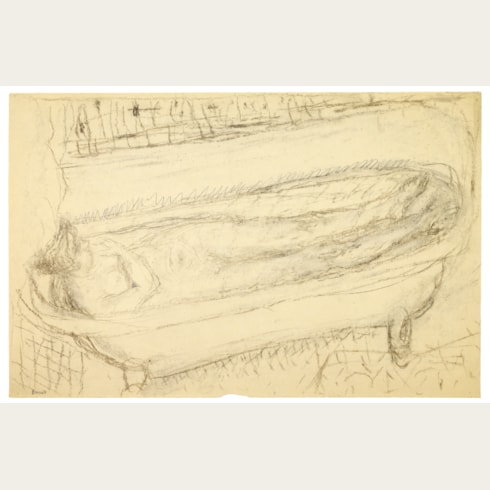
A compulsive draughtsman, Pierre Bonnard relied on his studies and sketches extensively in the preparation of his pictures. Most of his drawings seem to have been made in the process of developing the composition of a painting, and indeed he seems to have preferred to work from drawings rather than relying on direct observation. He made use of whatever paper came to hand, sometimes lined or squared pages of cheap paper or small sketchbooks, and generally of a small enough size to fit into his pocket. He almost always used a hard or soft pencil and only very rarely applied colour to his drawings, relying on the strength and shading of the pencil strokes to suggest tone and colour. In conversation with his nephew Charles Terrasse, Bonnard noted that ‘I am drawing incessantly - after drawing comes the composition which must have a perfect equilibrium, a well constructed picture is the battle half won, the art of composition is so powerful that with only black and white - a pencil, a pen or a lithographic pencil, one arrives at results as complete and of a quality nearly as beautiful as with a whole arsenal of colours.’
Bonnard rarely parted with his drawings, which were never intended to be exhibited or, indeed, regarded as independent works of art. Nevertheless, the artist’s work as a draughtsman is crucial to an understanding of his approach to painting. As Jack Flam has written, ‘Bonnard’s drawings are often very small, and as a result they are frequently overlooked in discussions of modern drawing. But their formal variety and sensitivity of touch are remarkable, as is the often fluctuant nature of their imagery. Although many of Bonnard’s drawings seem like shorthand notations of visual information recorded for later use in paintings, they are nonetheless effective as independent entities precisely because of the intensity of perception they incorporate. They also demonstrate an extraordinary sensitivity to the nature of the medium itself, unadorned by elaborate technical procedures.’
Provenance
Jean-Bernard Sandler, Tours (Lugt 3423)
Private collection.
Private collection.