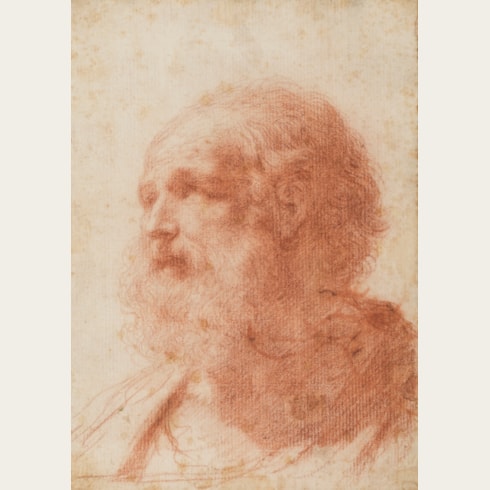
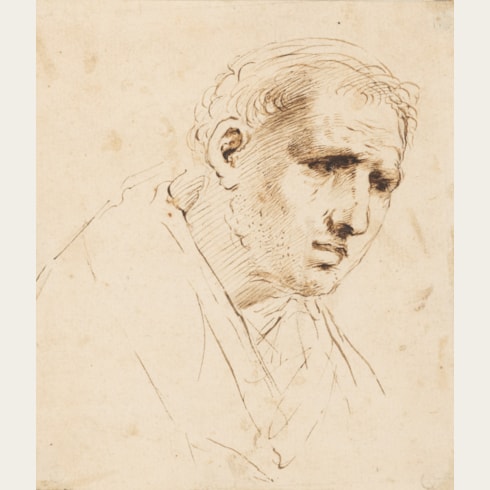
Giovanni Francesco Barbieri GUERCINO
(Cento 1591 - Bologna 1666)
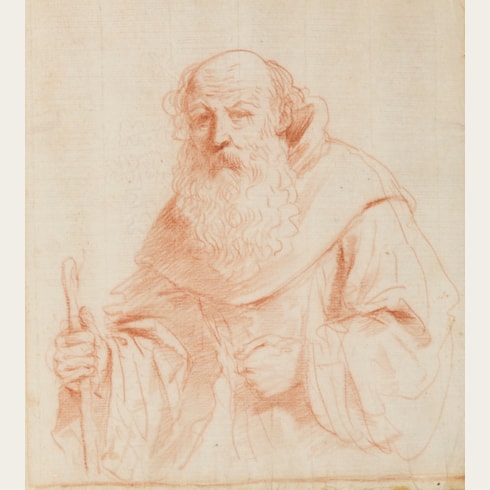
Saint Augustine Reading in an Interior
Sold
Red chalk, with framing lines in red chalk.
Inlaid on a 19th century album page and numbered N.27 in white chalk above the drawing and inscribed GUERCINO in white chalk below the sheet.
Numbered (by Vallardi) L.145 in red chalk on the verso of the sheet.
Further inscribed Guercino in pencil on the verso.
265 x 201 mm. (10 3/8 x 7 7/8 in.)
Inlaid on a 19th century album page and numbered N.27 in white chalk above the drawing and inscribed GUERCINO in white chalk below the sheet.
Numbered (by Vallardi) L.145 in red chalk on the verso of the sheet.
Further inscribed Guercino in pencil on the verso.
265 x 201 mm. (10 3/8 x 7 7/8 in.)
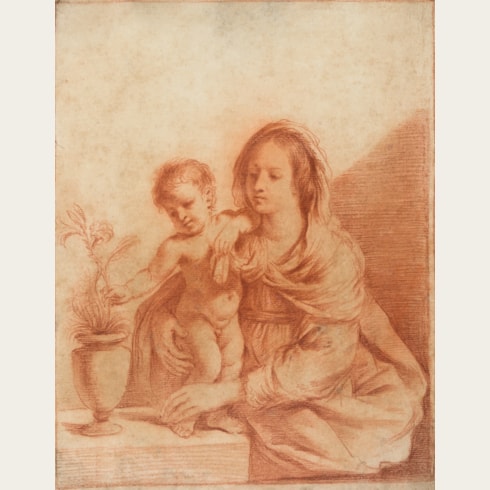
The Guercino scholar David Stone has dated this drawing to the decade of the 1640s. As he has written, the present sheet ‘represents [Saint] Augustine in his study with a bookcase (one of the volumes is clearly inscribed De Trinitate, one of Augustine’s most famous works). Here he is shown standing (with the crozier resting on his chest), reading a book, and facing towards the left. A small desk on the right features an ink well with a quill.’ Although unconnected to any known painting or print by the artist, this fine drawing may be associated with another red chalk drawing of the same subject today in the collection of the Real Accademia des Bellas Artes de San Fernando in Madrid. The Madrid drawing depicts Saint Augustine kneeling in front of a bookshelf in a study, facing to the right and reading a book held up by a standing winged putto. Stone has further suggested that both the present sheet and that in Madrid may have been intended as studies for an altarpiece or easel painting of Saint Augustine in his study, although no such work survives or is recorded.
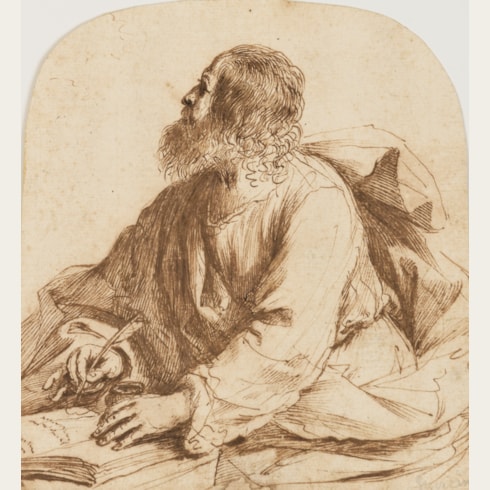
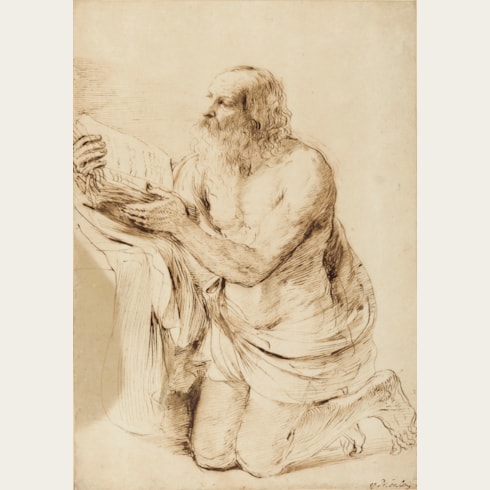
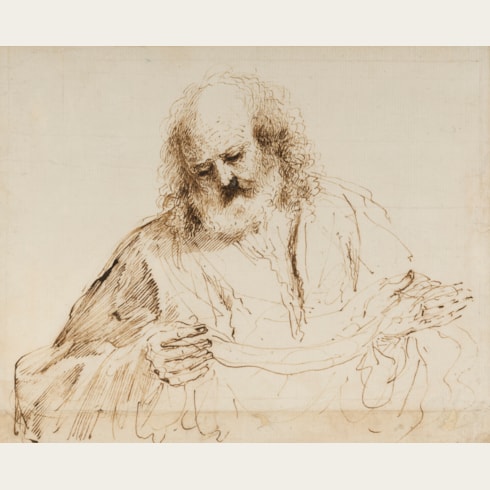
Thematically related to the present sheet is a highly finished pen and ink drawing of a Seated Bishop Saint Reading, of the same approximate date, that was recently on the art market. Likewise unrelated to any known painting, Stone has suggested that the drawing may depict Saint Ambrose, the teacher of Saint Augustine and, like him, one of the four Latin Fathers of the Church. Unlike the two red chalk drawings of Saint Augustine, however, the pen and ink drawing is of horizontal format and is unlikely to have been a study for an altarpiece, although it may have been intended for a print or book illustration.
The present sheet bears the stamp of Giuseppe Vallardi (1784-1861), an influential Milanese dealer in prints, drawings, books, paintings and sculpture. Vallardi, who was also a print publisher, pioneered the practice of issuing catalogues of works for sale, and often added a stock code or numbering in red chalk on the versos of the drawings that he offered for sale, as is the case with this sheet. A large number of Italian drawings bearing Vallardi’s stamp, including the present sheet, were acquired by the 19th century Milanese collector Captain Carlo Prayer (1826-1900), who later sold part of his large collection of drawings to the dealer H. G. Gutekunst of Stuttgart.
Thematically related to the present sheet is a highly finished pen and ink drawing of a Seated Bishop Saint Reading, of the same approximate date, that was recently on the art market. Likewise unrelated to any known painting, Stone has suggested that the drawing may depict Saint Ambrose, the teacher of Saint Augustine and, like him, one of the four Latin Fathers of the Church. Unlike the two red chalk drawings of Saint Augustine, however, the pen and ink drawing is of horizontal format and is unlikely to have been a study for an altarpiece, although it may have been intended for a print or book illustration.
The present sheet bears the stamp of Giuseppe Vallardi (1784-1861), an influential Milanese dealer in prints, drawings, books, paintings and sculpture. Vallardi, who was also a print publisher, pioneered the practice of issuing catalogues of works for sale, and often added a stock code or numbering in red chalk on the versos of the drawings that he offered for sale, as is the case with this sheet. A large number of Italian drawings bearing Vallardi’s stamp, including the present sheet, were acquired by the 19th century Milanese collector Captain Carlo Prayer (1826-1900), who later sold part of his large collection of drawings to the dealer H. G. Gutekunst of Stuttgart.
Giovanni Francesco Barbieri, known as Il Guercino (‘the squinter’) because he was cross-eyed, was by the second decade of the 17th century one of the leading painters in the province of Emilia. Born in Cento, a small town between Bologna and Ferrara, Guercino was largely self-taught, although his early work was strongly influenced by the paintings of Ludovico Carracci. In 1617 he was summoned to Bologna by Alessandro Ludovisi, the Cardinal Archbishop of Bologna, and there painted a number of important altarpieces, typified by the Saint William Receiving the Monastic Habit, painted in 1620 and now in the Pinacoteca Nazionale in Bologna. When Ludovisi was elected Pope Gregory XV in 1621, Guercino was summoned to Rome to work for the pontiff and his nephew, Cardinal Ludovico Ludovisi. It was in Rome that Guercino painted some of his most celebrated works, notably the ceiling fresco of Aurora in the Casino Ludovisi and the large altarpiece of The Burial and Reception into Heaven of Saint Petronilla for an altar in Saint Peter’s. The papacy of Gregory XV was short-lived, however, and on the death of the Pope in 1623 Guercino returned to his native Cento. He remained working in Cento for twenty years, though he continued to receive commissions from patrons throughout Italy and beyond, and turned down offers of employment at the royal courts in London and Paris. Following the death of Guido Reni in 1642, Guercino moved his studio to Bologna, where he received commissions for religious pictures of the sort that Reni had specialized in, and soon inherited his position as the leading painter in the city.
Guercino was among the most prolific draughtsmen of the 17th century in Italy, and his preferred medium was pen and brown ink, although he also worked in red chalk, black chalk, and charcoal. He appears to have assiduously kept his drawings throughout his long career, and to have only parted with a few of them. Indeed, more drawings by him survive today than by any other Italian artist of the period. On his death in 1666 all of the numerous surviving sheets in his studio passed to his nephews and heirs, the painters Benedetto and Cesare Gennari, known as the ‘Casa Gennari’.
The drawings of Guercino, which include figural and compositional studies, landscapes, caricatures and genre scenes, have always been coveted by later collectors and connoisseurs. Indeed, the 18th century amateur Pierre-Jean Mariette noted of the artist that ‘Ce peintre a outre cela une plume tout-à-faite séduisante’. The largest extant group of drawings by Guercino is today in the Royal Collection at Windsor Castle; these were acquired from the Gennari family by King George III’s librarian, Richard Dalton, between about 1758 and 1764.
Provenance
Giuseppe Vallardi, Milan (Lugt 1223), with his stock number L.145 on the verso
Carlo Prayer, Milan (Lugt 2044, and on his mount with a black border)
Possibly H. G. Gutekunst, Stuttgart.
Carlo Prayer, Milan (Lugt 2044, and on his mount with a black border)
Possibly H. G. Gutekunst, Stuttgart.
Literature
David Stone, ‘Giovanni Francesco Barbieri, called Il Guercino (Cento 1591–1666 Bologna), Seated Bishop Saint Reading, facing towards the right (Saint Ambrose Reading Silently?)’, Unpublished text for Enrico Frascione Gallery, 18 March 2024, p.3, illustrated p.8, fig.4.