Francesco GUARDI
(Venice 1712 - Venice 1793)
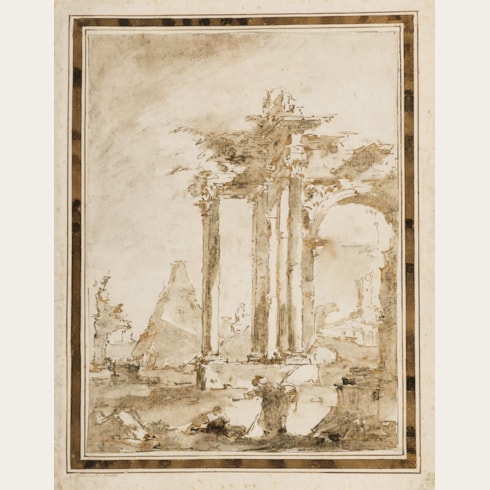
A Capriccio of Ruins with an Architrave
Pen and brown ink on light brown paper.
A sketch of columns, arches and an architrave drawn in pen and brown ink on the verso.
139 x 146 mm. (5 1/2 x 5 3/4 in.)
A sketch of columns, arches and an architrave drawn in pen and brown ink on the verso.
139 x 146 mm. (5 1/2 x 5 3/4 in.)
Francesco Guardi’s capriccio studies are perhaps his most individual works as a draughtsman. In his survey of the artist’s drawings, published in 1951, James Byam Shaw reiterated that studies of architectural capricci, such as the present sheet, were ‘evidently more to the taste of Venetian collectors than of foreign visitors at the time. The Venetian gentleman needed no souvenir: he could admire the gay scene in the Piazza any day of his life, or watch the Regatta, if he chose, from his balcony on the Grand Canal. But a Capriccio was something à la mode, a work of the imagination, a work of art. It is the Veduta ideata (imaginary view), as opposed to the Veduta presa dal Luogo (view taken on the spot)….but this particular category, which is so characteristic of Guardi, consists in the combination of motives taken from Venetian or other architecture, some of which are introduced with variations again and again…the Architectural Capriccio, whether in drawing or painting - and many of the drawings of this kind were adapted eventually on canvas or panel – is clearly distinct from the Venetian View in intention. It is a composition and not a view…even where a motive derives from the realities of the Venetian scene, the spirit is elsewhere, in the region of fancy.’
The composition of this drawing is closely related to that of a late painting by Francesco Guardi, one of a pair of small capricci of c.1770-1780 formerly in the collection of Robert Hays Smith in Burlingame, California, and sold at auction in New York in 2016.
The present sheet may be likened to other pen and ink bucolic landscape drawings of Guardi’s mature period, such as a Landscape with a Rustic House and Portico in the collection of the Museo Correr in Venice. The architectural sketches on the verso of this sheet can be likened to similar sketches in a drawing with four studies of a man playing with a dog, also in the Museo Correr.
The composition of this drawing is closely related to that of a late painting by Francesco Guardi, one of a pair of small capricci of c.1770-1780 formerly in the collection of Robert Hays Smith in Burlingame, California, and sold at auction in New York in 2016.
The present sheet may be likened to other pen and ink bucolic landscape drawings of Guardi’s mature period, such as a Landscape with a Rustic House and Portico in the collection of the Museo Correr in Venice. The architectural sketches on the verso of this sheet can be likened to similar sketches in a drawing with four studies of a man playing with a dog, also in the Museo Correr.
Francesco Guardi is thought to have trained in the studio of his brother-in-law, Giovanni Battista Tiepolo. Unlike Canaletto or the Tiepolos, however, he never seems to have sought fame abroad, preferring instead to remain almost exclusively in and around his native Venice. For much of his early career Guardi worked as a history painter, often in collaboration with his elder brother Gian Antonio, and it was not until quite late in his life - indeed, already in middle age - that he took up the vedute painting for which he is best known today. He may even have been an assistant in the studio of Canaletto in the late 1750s or early 1760s, to judge from a contemporary description of him in 1764 as ‘a good pupil of the celebrated Canaletto’, although this is by no means certain. Guardi did, nevertheless, borrow liberally from Canaletto’s compositions throughout his career.
By 1761 Guardi had joined the painter’s guild in Venice, and soon established a reputation as a painter of Venetian views and imaginary landscapes, or capricci. He enjoyed a market for his views of Venice, painted with loose, spirited brushwork and transparent washes which allowed the artist the freedom to explore atmospheric effects. While he was fairly successful as a view painter, Guardi never achieved the level of fame enjoyed by Canaletto, particularly among foreign visitors to Venice. Nevertheless, his work was popular with British tourists to the city, and among his patrons was the English diplomat John Strange, the British resident in Venice between 1773 and 1790, who commissioned a series of view paintings of country villas on the terraferma. It was not until 1784, at the age of seventy-one, that Guardi was admitted to the Accademia in Venice, as a ‘pittore prospetico’. His son Giacomo was also an artist, and continued the family studio well into the 19th century.
As Rudolf Wittkower has written, ‘Francesco Guardi’s art has often been compared with the music of Mozart. Despite his modernity, Guardi was a man of his century and, more specifically, a man of the Rococo. He continued creating his spirited capriccios and limpid visions of Venice long after the spectre of a new heroic age had broken in on Europe. When he died in the fourth year of the French Revolution, few may have known or cared that the reactionary backwater of Venice…had harboured a great revolutionary of the brush.’
A gifted draughtsman, Guardi was a prolific and spirited master of the pen. (Antonio Morassi listed over 650 drawings by the artist in his catalogue raisonné of 1984.) As has been noted, ‘There was something of Watteau in his make-up; he was seldom without a sketchbook at hand in which to jot down anything that took his fancy whether or not it was used in a painting later on.’ Guardi’s drawings include sheets of studies of figures and boats, architectural scenes, designs for wall and ceiling decorations, landscape capricci and topographical Venetian views. ‘By 1765 or so’, as another scholar has written, ‘Guardi had developed his personal style, in which a nervous, flickering line and subtly and richly varied washes give an atmospheric brilliance and luminosity that transform the subject into pictorial enchantment.’
A large and varied collection of drawings by the artist is today in the Museo Correr in Venice, acquired by Count Teodoro Correr from Giacomo Guardi. These are, however, mostly sketches and quick studies for pictures, rather than large-scale, finished sheets, and as such represent the typical contents of an artist’s workshop. Smaller but significant collections of drawings by Guardi are today in the British Museum and the Courtauld Gallery in London, the Pierpont Morgan Library and Metropolitan Museum of Art in New York, the Ashmolean Museum in Oxford and the Louvre in Paris.
By 1761 Guardi had joined the painter’s guild in Venice, and soon established a reputation as a painter of Venetian views and imaginary landscapes, or capricci. He enjoyed a market for his views of Venice, painted with loose, spirited brushwork and transparent washes which allowed the artist the freedom to explore atmospheric effects. While he was fairly successful as a view painter, Guardi never achieved the level of fame enjoyed by Canaletto, particularly among foreign visitors to Venice. Nevertheless, his work was popular with British tourists to the city, and among his patrons was the English diplomat John Strange, the British resident in Venice between 1773 and 1790, who commissioned a series of view paintings of country villas on the terraferma. It was not until 1784, at the age of seventy-one, that Guardi was admitted to the Accademia in Venice, as a ‘pittore prospetico’. His son Giacomo was also an artist, and continued the family studio well into the 19th century.
As Rudolf Wittkower has written, ‘Francesco Guardi’s art has often been compared with the music of Mozart. Despite his modernity, Guardi was a man of his century and, more specifically, a man of the Rococo. He continued creating his spirited capriccios and limpid visions of Venice long after the spectre of a new heroic age had broken in on Europe. When he died in the fourth year of the French Revolution, few may have known or cared that the reactionary backwater of Venice…had harboured a great revolutionary of the brush.’
A gifted draughtsman, Guardi was a prolific and spirited master of the pen. (Antonio Morassi listed over 650 drawings by the artist in his catalogue raisonné of 1984.) As has been noted, ‘There was something of Watteau in his make-up; he was seldom without a sketchbook at hand in which to jot down anything that took his fancy whether or not it was used in a painting later on.’ Guardi’s drawings include sheets of studies of figures and boats, architectural scenes, designs for wall and ceiling decorations, landscape capricci and topographical Venetian views. ‘By 1765 or so’, as another scholar has written, ‘Guardi had developed his personal style, in which a nervous, flickering line and subtly and richly varied washes give an atmospheric brilliance and luminosity that transform the subject into pictorial enchantment.’
A large and varied collection of drawings by the artist is today in the Museo Correr in Venice, acquired by Count Teodoro Correr from Giacomo Guardi. These are, however, mostly sketches and quick studies for pictures, rather than large-scale, finished sheets, and as such represent the typical contents of an artist’s workshop. Smaller but significant collections of drawings by Guardi are today in the British Museum and the Courtauld Gallery in London, the Pierpont Morgan Library and Metropolitan Museum of Art in New York, the Ashmolean Museum in Oxford and the Louvre in Paris.
Provenance
Anonymous sale (‘The Property of a Gentleman, consigned from abroad’), London, Christie’s, 5 July 1983, lot 74
John and Alice Steiner, New York
Anonymous sale, New York, Sotheby’s, 25 January 2006, lot 93
Galerie Eric Coatalem, Paris.
John and Alice Steiner, New York
Anonymous sale, New York, Sotheby’s, 25 January 2006, lot 93
Galerie Eric Coatalem, Paris.
Literature
Julien Stock, ed., Annuari di economia dell’arte: Il valore dei disegni antichi, Turin, 1984, p.107.