18th Century FRENCH SCHOOL
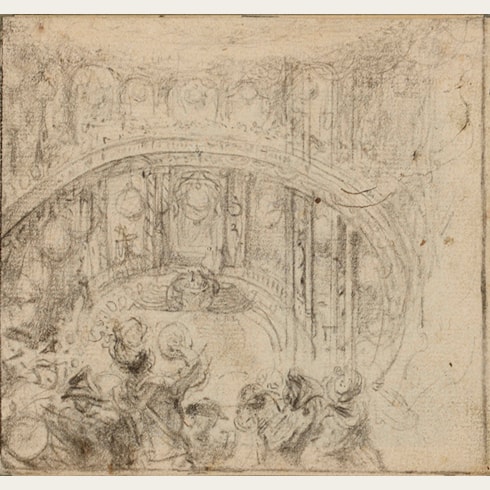
An Offering in a Temple
Pen and brown ink and red wash.
Laid down on a 19th century mount, with framing lines in black ink.
Inscribed Schafers Cat. No 269 at the lower left of the mount.
140 mm. (5 1/2 in.) diameter.
Laid down on a 19th century mount, with framing lines in black ink.
Inscribed Schafers Cat. No 269 at the lower left of the mount.
140 mm. (5 1/2 in.) diameter.
This refined 18th century French drawing exemplifies the Neoclassical taste that dominated academic art in the later decades of the Enlightenment. Executed in pen and brown ink with a delicate reddish wash, the composition demonstrates linear control and tonal modulation. The subject matter, a solemn offering before an altar in a grand classical interior, aligns with the period’s fascination with antiquity and morality drawn from Greco-Roman history and mythology. The draped figures in idealized poses, within an architectural interior of columns and domed ceiling, evoke the splendour of ancient Rome.
The firm yet graceful contours, the sculptural modelling of bodies and the compositional balance recall the work of Augustin Pajou (1730-1809), one of the leading sculptors of the French Neoclassical movement. Born into a family of sculptors in wood, Pajou entered the studio of the sculptor Jean-Baptiste Lemoyne at the age of fourteen. He won the Prix de Rome for sculpture in 1748, spending a few years at the Ecole Royale des Elèves Protegés before taking up his place at the French Academy in Rome in 1752. Agrée at the Académie Royale in 1759 and reçu the following year, at the age of thirty, Pajou produced portrait busts, religious sculptures and funerary monuments, as well as small-scale terracotta statuettes and reliefs for collectors. Among his public commissions were decorative reliefs for the Palais-Royal in Paris and the Royal opera house at Versailles, as well as sculptures and reliefs for the Parisian church of Saint-Roch and the cathedral of Sainte-Croix in Orléans. A gifted teacher, he was appointed an assistant professor of sculpture at the Académie Royale in 1762 and a full professor in 1766. From 1744 Pajou earned a significant number of Royal commissions from the Comte d’Angiviller, director of the Bâtiments du Roi under Louis XVI. He was named garde des antiques du roi in 1777, but with the coming of the Revolution lost his lodgings at the Louvre. Pajou spent the early 1790s in Montpellier and worked very little in the last decade or so of his life.
Pajou was an exceptional draughtsman and produced highly refined drawings in red chalk for his sculptural works, as well as a number of finished composition drawings intended for collectors and sometimes shown at the Salons. (In a review of the 1773 Salon, his draughtsmanship was praised as ‘recalling the noble style of Poussin; the architecture is rendered with taste, the groups are well arranged and the general effect is finely expressed.’) In addition, during his period of study as a pensionnaire at the Académie de France in Rome between 1752 and 1756, he made numerous pen and ink drawings after Greek and Roman antiquities in both Rome and Naples, as well copies after works by Renaissance and Baroque masters.
Somewhat comparable are a few highly finished drawings by Pajou which depict subjects of mythology or of the history of antiquity. These include a drawing representing The Roman Army under Camillus Assaulting the Temple of Juno at Veii in a private collection, and Lycurgus Presenting Their New King to the Spartans in the Musee des Beaux-Arts in Rouen.
The tondo framing of the present drawing echoes classical medallion formats. In the early 1770s, Pajou was responsible for creating a series of designs for medals and tokens, the majority of which are in black chalk. Amongst these is a large sheet commemorating the royal visit to Cherbourg, in the Bibliotèque Nationale, and another design commemorating the birth of the Dauphin de France, which appeared at auction in 2003.
The firm yet graceful contours, the sculptural modelling of bodies and the compositional balance recall the work of Augustin Pajou (1730-1809), one of the leading sculptors of the French Neoclassical movement. Born into a family of sculptors in wood, Pajou entered the studio of the sculptor Jean-Baptiste Lemoyne at the age of fourteen. He won the Prix de Rome for sculpture in 1748, spending a few years at the Ecole Royale des Elèves Protegés before taking up his place at the French Academy in Rome in 1752. Agrée at the Académie Royale in 1759 and reçu the following year, at the age of thirty, Pajou produced portrait busts, religious sculptures and funerary monuments, as well as small-scale terracotta statuettes and reliefs for collectors. Among his public commissions were decorative reliefs for the Palais-Royal in Paris and the Royal opera house at Versailles, as well as sculptures and reliefs for the Parisian church of Saint-Roch and the cathedral of Sainte-Croix in Orléans. A gifted teacher, he was appointed an assistant professor of sculpture at the Académie Royale in 1762 and a full professor in 1766. From 1744 Pajou earned a significant number of Royal commissions from the Comte d’Angiviller, director of the Bâtiments du Roi under Louis XVI. He was named garde des antiques du roi in 1777, but with the coming of the Revolution lost his lodgings at the Louvre. Pajou spent the early 1790s in Montpellier and worked very little in the last decade or so of his life.
Pajou was an exceptional draughtsman and produced highly refined drawings in red chalk for his sculptural works, as well as a number of finished composition drawings intended for collectors and sometimes shown at the Salons. (In a review of the 1773 Salon, his draughtsmanship was praised as ‘recalling the noble style of Poussin; the architecture is rendered with taste, the groups are well arranged and the general effect is finely expressed.’) In addition, during his period of study as a pensionnaire at the Académie de France in Rome between 1752 and 1756, he made numerous pen and ink drawings after Greek and Roman antiquities in both Rome and Naples, as well copies after works by Renaissance and Baroque masters.
Somewhat comparable are a few highly finished drawings by Pajou which depict subjects of mythology or of the history of antiquity. These include a drawing representing The Roman Army under Camillus Assaulting the Temple of Juno at Veii in a private collection, and Lycurgus Presenting Their New King to the Spartans in the Musee des Beaux-Arts in Rouen.
The tondo framing of the present drawing echoes classical medallion formats. In the early 1770s, Pajou was responsible for creating a series of designs for medals and tokens, the majority of which are in black chalk. Amongst these is a large sheet commemorating the royal visit to Cherbourg, in the Bibliotèque Nationale, and another design commemorating the birth of the Dauphin de France, which appeared at auction in 2003.
Provenance
Benjamin Wolff, Engelholm, Denmark (Lugt 420), with his drystamp at the lower centre
Thence by descent in the Wolff-Sneedorf family until 2018.
Thence by descent in the Wolff-Sneedorf family until 2018.