

David HOCKNEY
(Bradford 1937 - London 2026)
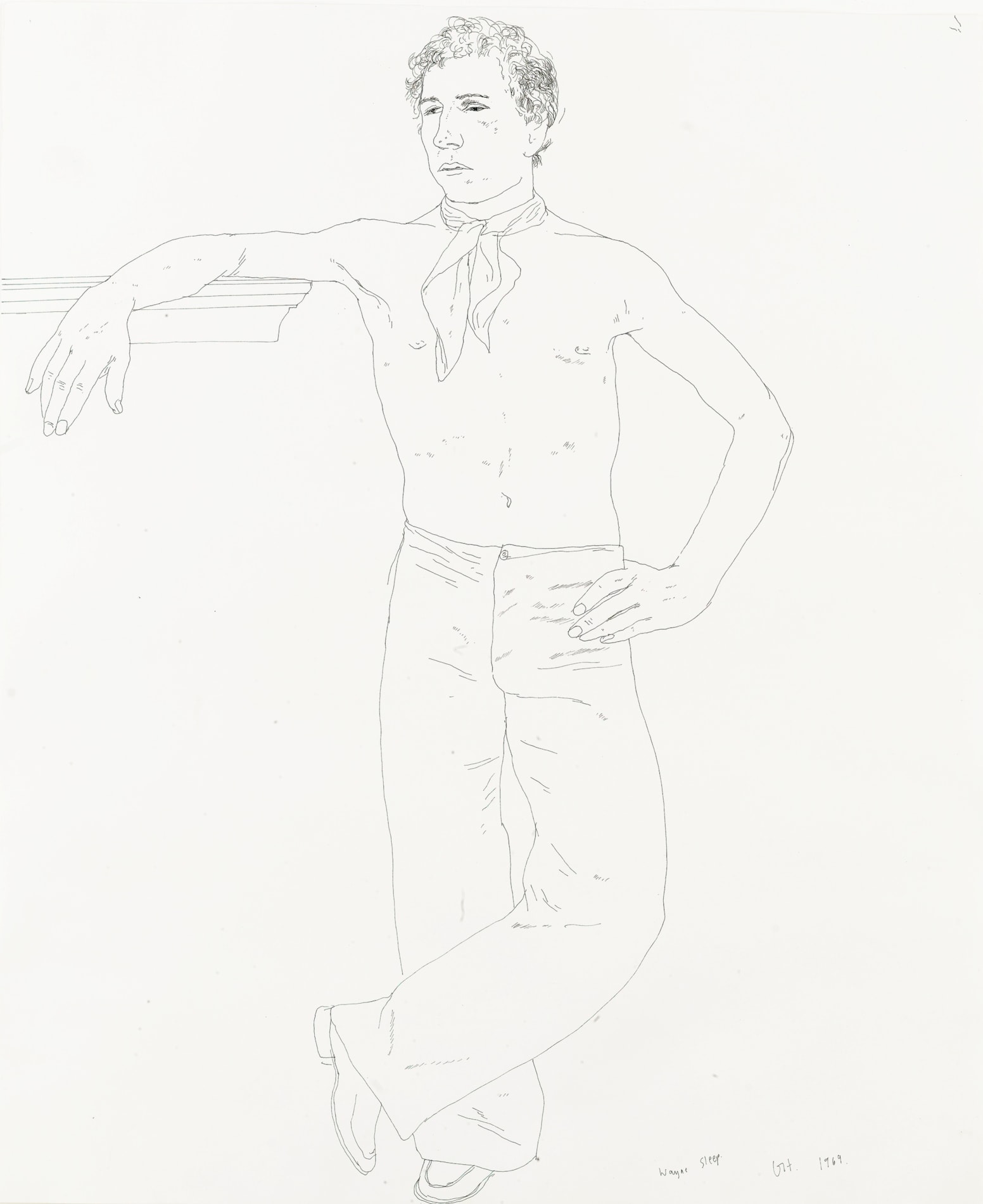
Wayne Sleep
Sold
Black ink on paper.
Inscribed, signed with initials and dated Wayne Sleep DH. 1969 at the lower right.
430 x 354 mm. (16 7/8 x 13 7/8 in.)
Inscribed, signed with initials and dated Wayne Sleep DH. 1969 at the lower right.
430 x 354 mm. (16 7/8 x 13 7/8 in.)
A splendid example of what are among Hockney’s most celebrated works, his pen and ink line portrait drawings, this is a portrait of the dancer Wayne Sleep (b.1948), who has modelled for the artist on several occasions. A principal dancer at the Royal Ballet, Sleep first met Hockney in 1967, a year after joining the company. The two were introduced by Lindy Dufferin, who had arranged for the artist to draw Rudolf Nureyev at the rehearsal studios of the Royal Ballet. Hockney and Sleep became good friends, and the artist was responsible for introducing Sleep to George Lawson, with whom he has since had a long relationship.
Despite the apparent facility with which these drawings are produced, the difficulty in defining a pose and likeness through outline alone, without tonal washes or shading, should not be underestimated. As the artist himself noted, ‘I never talk when I’m drawing a person, especially if I am making line drawings. I prefer there to be no noise at all so I can concentrate more. You can’t make a line too slowly, you have to go at a certain speed; so the concentration needed is quite strong. It’s very tiring as well. If you make two or three line drawings, it’s very tiring in the head, because you have to do it all at one go, something you’ve no need to do with pencil drawing; that doesn’t have to be done in one go; you can stop, you can rub out. With line drawings, you don’t want to do that. You can’t rub out line, mustn’t do it. It’s exciting doing it, and I think it’s harder than anything else; so when they succeed, they’re much better drawings, often. The failure rate amongst my line drawings is still high; I’m always tearing them up and putting crosses through them, because you can’t touch them up. If you draw the leg all wrong, you just have to throw it away.’
Between 1972 and 1975 Hockney worked on a large painting of Wayne Sleep and George Lawson, which he eventually abandoned. Set in Lawson’s London mews house, the painting showed him seated at a clavichord with Sleep standing in a doorway, listening to him playing. As Lawson recently recalled, ‘The pose was interesting...Wayne was looking at me at the keyboard, standing and listening. I think it was nice conceit that he had a ballet dancer not moving just listening.’4 However, Hockney soon found himself struggling with the painting. As he noted at the time, ‘in 1972, I began the painting of George Lawson and Wayne Sleep. Six months I worked on it, altering it, repainting it many times. It is documented, in its various stages. I kept taking photographs, thinking it was finished myself, and then deciding, it’s not right, no, that’s not right…I had a real struggle with it. Looking back now, two years later, I can see that the struggle was about naturalism, acrylic paint; it’s why I later abandoned acrylic paint and began to move away from naturalism.’
The present sheet, though drawn a few years earlier in 1969, is related to this unfinished painting in the pose of Sleep, who is shown standing with his legs crossed in the same way as in the drawing. Hockney may have referred to the present sheet when he came to develop the pose of Sleep in the painting.
Despite the apparent facility with which these drawings are produced, the difficulty in defining a pose and likeness through outline alone, without tonal washes or shading, should not be underestimated. As the artist himself noted, ‘I never talk when I’m drawing a person, especially if I am making line drawings. I prefer there to be no noise at all so I can concentrate more. You can’t make a line too slowly, you have to go at a certain speed; so the concentration needed is quite strong. It’s very tiring as well. If you make two or three line drawings, it’s very tiring in the head, because you have to do it all at one go, something you’ve no need to do with pencil drawing; that doesn’t have to be done in one go; you can stop, you can rub out. With line drawings, you don’t want to do that. You can’t rub out line, mustn’t do it. It’s exciting doing it, and I think it’s harder than anything else; so when they succeed, they’re much better drawings, often. The failure rate amongst my line drawings is still high; I’m always tearing them up and putting crosses through them, because you can’t touch them up. If you draw the leg all wrong, you just have to throw it away.’
Between 1972 and 1975 Hockney worked on a large painting of Wayne Sleep and George Lawson, which he eventually abandoned. Set in Lawson’s London mews house, the painting showed him seated at a clavichord with Sleep standing in a doorway, listening to him playing. As Lawson recently recalled, ‘The pose was interesting...Wayne was looking at me at the keyboard, standing and listening. I think it was nice conceit that he had a ballet dancer not moving just listening.’4 However, Hockney soon found himself struggling with the painting. As he noted at the time, ‘in 1972, I began the painting of George Lawson and Wayne Sleep. Six months I worked on it, altering it, repainting it many times. It is documented, in its various stages. I kept taking photographs, thinking it was finished myself, and then deciding, it’s not right, no, that’s not right…I had a real struggle with it. Looking back now, two years later, I can see that the struggle was about naturalism, acrylic paint; it’s why I later abandoned acrylic paint and began to move away from naturalism.’
The present sheet, though drawn a few years earlier in 1969, is related to this unfinished painting in the pose of Sleep, who is shown standing with his legs crossed in the same way as in the drawing. Hockney may have referred to the present sheet when he came to develop the pose of Sleep in the painting.
Long recognized as one of the finest draughtsmen of his generation, David Hockney began drawing from a very early age and continued to do so throughout his long career. Indeed, it may be argued that drawing was always his primary medium, lying as it did at the heart of his artistic process. As he has once stated, ‘It is the most immediate thing you can do as an artist. It is direct. Drawing gives you a confidence and it opens your eyes.’
The American art critic and curator Gene Baro, in an early account of the artist’s work on paper, noted that, ‘A Hockney drawing discovers its attitudes in process of being made; such ambiguity as it may possess is all of a piece and belongs to the person and the occasion. In short, Hockney does not impose a way of seeing upon what he sees; the drawings are, in effect, dialogues, rather than monologues…The drawings in colour…are more playful – and more wasteful, however charming. Usually, they are coloured drawings and not drawings in colour. The linear forms, patterns, and graphic energies are in no inevitable relationship to the hues. Colour serves rather as a gloss upon or support of the meaning as sheer line or pattern…But even at its most arbitrary or decorative Hockney’s colour will beguile the eye.’
The American art critic and curator Gene Baro, in an early account of the artist’s work on paper, noted that, ‘A Hockney drawing discovers its attitudes in process of being made; such ambiguity as it may possess is all of a piece and belongs to the person and the occasion. In short, Hockney does not impose a way of seeing upon what he sees; the drawings are, in effect, dialogues, rather than monologues…The drawings in colour…are more playful – and more wasteful, however charming. Usually, they are coloured drawings and not drawings in colour. The linear forms, patterns, and graphic energies are in no inevitable relationship to the hues. Colour serves rather as a gloss upon or support of the meaning as sheer line or pattern…But even at its most arbitrary or decorative Hockney’s colour will beguile the eye.’
Provenance
Gene Baro, Old Bennington, Vermont
Private collection
Anonymous sale, Boston, Skinner, 19 May 2006, lot 456
Anonymous sale, London, Christie’s, 17 November 2006, lot 120
Agnew’s, London, in 2007.