Pablo PICASSO
(Malaga 1881 - Mougins 1973)
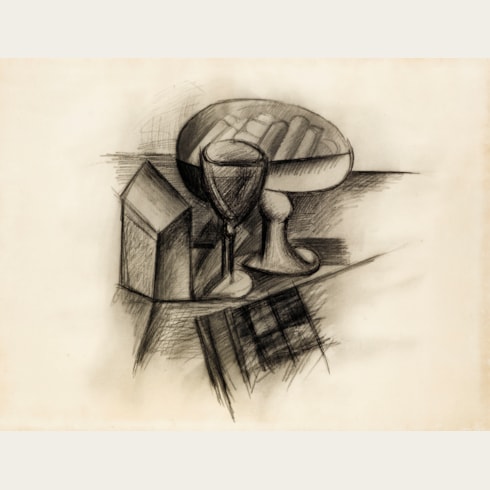
Still Life with a Teapot (La Théière)
Charcoal on paper.
Signed Picasso in black ink at the lower left.
317 x 485 mm. (12 1/2 x 19 1/8 in.)
Signed Picasso in black ink at the lower left.
317 x 485 mm. (12 1/2 x 19 1/8 in.)
During his early Cubist phase, Pablo Picasso painted a series of still life paintings and drawings, depicting jugs, pitchers, glasses, bowls and fruit on a table, in his Paris studio. These still life compositions, painted between 1907 and 1910, are characterized by simple geometric forms, depicted with a certain monumentality. As the artist’s biographer John Richardson has noted, ‘‘To take his mind off the Demoiselles, Picasso turned his attention to still life – a genre he had yet to tackle in any depth...Between the fall of 1907 and the spring of 1908, Picasso pitted himself against Cézanne in a series of deceptively simple-looking paintings of utilitarian objects – bowls, jars, saucers, jugs –...Picasso dramatizes and individualizes these mundane things so forcefully – as forcefully as Van Gogh in his Yellow Chair – that their very tension seems to reflect the tensions of their creator’s existence.’ Prominent among Picasso’s still life paintings of this period are such works as the Carafe and Three Bowls in the Hermitage in St. Petersburg, the Bowls and a Jug in the Philadelphia Museum of Art and the Bread and Fruit Dish on a Table in the Kunstmuseum in Basel.
Picasso’s still life compositions of this period display the influence of Paul Cézanne, filtered through a monumental Cubism, as was noted by the critic Léon Werth in a review of an exhibition at the Galerie Notre-Dame-des-Champs in Paris in 1910. Describing a still life painting by Picasso in the exhibition, Werth noted that it showed a ‘fruit-dish and glass, which display their structure, substructure, and superstructure and whose harmony, simplified as it is, is made up of the yellows and greens of certain Cézannes.’
It has been suggested that the composition of Picasso’s Cubist still life drawings, with the objects placed against a spare white background, may be due to the fact that in the autumn of 1909, Picasso and Fernande Olivier moved out of the Bateau-Lavoir studio in which the artist had lived worked for more than five years and settled into an apartment on the Boulevard de Clichy. The new apartment, as well as being larger and having more light than the old studio, was also relatively bare, since much of the contents of the Bateau-Lavoir studio remained packed in boxes.
Among similar works of the same medium and period by Picasso is a charcoal drawing of a still life of a bottle and an apple that was formerly in the collection of the French industrialist Roger Adolphe Dutilleul. Another large and stylistically comparable drawing of a carafe and other objects appeared at auction in 2002.
The first owner of this drawing was the pioneering American art historian and museum curator Alfred H. Barr, Jr. (1902-1981), who was an early champion of the work of Picasso in America. In 1929, aged just twenty-seven, Barr became the inaugural director of the Museum of Modern Art in New York, and ten years later mounted a major retrospective of the artist’s work, entitled Picasso: Forty Years of his Art, at the museum. It was around this time that Barr acquired the present sheet from the Parisian art dealer Pierre Loeb (1897-1954) - probably from an exhibition of drawings by Picasso held at Loeb’s Galerie Pierre in January 1939 - for the sum of 1,500 francs. The present sheet was later inherited by Barr’s daughter, the abstract painter Victoria Barr (1937-2025).
Picasso’s still life compositions of this period display the influence of Paul Cézanne, filtered through a monumental Cubism, as was noted by the critic Léon Werth in a review of an exhibition at the Galerie Notre-Dame-des-Champs in Paris in 1910. Describing a still life painting by Picasso in the exhibition, Werth noted that it showed a ‘fruit-dish and glass, which display their structure, substructure, and superstructure and whose harmony, simplified as it is, is made up of the yellows and greens of certain Cézannes.’
It has been suggested that the composition of Picasso’s Cubist still life drawings, with the objects placed against a spare white background, may be due to the fact that in the autumn of 1909, Picasso and Fernande Olivier moved out of the Bateau-Lavoir studio in which the artist had lived worked for more than five years and settled into an apartment on the Boulevard de Clichy. The new apartment, as well as being larger and having more light than the old studio, was also relatively bare, since much of the contents of the Bateau-Lavoir studio remained packed in boxes.
Among similar works of the same medium and period by Picasso is a charcoal drawing of a still life of a bottle and an apple that was formerly in the collection of the French industrialist Roger Adolphe Dutilleul. Another large and stylistically comparable drawing of a carafe and other objects appeared at auction in 2002.
The first owner of this drawing was the pioneering American art historian and museum curator Alfred H. Barr, Jr. (1902-1981), who was an early champion of the work of Picasso in America. In 1929, aged just twenty-seven, Barr became the inaugural director of the Museum of Modern Art in New York, and ten years later mounted a major retrospective of the artist’s work, entitled Picasso: Forty Years of his Art, at the museum. It was around this time that Barr acquired the present sheet from the Parisian art dealer Pierre Loeb (1897-1954) - probably from an exhibition of drawings by Picasso held at Loeb’s Galerie Pierre in January 1939 - for the sum of 1,500 francs. The present sheet was later inherited by Barr’s daughter, the abstract painter Victoria Barr (1937-2025).
‘I do not know if I am a great painter, but I am a great draughtsman.’ (Picasso to Max Jacob).
Provenance
Pierre Loeb (Galerie Pierre), Paris
Acquired from him in c.1939 by Alfred H. Barr Jr., New York
On loan to the Museum of Modern Art, New York
By descent to Barr's daughter Victoria Barr, New York.
Acquired from him in c.1939 by Alfred H. Barr Jr., New York
On loan to the Museum of Modern Art, New York
By descent to Barr's daughter Victoria Barr, New York.
Literature
Christian Zervos, Pablo Picasso. Vol.2*: Oeuvres de 1906 à 1912, Paris, 1942, pl.90, no.182 (where dated Winter 1909).
Exhibition
New York, Metropolitan Museum of Art, Summer Loan Exhibition: Paintings, drawings and sculpture from private collections, 1966, no.22 (‘Teapot’, lent anonymously).