John MINTON
(Great Shelford 1917 - London 1957)
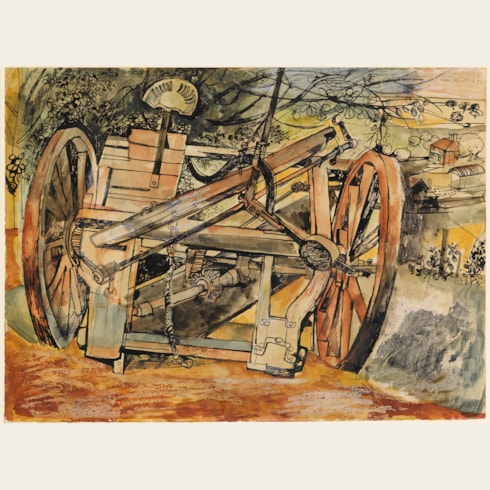
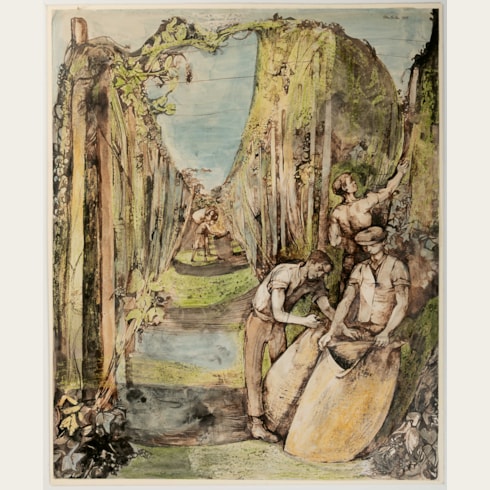
Little Pink House
Sold
Pen and brown ink and brown wash, pencil and watercolour, with touches of white heightening. Laid down.
Signed and dated John Minton 1945 at the upper right.
279 x 387 mm. (11 x 15 1/4 in.)
Signed and dated John Minton 1945 at the upper right.
279 x 387 mm. (11 x 15 1/4 in.)
Drawn in 1945, this fine sheet is a splendid example of John Minton’s landscape draughtsmanship. The artist’s biographer Frances Spalding has suggested that this drawing may depict ‘Marshalls’, the home of his friends Edie and Newton Lamont in the village of Chart Sutton in Kent. Minton had met Edie Lamont in the 1930s when both were students at the St. John’s Wood Art School, and they remained good friends for many years afterward. Between 1945 and 1954 Minton would occasionally escape postwar London to stay with the Lamonts at ‘Marshalls’, with its view over the Weald of Kent, and make sketching trips with Edie around the countryside, at such places as Forstall, Frittenden, Little Chart and Tenterden. As Spalding recounts, ‘From [Edie’s] diaries we know that Minton made between two and four visits to ‘Marshalls’ every year up until 1954, staying usually a couple of nights and returning to London with sheaves of drawings…His Kent landscapes had contributed significantly to the success of his 1945 Rowland, Browse and Delbanco exhibition, soon after which he tried to interest the same gallery in Edie Lamont’s work…Minton’s friends were aware that Edie Lamont was an important figure in Minton’s life, but most knew little or nothing about her. He deliberately kept the Lamonts in a separate compartment, their home providing him with a place to refuel in company he enjoyed and in countryside he loved.’ Another drawing by Minton of ‘Marshalls’ and its garden, seen from a different angle, appeared at auction in London in 1993.
The present sheet may have been among a number of Minton’s Kent drawings that were exhibited at the newly-opened Rowland, Browse and Delbanco Gallery in London in 1945, the same year it was drawn. As Spalding writes, ‘Meanwhile [Minton’s] landscape drawings had become much sought after. He held two one-man exhibitions in 1945: one in the top floor gallery at the recently opened Roland, Browse and Delbanco of drawings of Kent and Cornwall; the other at the Lefevre Gallery. Both shows sold well, Minton’s drawings at this time fetching between ten and twenty guineas.’
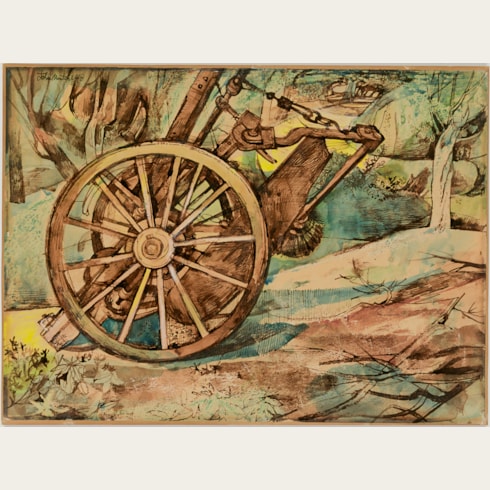
Among stylistically comparable works is Sunflowers, signed and dated 1945, which was purchased from the Rowland, Browse and Delbanco exhibition by the Victoria and Albert Museum.
Although he had only a relatively brief career before his death at the age of thirty-nine, John Minton was enormously prolific and achieved a great deal of success in his lifetime. Between 1945 and 1956 he had eight one-man shows, mainly at the Lefevre Gallery in London, as well as taking part in a number of group shows and the Royal Academy Summer exhibitions. Alongside his output as a painter and draughtsman, he provided numerous illustrations for books, book jackets, magazines and advertisements, and also designed posters, wallpaper and stage sets.
While he enjoyed considerable early success, by the 1950’s Minton’s work was becoming overshadowed by that of other artists in his circle, notably Lucian Freud and Francis Bacon. As a friend of his later wrote, ‘He saw himself as overtaken by fashions in art – abstract expressionism among others – for which he had no liking. While others of his contemporaries – Lucien Freud, Francis Bacon, Keith Vaughan - held their ground and came through, Minton saw himself as obsolete, as eccentric and old-fashioned as Edward Lear. He could not come to terms with new developments and he lost faith in his own talent…He was, I suppose, one of those kingfisher-like specimens whose bright plumage briefly glinted then was gone. It might, perhaps, have been different in other circumstances; a little more patience and he could have survived the disorienting shifts in taste.’
Minton devoted much of his later career to teaching, in particular at the Royal College of Art, and was a popular and inspirational figure among his students. As Frances Spalding has written of him, ‘Minton’s virtuoso performances with pencil or pen and ink commended him as a teacher. His students aspired to his dexterity and adopted his devices.’ Minton died, by his own hand, in January 1957.
Provenance
Possibly Edie Lamont, ‘Marshalls’, Chart Sutton, Kent
Private collection, United Kingdom
Anonymous sale, London, Bonham’s, 29 June 2011, lot 69
Day and Faber, London
Diane Nixon, New York.
Private collection, United Kingdom
Anonymous sale, London, Bonham’s, 29 June 2011, lot 69
Day and Faber, London
Diane Nixon, New York.
Exhibition
Possibly London, Arts Council Gallery, and elsewhere, John Minton 1917-1957: An Exhibition of Paintings, Drawings and Illustrations, 1958-1959, no.44 (‘Marshalls Garden 1945. Indian Ink. 10 3/4 x 14 3/4 in. Lent by Mrs. E. Lamont’).