Honoré DAUMIER
(Marseille 1808 - Valmondois 1879)
Au Théâtre (La loge)
Pen and brown ink, brown wash, and watercolour.
Signed with initials h.D. in black ink at the lower right.
220 x 281 mm. (8 5/8 x 11 1/8 in.) [sheet]
Signed with initials h.D. in black ink at the lower right.
220 x 281 mm. (8 5/8 x 11 1/8 in.) [sheet]
Most of Honoré Daumier’s surviving watercolours can be dated to the 1860s, when the artist produced finished works intended for sale to dealers and collectors. As Colta Ives has pointed out, ‘The medium of watercolor proved much more responsive to the artist’s hand than oil paint and allowed the vigor of his drawing to show through…It might be said that Daumier’s most finished watercolors of this period represent the surrender of his naturally unadorned draughtsmanship to the prejudices of current fashion.’ Daumier had a lifelong interest in the theatre and in theatre audiences, and a particular interest in studying a group of people watching a performance. As has been noted, ‘Spectators at the theatre was another subject which Daumier had treated often enough in lithographs, and which might have struck him as good for private sales of watercolours. An inveterate spectator himself, Daumier also liked to draw people watching each other…Daumier had been drawing cartoons of theatre audiences for Charivari during most of his career, but this subject is not found in his oil paintings and watercolours before about 1860.’
Datable to the first half of the 1860s, this exceptional watercolour - which has been aptly described as ‘stylistically and technically a very unusual drawing in Daumier’s oeuvre’ - is closely related to the artist’s sketchy, unfinished painting Orchestra Stalls (Fauteuils d’orchestre) of c.1865, today in the Cincinnati Art Museum in Ohio. Both works are unusual in Daumier’s oeuvre, as he rarely depicted elegantly dressed figures at the theatre, preferring to focus on ‘common’ spectators. A painting by Daumier of a similar subject, Une loge de théâtre, was formerly in the Robert Von Hirsch collection in Basel and was sold at auction in 1979, while a handful of other paintings of spectators at a theatre are known; in the Walters Art Museum in Baltimore, the Neue Pinakothek in Munich, the Bridgestone Museum in Tokyo, the National Gallery of Art in Washington, D.C, and elsewhere.
The Daumier scholar K. E. Maison has noted of the present sheet that ‘M. Adhémar very rightly comments on the resemblance of Manet’s pastel portraits of women to the treatment of the profiles in this watercolor. It is, of course, quite possible that Manet knew this study.’ Another scholar has further noted of this watercolour that ‘Color plays a far more important part in this work than in Daumier’s other watercolors. Furthermore, the work is fairly exceptional in its stress on feminine charms, not normally a preoccupation with this artist…In this watercolor, we find a more complex attitude, possibly hinting at secret longings. In front of two fashionable ladies, who are elegant enough but cold and unattractive, we are shown a somewhat languorous girl or young woman. The face, given in one-quarter view, has a lovely curving line; her cheek is smooth, the neck supple and unwrinkled. From her emanates an innate grace which, we feel, Daumier must have gazed at lovingly.’ Yet another writer, in one of the first published references to the present sheet, noted that ‘In this powerful study of physiognomies the modelling of the two men’s heads at the back is of surprising vigour.’
Daumier rarely portrayed women in his theatre subjects, which tend to focus almost exclusively on a masculine audience. In stylistic terms, this fine watercolour can be likened to a brush and ink drawing by Daumier of the profile of a woman, formerly in the collections of Claude Roger-Marx and Maurice Gobin, which is a study for the woman in the centre of the present composition. Also somewhat similar is an unfinished oil sketch by Daumier of the bust of a woman in profile, in the Dumbarton Oaks House Collection in Washington, D.C.
The first owner of the present sheet was French industrialist, engineer, painter and art collector Henri Rouart (1833-1912), who assembled a fine group of works by Daumier, amounting to thirteen paintings and some thirty-three drawings and watercolours. As noted in an article published shortly after the collector’s death, in which the present sheet was reproduced for the first time, ‘far-seeing as he always proved himself, M. Henri Rouart very early began to appreciate the genius of Daumier, and sought after his works with avidity…he realised that in Daumier we have an admirable painter who has created for himself an absolutely personal métier, and who has expressed with unequalled grandeur the passions of his great soul.’ Although included in the posthumous sale of Henri Rouart’s collection in 1912, this watercolour was acquired soon afterwards by his son Ernest Rouart (1874-1942), a painter and collector who had married Julie Manet, the daughter of Berthe Morisot and Eugène Manet.
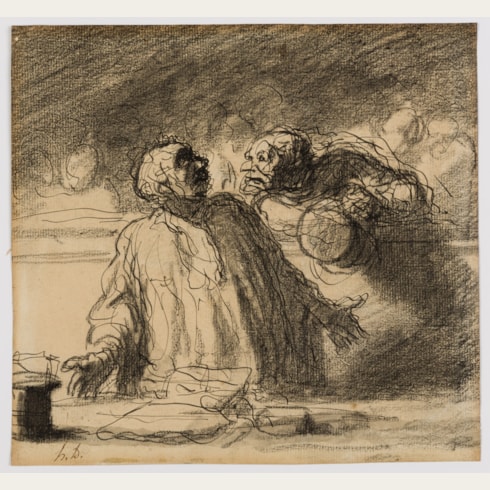
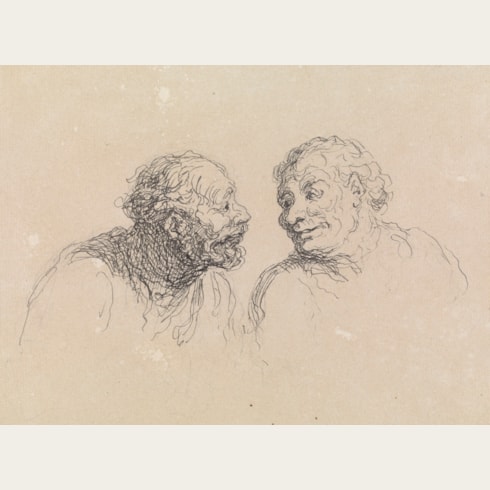
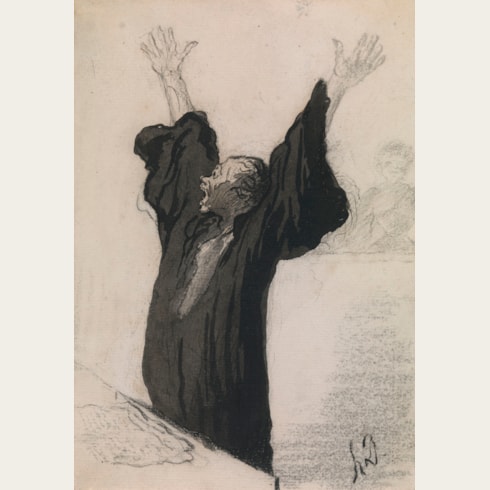
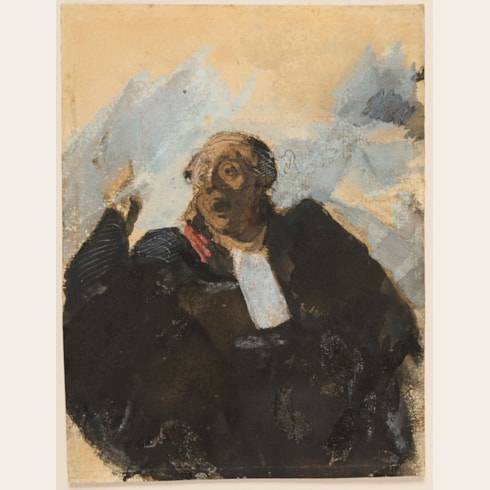
Born in Marseille but raised in Paris, Honoré Daumier was almost never to leave the city, and made its people the subject of much of his work. Although he attended life drawing classes at the Académie Suisse, he had little formal artistic training and was, for the most part, self-taught. He began his career as an illustrator and lithographer, providing images and political caricatures for newspapers and magazines such as La Silhouette, La Caricature and, most famously, Le Charivari. He soon established a formidable reputation as a caricaturist. Over the course of his life, Daumier produced over four thousand lithographs and some eight hundred drawings and watercolours. The drawings were mainly done during periods in his career – in the late 1840s and early 1850s, and again in the 1860s - when the artist’s time was not completely devoted to his commercial work as a lithographer. In the 1860s, for example, when he was temporarily laid off by Le Charivari, Daumier produced a number of highly finished and elaborate watercolours to be sold to collectors.
As a draughtsman, Daumier tended to depict a handful of favourite themes, notably carnival performers, women and children, people on trains and in railway stations, and the law courts. Working in chalk, charcoal, watercolour, pen and ink and wash, he created both finished drawings and watercolours for sale, as well as sketches or studies and quick ‘notes’. As the critic Claude Roger-Marx wrote of the artist, ‘When Daumier drew to please himself and without thought of a purchaser, it was nearly always with the pen or with charcoal; sometimes with a Conté crayon, very seldom with a lead pencil. To an expansive genius, driven by the power of his imagination, charcoal gives the greatest scope, enabling him to pass in an instant from the most velvety black to silvery grey, to stress contrasting values, to make the most of the qualities of shimmering light which transform the charcoal powder into a modest form of pastel…The pen in Daumier’s inspired fingers was no less rapid: we may follow its course across the surface of the smooth laid paper which he used for choice. It runs lightly, leaving furrows as though seared by fire, and, like the charcoal, it never fails to achieve a miracle...’ Daumier’s drawings are very rarely dated and are often unsigned, and only a very few were exhibited in his lifetime.
As a draughtsman, Daumier tended to depict a handful of favourite themes, notably carnival performers, women and children, people on trains and in railway stations, and the law courts. Working in chalk, charcoal, watercolour, pen and ink and wash, he created both finished drawings and watercolours for sale, as well as sketches or studies and quick ‘notes’. As the critic Claude Roger-Marx wrote of the artist, ‘When Daumier drew to please himself and without thought of a purchaser, it was nearly always with the pen or with charcoal; sometimes with a Conté crayon, very seldom with a lead pencil. To an expansive genius, driven by the power of his imagination, charcoal gives the greatest scope, enabling him to pass in an instant from the most velvety black to silvery grey, to stress contrasting values, to make the most of the qualities of shimmering light which transform the charcoal powder into a modest form of pastel…The pen in Daumier’s inspired fingers was no less rapid: we may follow its course across the surface of the smooth laid paper which he used for choice. It runs lightly, leaving furrows as though seared by fire, and, like the charcoal, it never fails to achieve a miracle...’ Daumier’s drawings are very rarely dated and are often unsigned, and only a very few were exhibited in his lifetime.
Provenance
Henri Rouart, Paris
His posthumous sale, Paris, Galerie Manzi-Joyant, 16-18 December 1912, lot 33 (bt. Chialiva for 8,000 francs)
Luigi Chialiva, Berlin and Paris
Ernest Rouart, Paris
By descent to his son, Henri ‘Julien’ Eugène Rouart, Paris
By descent to his wife, Thérèse Garrigues Rouart, Paris
Her posthumous sale (‘Important dessins et tableaux impressionists, provenant de la succession de Madame Julien Rouart’), Paris, Drouot Montaigne, 27 November 1997, lot 24 (sold for FF 1,150,000)
Anonymous sale, London, Christie’s, 17 November 2005, lot 79
Nahmad Collection, Switzerland
With Crane Kalman Gallery, London, in 2014
Private collection, London.
Literature
Henri Franz, ‘The Rouart Collection: II. The Works of Daumier’, The International Studio, May 1913, p.192, illustrated p.189; Erich Klossowski, Honoré Daumier, Munich, 1923, p.93, no.89, illustrated pl.61 (as Loge de theatre); Raymond Escholier, Daumier, Peintre et Lithographe, Paris, 1923, illustrated in colour facing p.136; Charles Martine, ed., Dessins de maitres français IV. Honoré Daumier: Cinquante reproductions, Paris, 1924, no.15, pl.15; Charles Baudelaire, Ars Graphica. Les dessins de Daumier, Paris, 1924, pl.49; Edouard Fuchs, Der Maler Daumier, Munich, 1930, p.28, no.253b, pl.253b; New York, Museum of Modern Art, Corot Daumier, exhibition catalogue, 1930, no.97, pl.97 (as At the Theatre); French Art: An Illustrated Souvenir of the Exhibition of French Art at the Royal Academy of Arts, London, London, 1932, p.87, no.912; Marie Dormoy, ‘The Ernest Rouart Collection’, Formes, April 1932, p.259, illustrated between pp.258 and 259; Commemorative Catalogue of the Exhibition of French Art at Burlington House, London, 1933, no.807; Jacques Lassaigne, Daumier, Paris, 1938, illustrated in colour p.129 (as The Audience); Maurice Sachs, Honoré Daumier, Paris, n.d. [1939?], pl.34; Jacques Lassaigne, Daumier, Paris, 1946, p.37; Jean Adhémar, Honoré Daumier, Paris, 1954, illustrated in colour pl.137; Curt Schweicher, Daumier, London, 1954, pl.51; Jean Adhémar and Claude Roger-Marx, Honoré Daumier: Drawings and Watercolours, New York and Basel, 1954, p.22, no.21, pl.21; K. E. Maison, Daumier Drawings, London and New York, 1960, p.26, pl.106 (as A Box in the Theater); Robert Rey, Honoré Daumier, London, 1966, pp.128-129 (as Five Spectators); K. E. Maison, Honoré Daumier: Catalogue Raisonné of the Paintings, Watercolours and Drawings, Volume I: The Paintings, London, 1967, pp.154-155,under nos. I-187 and I-188; K. E. Maison, Honoré Daumier: Catalogue Raisonné of the Paintings, Watercolours and Drawings, Volume II: The Watercolours and Drawings, London, 1967, p.167,no.498 and p.164, under no.488, illustrated pl.169; Luigi Barzini and Gabriele Mandel, L’opera pittorica completa di Daumier, Milan, 1971, pp.108-109, under no.239, no.2391, fig.2391; Roger Passeron, Daumier, Oxford, 1981, p.203; Henri Loyrette et al, Daumier 1808-1879, exhibition catalogue, Ottawa, Paris and Washington DC, 1999-2000, p.420, illustrated p.418, fig.3; Catherine Lampert and Ann Dumas, ed., Daumier (1808-1879): Visions of Paris, exhibition catalogue, London, 2013-2014, p.16, p.207, illustrated p.153, no.88.
Exhibition
Paris, Palais de l’Ecole des Beaux-Arts, Exposition Daumier, 1901, no.273; Paris, Maison de Victor Hugo, Exposition Daumier et Gavarni, 1923, no.36; Paris, Galerie Dru, Aquarelles et dessins de Daumier, 1927, no.17; New York, Museum of Modern Art, Eighth Loan Exhibition: Corot Daumier, 1930, no.97; London, Royal Academy of Arts, Exhibition of French Art 1200-1900, 1932, no.912; Paris, Musée de l’Orangerie, Daumier: Peintures aquarelles dessins, 1934, no.92; London, The Leicester Galleries, Exhibition of Paintings, Drawings & Lithographs by Honoré Daumier (1808-1879), June 1936, no.61; Vienna, Albertina, Honoré Daumier: Zeichnungen, Aquarelle, Lithographen, Kleinplastiken, 1936, no.15; Paris, Palais National des Arts, Chefs d’oeuvre de l’art français, 1937, no.624; Paris, Galerie Sagot-Le Garrec, Daumier sculpteur, lithographe et dessinateur, 1957, no.34; London, Royal Academy of Arts, Daumier (1808-1879): Visions of Paris, 2013-2014, no.88.