Avigdor ARIKHA
(Rădăuți 1928 - Paris 2010)
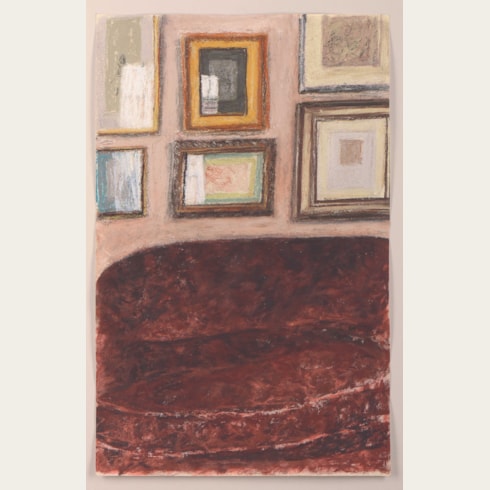
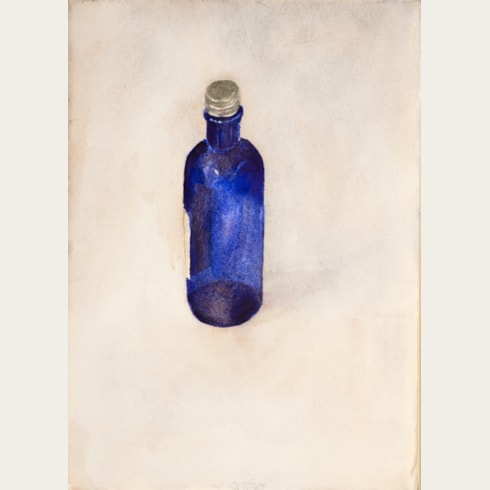
Coin Purse
Pastel.
Signed and dated Arikha 86 in pencil at the lower centre edge.
Inscribed For Janie in pencil at the lower left and Happy birthday 23.IV.87 in pencil at the lower right and along the bottom of the right edge of the sheet.
237 x 155 mm. (9 3/8 x 6 1/8 in.)
Signed and dated Arikha 86 in pencil at the lower centre edge.
Inscribed For Janie in pencil at the lower left and Happy birthday 23.IV.87 in pencil at the lower right and along the bottom of the right edge of the sheet.
237 x 155 mm. (9 3/8 x 6 1/8 in.)
The present sheet belongs with a group of pastel drawings that Avigdor Arikha produced in the 1980s. As the artist later recalled, writing in the introduction to the catalogue of an exhibition of his pastels held in 2007, in which this work was included, ‘One winter afternoon, during the first months of 1983, I was present at the arrival and unpacking of a crate at the Cabinet des Dessins of the Louvre. It contained the pastel-portrait of Madame Tronchin by Jean-Etienne Liotard. Its impact was such that I rushed to get pastels on the very next morning. I had not practiced this medium since the early ‘50s...The twenty-five pastel paintings in this exhibition were never exhibited nor published, remaining hidden in their drawer until now.’ The use of pastel became an important part of Arikha’s artistic process, and the medium was applied not only to drawing paper or tinted board, but also soft velvet paper and emery paper.
Drawn in 1986, this pastel was presented by the artist the following year, as a birthday gift, to the art dealer and museum curator Janie C. Lee (1937-2024). Lee mounted exhibitions of Arikha’s work in her gallery in Houston, Texas, in 1974 and 1979.
Drawn in 1986, this pastel was presented by the artist the following year, as a birthday gift, to the art dealer and museum curator Janie C. Lee (1937-2024). Lee mounted exhibitions of Arikha’s work in her gallery in Houston, Texas, in 1974 and 1979.
Arguably one of the finest draughtsmen of the second half of the 20th century, Avigdor Arikha was born to German-speaking Jewish parents in Romania in 1929. The drawings he produced as a thirteen-year old boy while imprisoned in a Ukrainian labour camp brought him to the attention of the International Red Cross, who in 1944 rescued him and sent him to a kibbutz in Palestine. After a period of study at the Bezalel Academy of Fine Arts in Jerusalem, Arikha went to Paris in 1949, where he completed his training at the Ecole des Beaux-Arts. He had his first solo exhibitions in Tel Aviv and Jerusalem in 1952 and 1953, and eventually settled in Paris in 1954, studying philosophy at the Sorbonne and establishing lifelong and intimate friendships with Samuel Beckett and Alberto Giacometti. Arikha began his career as an abstract painter, but in 1965 abandoned painting completely, and spent the next eight years working on black and white drawings, as well as a series of monochromatic etchings. By the time he returned to painting in 1973, he had become a committed figurative painter, producing portraits of family and friends, interior scenes and still life subjects. Arikha’s work was the subject of numerous gallery and museum exhibitions in Europe and America throughout his career, with large retrospective exhibitions held in Tel Aviv, Jerusalem and Edinburgh in 1998-1999 and London in 2006.
Provenance
Presented by the artist to Janie Curry Lee, New York and Houston, in April 1987
Thence by descent.
Thence by descent.