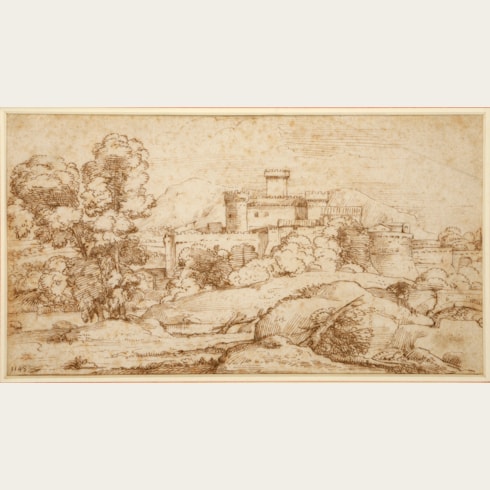
Giovanni Francesco GRIMALDI
(Bologna 1606 - Rome 1680)
A Design for the Spanish Steps in Rome, with a Bird’s-Eye View of the Same
Pen and brown ink, over traces of an underdrawing in red chalk, laid down on another sheet of paper.
Numbered 2 in brown ink at the lower right.
A plan of a circular palace faintly drawn in brown ink on the verso.
259 x 223 mm. (10 1/8 x 8 3/4 in.)
Numbered 2 in brown ink at the lower right.
A plan of a circular palace faintly drawn in brown ink on the verso.
259 x 223 mm. (10 1/8 x 8 3/4 in.)
In 1997, when the present sheet by Giovanni Francesco Grimaldi first appeared at auction, the scholar Isabella Lodi-Fé Chapman had tentatively suggested that it might be related to the construction of the Villa Doria Pamphili, just outside the walls of Rome, directed by Alessandro Algardi with the assistance of Grimaldi. The commission had been given to Algardi by Camillo Pamphili, nephew of Pope Innocent X. However, as some contemporary biographers note, Algardi had little experience in architecture and relied to a large extent on Grimaldi’s help; indeed, some sources refer to Grimaldi, and not Algardi, as the architect responsible for the Villa Pamphili.
The present sheet, however, is more likely to be related to Grimaldi’s proposed design for the Spanish Steps in Rome, a monumental stairway which leads steeply down from the French church of the Trinità dei Monti on the Pincian Hill to the Piazza di Spagna at the bottom. The design and construction of the Spanish Steps was among the most significant urban architectural projects of the Baroque period in Rome. In 1660 Grimaldi is known to have provided a finished drawing of his design for the steps in front of the Trinità dei Monti for Cardinal Mazarin in Paris, who had taken charge of the project. Abbot Elpidio Benedetti, the Cardinal’s agent in Rome, sent Mazarin four different designs for the Scalinata di Trinità dei Monti; one by the young French architect François d’Orbay and another by Carlo Rainaldi, both sent to Paris on 19 August 1660, and a further two, one by Grimaldi drawn on blue paper (‘carta turchina’) and the other by Benedetti himself3, included with a letter dated 21 October 1660. In this second letter to Mazarin, Benedetti writes, ‘I am sending Your Eminence...a tin box containing two drawings for the staircase to be built at the Trinità de Monti. One, on blue paper, is by Giovanni Francesco [Grimaldi] Bolognese, who has already painted in Your Eminence’s palace, vague, sensational, and very expensive, more suitable for a garden than for a street…’ It has been suggested the proposal by Grimaldi sent to Mazarin can be identified with an elaborate, finished drawing for the Scalinata and the façade of the church of the Trinità dei Monti, today in the collection of the Kunstbibliothek in Berlin5.
This drawing appears to represent Grimaldi’s working design for the Scalinata di Trinità dei Monti, incorporating Mazarin’s specification of a pair of grand semicircular staircases leading from the front of the church to the piazza at the bottom, as well as a fountain with reclining river gods, presumably representing the Seine and the Tiber. The drawing only depicts one half of the design, since it would have been mirrored at the left side. Grimaldi’s aerial perspective view of the Steps is supplemented by a schematic sketch of the same, drawn at the top of the sheet.
From the bottom of the composition, a curved staircase flanked by trees leads up from the Piazza di Spagna to the first landing, where a prominent oval arcade leads further upwards to the next level. At the beginning of this arcade can be seen an oval portrait medallion of a man in profile, presumably King Louis XIV of France, supported on each side by putti. A sloping ramp leads from the right edge to the second level, where it meets the arcade in front of a curved façade next to an arched opening. Above this is a colonnade that runs in front of the façade of the Trinità dei Monti church, surmounted by a balustrade looking out over the city. This drawing also appears to depict two windows and the façade of the Keats-Shelley House, which sits at the base of the Steps at the bottom of the Pincian Hill, at the lower right of the composition. Built around 1600, the house, at Piazza di Spagna 26, was given a new façade around 1724-1725 by the little-known architect Francesco de Sanctis, who had also won the prized commission to build the Spanish Steps.
It has been suggested that one reason that Grimaldi’s design for the Scalinata was not adopted was that it may have been seen to echo too closely Gianlorenzo Bernini’s design for the square in front of the Basilica of St. Peter’s in Rome, with its monumental curving colonnades, which was under construction at the same time. Nevertheless, the present day appearance of the iconic Spanish Steps, as eventually designed and constructed by de Sanctis in the first quarter of the 18th century, owes much to the visual concepts developed by Grimaldi in drawings such as the present sheet.
The present sheet, however, is more likely to be related to Grimaldi’s proposed design for the Spanish Steps in Rome, a monumental stairway which leads steeply down from the French church of the Trinità dei Monti on the Pincian Hill to the Piazza di Spagna at the bottom. The design and construction of the Spanish Steps was among the most significant urban architectural projects of the Baroque period in Rome. In 1660 Grimaldi is known to have provided a finished drawing of his design for the steps in front of the Trinità dei Monti for Cardinal Mazarin in Paris, who had taken charge of the project. Abbot Elpidio Benedetti, the Cardinal’s agent in Rome, sent Mazarin four different designs for the Scalinata di Trinità dei Monti; one by the young French architect François d’Orbay and another by Carlo Rainaldi, both sent to Paris on 19 August 1660, and a further two, one by Grimaldi drawn on blue paper (‘carta turchina’) and the other by Benedetti himself3, included with a letter dated 21 October 1660. In this second letter to Mazarin, Benedetti writes, ‘I am sending Your Eminence...a tin box containing two drawings for the staircase to be built at the Trinità de Monti. One, on blue paper, is by Giovanni Francesco [Grimaldi] Bolognese, who has already painted in Your Eminence’s palace, vague, sensational, and very expensive, more suitable for a garden than for a street…’ It has been suggested the proposal by Grimaldi sent to Mazarin can be identified with an elaborate, finished drawing for the Scalinata and the façade of the church of the Trinità dei Monti, today in the collection of the Kunstbibliothek in Berlin5.
This drawing appears to represent Grimaldi’s working design for the Scalinata di Trinità dei Monti, incorporating Mazarin’s specification of a pair of grand semicircular staircases leading from the front of the church to the piazza at the bottom, as well as a fountain with reclining river gods, presumably representing the Seine and the Tiber. The drawing only depicts one half of the design, since it would have been mirrored at the left side. Grimaldi’s aerial perspective view of the Steps is supplemented by a schematic sketch of the same, drawn at the top of the sheet.
From the bottom of the composition, a curved staircase flanked by trees leads up from the Piazza di Spagna to the first landing, where a prominent oval arcade leads further upwards to the next level. At the beginning of this arcade can be seen an oval portrait medallion of a man in profile, presumably King Louis XIV of France, supported on each side by putti. A sloping ramp leads from the right edge to the second level, where it meets the arcade in front of a curved façade next to an arched opening. Above this is a colonnade that runs in front of the façade of the Trinità dei Monti church, surmounted by a balustrade looking out over the city. This drawing also appears to depict two windows and the façade of the Keats-Shelley House, which sits at the base of the Steps at the bottom of the Pincian Hill, at the lower right of the composition. Built around 1600, the house, at Piazza di Spagna 26, was given a new façade around 1724-1725 by the little-known architect Francesco de Sanctis, who had also won the prized commission to build the Spanish Steps.
It has been suggested that one reason that Grimaldi’s design for the Scalinata was not adopted was that it may have been seen to echo too closely Gianlorenzo Bernini’s design for the square in front of the Basilica of St. Peter’s in Rome, with its monumental curving colonnades, which was under construction at the same time. Nevertheless, the present day appearance of the iconic Spanish Steps, as eventually designed and constructed by de Sanctis in the first quarter of the 18th century, owes much to the visual concepts developed by Grimaldi in drawings such as the present sheet.
Giovanni Francesco Grimaldi, known as ‘Il Bolognese’, received his artistic training in his native city of Bologna, adopting the local interest in landscape drawing fostered by the Carracci and their Accademia degli Incamminati. By 1627 he was working in Rome, where he profited from his study of the works of the Carracci and their followers there, and in particular their approach to landscape. Grimaldi earned commissions from several noble Roman families, including the Barberini, Borghese, Chigi, Pamphili, Peretti and Santacroce, and was admitted into the Accademia di San Luca in 1635, eventually rising to become principe of the institution in 1666. (In 1643 he was also named to the Congregazione dei Virtuosi al Pantheon, the exclusive Pontifical Academy of Fine Arts and Letters.) As Isabella Lodi-Fè Chapman has noted, ‘The key to Grimaldi’s success was his brilliant ability to assimilate and produce variations of the landscape prototypes that were so popular in Rome. He was therefore often asked to provide the landscape elements of important projects supervised by major artists such as Alessandro Algardi or [Pietro da] Cortona, and also managed entire projects by himself.’
Grimaldi collaborated with Algardi on the decoration of the Villa Doria-Pamphili for Cardinal Camillo Pamphili in 1646. He enjoyed a highly successful career as a painter of fresco decorations, working at the Palazzo Nuñez, the Vatican and the Palazzo Quirinale in Rome, as well as the Villa Falconieri at Frascati. His reputation as a frescante spread as far as France, where in 1648 he was summoned by Cardinal Mazarin to work with Giovanni Francesco Romanelli on the fresco decoration of the Galerie Mazarin, part of a new wing of his Parisian palace commissioned from the architect François Mansart in 1644. Grimaldi served as painter to the Duc d’Orléans and decorated the apartments of Anne of Austria in the Louvre before returning to Italy in 1651. For much of the 1670s Grimaldi worked at the Palazzo Borghese in Rome, supervising the interior decoration of the building. A versatile artist, he was also active as a printmaker, architect, scenographer and a designer of book illustrations.
A prolific draughtsman, Grimaldi is best known for his pure landscape studies in pen and ink. Only a very few of these, however, are signed or dated, and since his style as a draughtsman remained fairly consistent during his career such drawings can be difficult to date with any accuracy. While some of his landscape drawings were used to prepare the decorative murals that the artist painted for Roman palaces, others may well have been intended for sale as works of art in their own right. (A number of landscape drawings that incorporate figures by Algardi are also known.) An album of around 130 landscape drawings and decorative designs by Grimaldi, assembled in Rome by the Spanish painter Vincenzo Vittoria before 1701, is today in the British Museum, while a smaller number of drawings with the same provenance is in the Royal Library at Windsor Castle. Other significant groups of drawings by the artist are in the collections of the Statens Museum for Kunst in Copenhagen, the Teyler Museum in Haarlem, the Louvre in Paris, the Nationalmuseum in Stockholm and the University Library in Warsaw. Grimaldi also produced more than sixty landscape etchings, which, like his drawings, reveal the influence of the Carraccesque tradition in which he was trained and, by extension, the work of Domenichino in Rome.
Grimaldi collaborated with Algardi on the decoration of the Villa Doria-Pamphili for Cardinal Camillo Pamphili in 1646. He enjoyed a highly successful career as a painter of fresco decorations, working at the Palazzo Nuñez, the Vatican and the Palazzo Quirinale in Rome, as well as the Villa Falconieri at Frascati. His reputation as a frescante spread as far as France, where in 1648 he was summoned by Cardinal Mazarin to work with Giovanni Francesco Romanelli on the fresco decoration of the Galerie Mazarin, part of a new wing of his Parisian palace commissioned from the architect François Mansart in 1644. Grimaldi served as painter to the Duc d’Orléans and decorated the apartments of Anne of Austria in the Louvre before returning to Italy in 1651. For much of the 1670s Grimaldi worked at the Palazzo Borghese in Rome, supervising the interior decoration of the building. A versatile artist, he was also active as a printmaker, architect, scenographer and a designer of book illustrations.
A prolific draughtsman, Grimaldi is best known for his pure landscape studies in pen and ink. Only a very few of these, however, are signed or dated, and since his style as a draughtsman remained fairly consistent during his career such drawings can be difficult to date with any accuracy. While some of his landscape drawings were used to prepare the decorative murals that the artist painted for Roman palaces, others may well have been intended for sale as works of art in their own right. (A number of landscape drawings that incorporate figures by Algardi are also known.) An album of around 130 landscape drawings and decorative designs by Grimaldi, assembled in Rome by the Spanish painter Vincenzo Vittoria before 1701, is today in the British Museum, while a smaller number of drawings with the same provenance is in the Royal Library at Windsor Castle. Other significant groups of drawings by the artist are in the collections of the Statens Museum for Kunst in Copenhagen, the Teyler Museum in Haarlem, the Louvre in Paris, the Nationalmuseum in Stockholm and the University Library in Warsaw. Grimaldi also produced more than sixty landscape etchings, which, like his drawings, reveal the influence of the Carraccesque tradition in which he was trained and, by extension, the work of Domenichino in Rome.
Provenance
Anonymous sale, New York, Christie’s, 30 January 1997, lot 51
Anonymous sale, London, Christie’s, 7 July 1998, lot 114
Jutta Kleinknecht, Bad Hönningen.
Anonymous sale, London, Christie’s, 7 July 1998, lot 114
Jutta Kleinknecht, Bad Hönningen.