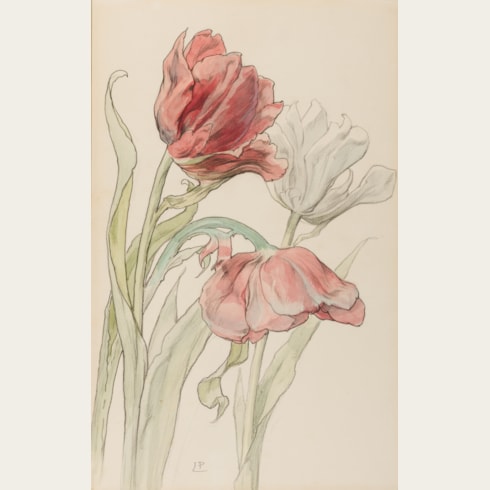
Henri PRIVAT-LIVEMONT
(Schaerbeek 1861 - Schaerbeek 1936)
Design for a Belgian Postage Stamp for the Red Cross: A Mother and a Praying Child
Pencil, brown wash and watercolour, with framing lines in brown ink.
Signed with the artist’s initials LP in pencil at the lower left.
Inscribed BELGIQUE in brown ink at the top and dated 1934 at the upper right.
92 x 121 mm. (3 5/8 x 4 3/4 in.) [image]
119 x 148 mm. (4 5/8 x 5 3/4 in.) [sheet]
Signed with the artist’s initials LP in pencil at the lower left.
Inscribed BELGIQUE in brown ink at the top and dated 1934 at the upper right.
92 x 121 mm. (3 5/8 x 4 3/4 in.) [image]
119 x 148 mm. (4 5/8 x 5 3/4 in.) [sheet]
One of a group of designs for Belgian postage stamps for the Red Cross produced by Henri Privat-Livemont in the last years of his career. It appears that none of these designs were ever actually produced as postage stamps, however.
As the scholar Benoît Schoonbroodt has noted, this was not the only time that Privat-Livemont produced designs for postage stamps. Almost four decades earlier, around 1895, the artist had designed a set of Belgian postage stamps in denominations of 5, 10, 20, 30 and 50 centimes and 1 franc. Privat-Livemont’s design proved popular, and the stamps were reissued numerous times, sometimes with different colours and denominations, between 1900 and 1953.
As the scholar Benoît Schoonbroodt has noted, this was not the only time that Privat-Livemont produced designs for postage stamps. Almost four decades earlier, around 1895, the artist had designed a set of Belgian postage stamps in denominations of 5, 10, 20, 30 and 50 centimes and 1 franc. Privat-Livemont’s design proved popular, and the stamps were reissued numerous times, sometimes with different colours and denominations, between 1900 and 1953.
One of the leading artists of the Belle Epoque in France and Belgium, Henri Privat Antoine Livemont, known as Privat-Livemont, studied at the School of Decorative Arts in Sint-Josse-ten-Noode before earning a scholarship to complete his training in Paris, where he lived and worked for six years, between 1883 and 1889. He initially won a commission to work on part of the decoration of the Hôtel de Ville, but soon fell foul of a new law that prohibited non-French artists from working on official civic projects. Nevertheless, he worked in the studio of the scenographer Jean-Baptiste Lavastre, where he created stage designs for a production of Hamlet at the Théâtre Français, where he also worked on the interior decoration of the theatre. On his return to Belgium in 1889 he settled in Schaerbeek, in the northern part of Brussels. He received several important commissions, notably the decoration of the provincial government building in the city of Hasselt. Privat-Livemont worked with several architects and designed the interiors of a number of private homes in Brussels, as well as painting murals for a theatre in Ostend.
Privat-Livemont’s career as a painter, decorator, lithographer and commercial and magazine illustrator was a very successful one. (The artist’s letterhead noted that he was a purveyor of ‘Art posters and prints. Decorations for apartments. Traditional and modern styles. Sgraffiti’.) He became especially known as a designer of Art Nouveau posters, which he began producing in 1890, when he produced a striking poster for an exhibition in Schaerbeek, and this soon led to other commissions for posters, notably for the Cercle Artistique de Schaerbeek. By 1900 Privat-Livemont had designed some thirty posters, many published by the artist himself, and had also taken up lithography and printmaking. Among his best-known posters are those for the Casino de Cabourg and such products as Absinthe Robette or Van Houten cocoa, as well as for the Brussels International Exposition of 1897. Privat-Livemont’s poster designs were almost always based on striking images of beautiful dreamlike women, displaying a product for sale or engaged in some activity, often accompanied by floral motifs in their elegant borders. As the contemporary Belgian art critic Octave Maus, writing in 1900, noted, ‘it was easy to discover certain analogies between the posters of Privat Livemont and those of [Alphonse] Mucha…Perhaps the enquiry, far from hurting M. Privat Livemont, would be in favour of the Brussels artist whose first posters go back to 1890, that is to say, to a period when the name of Mucha was unknown.’ In his later years Privat-Livemont taught at the Académie in his native municipality of Schaerbeek.
Privat-Livemont’s career as a painter, decorator, lithographer and commercial and magazine illustrator was a very successful one. (The artist’s letterhead noted that he was a purveyor of ‘Art posters and prints. Decorations for apartments. Traditional and modern styles. Sgraffiti’.) He became especially known as a designer of Art Nouveau posters, which he began producing in 1890, when he produced a striking poster for an exhibition in Schaerbeek, and this soon led to other commissions for posters, notably for the Cercle Artistique de Schaerbeek. By 1900 Privat-Livemont had designed some thirty posters, many published by the artist himself, and had also taken up lithography and printmaking. Among his best-known posters are those for the Casino de Cabourg and such products as Absinthe Robette or Van Houten cocoa, as well as for the Brussels International Exposition of 1897. Privat-Livemont’s poster designs were almost always based on striking images of beautiful dreamlike women, displaying a product for sale or engaged in some activity, often accompanied by floral motifs in their elegant borders. As the contemporary Belgian art critic Octave Maus, writing in 1900, noted, ‘it was easy to discover certain analogies between the posters of Privat Livemont and those of [Alphonse] Mucha…Perhaps the enquiry, far from hurting M. Privat Livemont, would be in favour of the Brussels artist whose first posters go back to 1890, that is to say, to a period when the name of Mucha was unknown.’ In his later years Privat-Livemont taught at the Académie in his native municipality of Schaerbeek.
Provenance
The estate of the artist
Private collection.
Private collection.