Emil PIRCHAN
(Brno 1884 - Vienna 1957)
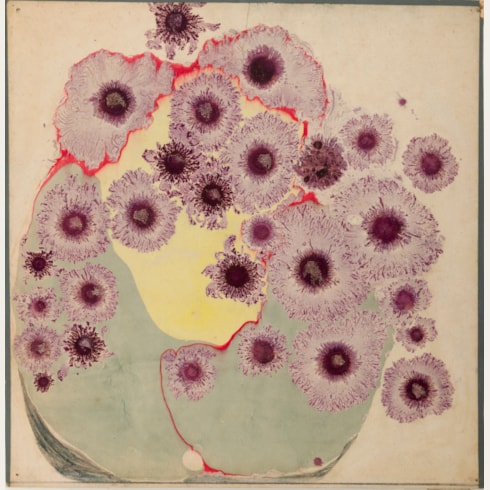
Design for a Country House
Pen and black ink over a pencil underdrawing, with framing lines in black ink, mounted by the artist on cardboard.
Inscribed ANSICHT / VON DER / OST- / SEITE in black ink at the lower left.
Further inscribed Skizze 1906 and Architekt Pirch[an] / Studie in pencil on the backing board.
245 x 250 mm. (9 5/8 x 9 7/8 in.) [sheet]
Inscribed ANSICHT / VON DER / OST- / SEITE in black ink at the lower left.
Further inscribed Skizze 1906 and Architekt Pirch[an] / Studie in pencil on the backing board.
245 x 250 mm. (9 5/8 x 9 7/8 in.) [sheet]
The present sheet was drawn during, or shortly after, Emil Pirchan’s period of study with the leading Viennese architect Otto Wagner at the architecture school of the Academy of Fine Arts in Vienna, between 1903 and 1906. Although only a few of Pirchan’s architectural designs were realized, his studies with Wagner were to be of particular importance in his later career as a set designer. As he later recalled, ‘In Otto Wagner’s master class, I dedicated myself to modern architecture and was just getting to grips with the trends of the emerging Viennese Modernism.’
Most of Pirchan’s architectural designs can be dated between 1905 and 1910, and many were illustrated in the Viennese magazine Der Architekt. His drawings for architectural projects were strongly influenced by the example of his teacher Wagner and included designs for country homes, a mountaintop cemetery in Trieste, a pilgrimage church, a monument to the writer Friedrich Schiller (for which Pirchan received the Akademie’s Füger-Medal), a restaurant and a recreational building for workers, among others. Around 1930 he also produced futuristic designs for a theatre in South America, a project about which little else is known. Pirchan’s designs for private homes share an interest in the reduction of the forms to geometric structures. Following his mentor Wagner, he stated his belief that architecture ‘is not just a dispensable extra, a decorative ingredient, but the formative fulfilment of functionality.’
Most of Pirchan’s architectural designs can be dated between 1905 and 1910, and many were illustrated in the Viennese magazine Der Architekt. His drawings for architectural projects were strongly influenced by the example of his teacher Wagner and included designs for country homes, a mountaintop cemetery in Trieste, a pilgrimage church, a monument to the writer Friedrich Schiller (for which Pirchan received the Akademie’s Füger-Medal), a restaurant and a recreational building for workers, among others. Around 1930 he also produced futuristic designs for a theatre in South America, a project about which little else is known. Pirchan’s designs for private homes share an interest in the reduction of the forms to geometric structures. Following his mentor Wagner, he stated his belief that architecture ‘is not just a dispensable extra, a decorative ingredient, but the formative fulfilment of functionality.’
One of the most creative and prolific artists of his day, working mainly in Munich, Berlin, Prague and Vienna, Emil Pirchan was active as a designer, scenographer, commercial graphic artist, costumer, book illustrator and architect, as well as a writer and teacher. Born in the Moravian city of Brno, in what is today the Czech Republic, he was a pupil of the Austrian architect Otto Wagner at the Academy of Fine Arts in Vienna. He was also much influenced by the work of his second cousin Joseph Hoffmann, an architect and designer who was a founder of both the Vienna Secession and the Wiener Werkstätte. He began his independent career in Brno, where he worked as a drawing teacher, before moving in 1908 to Munich, where established a school for graphic design and applied arts. He undertook several projects for interior decorations, and also produced a number of drawings for architectural projects, which were strongly influenced by the example of his teacher Wagner. In 1912 an exhibition of fifty of his set designs was held at Heinrich Thannhauser’s Moderne Galerie in Munich, and five years later he was appointed director of set design and costumes at the Bavarian State Theatre. Also in 1917, exhibitions of his work were held at the Landesgewerbemuseum in Stuttgart and the Museum August Kestner in Hannover. Pirchan worked in Munich for thirteen years, winning several prizes in national and international competitions.
In 1921 Pirchan moved to Berlin, where he worked as a scenographer at the State Theatre and oversaw numerous productions. He won a gold medal in the category of set design at the International Exposition in Barcelona in 1928, and in 1930 produced futuristic designs for a theatre in South America, a project about which little else is known. In 1932 Pirchan settled in Prague, working as the head of set design at the German Theatre. In 1936 he returned to Vienna, where he was to live and work until his death. He was appointed a professor at the Vienna Academy of Fine Arts and served as director of the newly-established school of set design there, while providing set designs for productions at the Burgtheater and the State Opera.
Throughout his long and successful career Pirchan produced numerous designs for posters, advertisements, furniture, jewellery, arts and crafts objects and fabrics. In addition, he was a novelist and playwright, and published several books on art and artists, including one of the first biographies of Gustav Klimt. The full range of Pirchan’s oeuvre was only relatively recently brought to light in a retrospective exhibition held at the Museum Folkwang in Essen and the Leopold Museum in Vienna between 2019 and 2021, which established him as a leading figure of Central European Modernism. Much of the exhibition was based on an archival collection of his work that was recently rediscovered in a box in an attic in a house in Zurich.
In 1921 Pirchan moved to Berlin, where he worked as a scenographer at the State Theatre and oversaw numerous productions. He won a gold medal in the category of set design at the International Exposition in Barcelona in 1928, and in 1930 produced futuristic designs for a theatre in South America, a project about which little else is known. In 1932 Pirchan settled in Prague, working as the head of set design at the German Theatre. In 1936 he returned to Vienna, where he was to live and work until his death. He was appointed a professor at the Vienna Academy of Fine Arts and served as director of the newly-established school of set design there, while providing set designs for productions at the Burgtheater and the State Opera.
Throughout his long and successful career Pirchan produced numerous designs for posters, advertisements, furniture, jewellery, arts and crafts objects and fabrics. In addition, he was a novelist and playwright, and published several books on art and artists, including one of the first biographies of Gustav Klimt. The full range of Pirchan’s oeuvre was only relatively recently brought to light in a retrospective exhibition held at the Museum Folkwang in Essen and the Leopold Museum in Vienna between 2019 and 2021, which established him as a leading figure of Central European Modernism. Much of the exhibition was based on an archival collection of his work that was recently rediscovered in a box in an attic in a house in Zurich.
Provenance
The estate of the artist, and thence by descent to the Steffan/Pabst collection, Vienna.