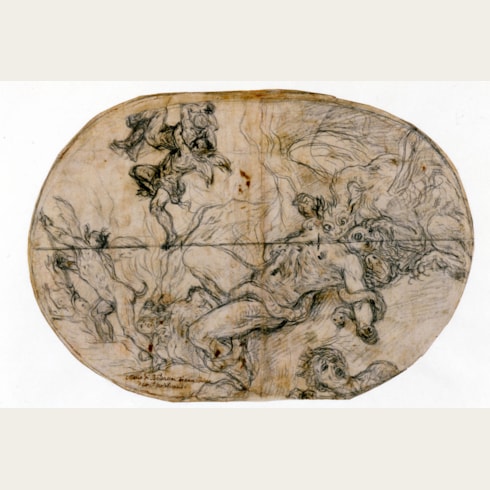
Baldassare Franceschini VOLTERRANO
(Volterra 1611 - Florence 1690)
Design for a Theatrum Sacrum
Red chalk.
Numbered 9 (or 6) in brown ink at the lower right.
571 x 439 mm. (22 1/2 x 17 1/4 in.)
Numbered 9 (or 6) in brown ink at the lower right.
571 x 439 mm. (22 1/2 x 17 1/4 in.)
This very large drawing is a design for a Theatrum Sacrum. Common in Italian art of the Baroque period, Theatrum Sacrum (Latin for ‘sacred theatre’) designs were produced for temporary ephemeral structures – usually elaborate in design and combining painting, sculpture and architectural elements to create a visually stunning ensemble – that were erected for religious festivals, processions and musical or theatrical performances, often held during ecclesiastical feast days, particularly during Easter and Holy Week. The present sheet depicts a large sculptural group centred by an allegorical figure of Faith, The present sheet drawing depicts a large sculptural group with an allegorical figure of Faith, seated on a raised dais within an apse containing further statues of Hope and Charity. Above are two flying putti holding an oval inscribed IHS, while to the right is a further bay with a balcony and two statues of angels holding candlesticks.
The present sheet can be closely related, in stylistic terms, with a number of Theatrum Sacrum drawings in red chalk by Volterrano that are studies for a catafalque in honour of Saint Mary Magdalene de’ Pazzi, whose canonization was celebrated in Florence in 1669. One such drawing, showing three separate designs for the catafalque, was formerly in the Steiner collection and is now in the Metropolitan Museum of Art in New York, while a related study of a single altar and catafalque is also in the Metropolitan Museum. A third sheet of studies by Volterrano related to this project was sold alongside the two Metropolitan Museum drawings at auction in London in 1974, while further related drawings are in the Albertina in Vienna and a private collection in Milan. The final appearance of Volterrano’s Theatrum Sacrum design of 1669 is recorded in a print by Theodor Verkruys.
The present sheet can be closely related, in stylistic terms, with a number of Theatrum Sacrum drawings in red chalk by Volterrano that are studies for a catafalque in honour of Saint Mary Magdalene de’ Pazzi, whose canonization was celebrated in Florence in 1669. One such drawing, showing three separate designs for the catafalque, was formerly in the Steiner collection and is now in the Metropolitan Museum of Art in New York, while a related study of a single altar and catafalque is also in the Metropolitan Museum. A third sheet of studies by Volterrano related to this project was sold alongside the two Metropolitan Museum drawings at auction in London in 1974, while further related drawings are in the Albertina in Vienna and a private collection in Milan. The final appearance of Volterrano’s Theatrum Sacrum design of 1669 is recorded in a print by Theodor Verkruys.
The preeminent fresco painter in Florence in the latter half of the 17th century, Baldassare Franceschini, known as Il Volterrano after his birthplace, studied with Matteo Rosselli and Giovanni da San Giovanni. His first significant independent commission came in 1636, when he was entrusted by Prince Don Lorenzo de’ Medici with the fresco decoration of the courtyard of the Medici villa of La Petraia, near Florence. This cycle of scenes from Medici history was not completed for another twelve years, however, as other commissions interrupted the project.
Volterrano painted frescoes, altarpieces and easel pictures for numerous churches and palaces in Florence, Volterra and Rome. His large-scale, crowded fresco compositions reflect an adaptation into a Florentine idiom of the Roman Baroque manner, derived from Pietro da Cortona’s frescoes in the Palazzo Pitti, where Volterrano himself also worked, decorating the ceiling of the Sala di Vittoria della Rovere. His painting style also shows the influence of Correggio, whose work in Parma he studied extensively; indeed one of Volterrano’s biographers, Niccolò Gabburri, describes the artist as ‘il secondo Correggio o pure il Coreggio dei Fiorentini.’
In 1650 Volterrano painted a large fresco of The Angels Ministering to Christ in the Wilderness for the refectory of the Florentine convent of Santa Teresa, a work he considered to be one of his finest achievements. Some of the artist’s most significant commissions were for Santissima Annunziata in Florence, where his fresco decoration of the chapel of Sant’Ansano in 1643 began an association with the church that was to last almost to the end of his career. Between 1664 and 1683, Volterrano executed paintings for the ceiling of the nave of the church and an altarpiece of San Filippo Benizzi in Glory, and his work at Santissima Annunziata culminated in the cupola fresco of The Coronation of the Virgin. Commissioned by the Grand Duke Cosimo III, the fresco was the artist’s last major project, as he suffered a stroke shortly after its completion.
Undoubtedly one of the finest draughtsmen of the Florentine Seicento, Volterrano, as one modern scholar has noted, ‘can take his place alongside the other major draughtsmen of the Baroque era; there is nothing provincial about any aspect of his drawing.’ Both of the artist’s biographers, Filippo Baldinucci and Francesco Maria Niccolò Gabburri, owned several of his drawings, and they were also popular with collectors. The largest extant groups of drawings by Volterrano are today in the collections of the Uffizi and the Albertina, while a number of designs for architecture, decorative motifs and metalwork are in the Kunstbibliothek in Berlin.
Provenance
Probably part of a group of 410 drawings by Volterrano, mounted into four albums and sold Paris, Hôtel Drouot, 8 November 1922, lot 214
Anonymous sale (‘An Important Group of Drawings by Baldassare Franceschini, called Il Volterrano’), London, Sotheby’s, 3 July 1980, lot 102 (as Studio of Volterrano).
Anonymous sale (‘An Important Group of Drawings by Baldassare Franceschini, called Il Volterrano’), London, Sotheby’s, 3 July 1980, lot 102 (as Studio of Volterrano).