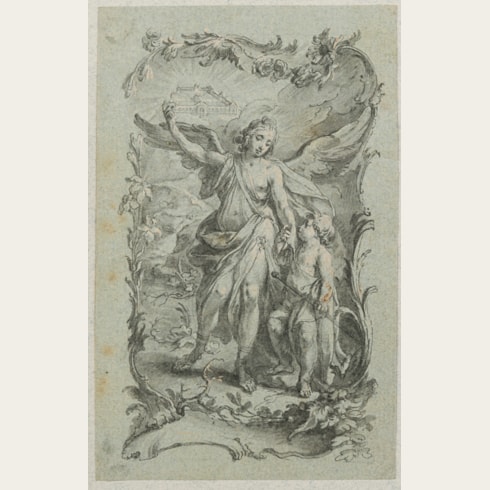
Johann Wolfgang BAUMGARTNER
(Ebbs 1702 - Augsburg 1761)
Ornamental Design: A Bedchamber
Pen and brush and grey ink and grey wash, heightened with white, on blue paper, within a fictive mount drawn with framing lines in black ink.
The verso rubbed with red chalk for transfer.
Inscribed J: Holzer fecit. in brown ink on the old backing sheet.
184 x 140 mm. (7 1/4 x 5 1/2 in.) [sheet]
The verso rubbed with red chalk for transfer.
Inscribed J: Holzer fecit. in brown ink on the old backing sheet.
184 x 140 mm. (7 1/4 x 5 1/2 in.) [sheet]
As the scholar Bruno Bushart noted, ‘[A] colourful blend of Christian and pagan themes, sacred and profane motifs, witty allegories and realistic genre scenes, is characteristic of Baumgartner’s entire drawn oeuvre…Baumgartner’s works impress with their wealth of ideas and innovations.’
Part of a group of four drawings of interiors traditionally given to the fresco painter Johann Evangelist Holzer (1709-1740), whose influence on Baumgartner is nevertheless evident in the latter’s frescoes, the correct attribution of this group was made in 1981 by the Baumgartner drawings scholar Annette Geissler-Petermann. As Gail Davidson has noted, this group of drawings ‘provides stunning examples of Baumgartner’s unique integration of figures, landscape, architecture, and ornament in a unified, sinuous rococo composition.’ Like many of Baumgartner’s drawings, the composition of each sheet is enlivened by an ornamental rocaille drawn border. As has been noted, ‘Like no other Augsburg artist, Baumgartner made rocaille decor central to his message. Along with [Gottfried Bernhard] Götz and Johann Evangelist Holzer, to whom he is particularly indebted, he relied on ornament to give structure to his picture[s].’ Similarly, another scholar has pointed out that ‘Baumgartner’s designs play with Rococo ornamentation in a highly distinctive manner. He did not merely surround scenes as cartouches but rather gave a Rocaille quality to nature, buildings, forms, the figures and the whole image.’
It has further been suggested by Bushart that these drawings, depicting the various rooms in a house, may have been intended to be ‘read’ in a sequence beginning at the lowest level of the home, with the cellar, and rising through the different floors of the home to the bedroom at the top. As such, the drawings may describe the refinement of taste and the senses ‘from the lowest level up to the more elevated pleasures, like drinking coffee, reading and courtship.’
The fact that the versos of each of these drawings are rubbed with red chalk would suggest that they were designs for prints and, given their small scale, were perhaps intended as book illustrations, although no such related works are known today.
Part of a group of four drawings of interiors traditionally given to the fresco painter Johann Evangelist Holzer (1709-1740), whose influence on Baumgartner is nevertheless evident in the latter’s frescoes, the correct attribution of this group was made in 1981 by the Baumgartner drawings scholar Annette Geissler-Petermann. As Gail Davidson has noted, this group of drawings ‘provides stunning examples of Baumgartner’s unique integration of figures, landscape, architecture, and ornament in a unified, sinuous rococo composition.’ Like many of Baumgartner’s drawings, the composition of each sheet is enlivened by an ornamental rocaille drawn border. As has been noted, ‘Like no other Augsburg artist, Baumgartner made rocaille decor central to his message. Along with [Gottfried Bernhard] Götz and Johann Evangelist Holzer, to whom he is particularly indebted, he relied on ornament to give structure to his picture[s].’ Similarly, another scholar has pointed out that ‘Baumgartner’s designs play with Rococo ornamentation in a highly distinctive manner. He did not merely surround scenes as cartouches but rather gave a Rocaille quality to nature, buildings, forms, the figures and the whole image.’
It has further been suggested by Bushart that these drawings, depicting the various rooms in a house, may have been intended to be ‘read’ in a sequence beginning at the lowest level of the home, with the cellar, and rising through the different floors of the home to the bedroom at the top. As such, the drawings may describe the refinement of taste and the senses ‘from the lowest level up to the more elevated pleasures, like drinking coffee, reading and courtship.’
The fact that the versos of each of these drawings are rubbed with red chalk would suggest that they were designs for prints and, given their small scale, were perhaps intended as book illustrations, although no such related works are known today.
Born near Kufstein in the Tyrol, the son of a blacksmith, Johann Wolfgang Baumgartner was one of the leading artists of the Rococo in Southern Germany, and a highly gifted draughtsman. He began his career in Salzburg as a painter of hinterglasmalerei; a method of painting on the reverse of glass panels. Although they were highly prized, very few of these precious works by the artist have survived. After travelling as a journeyman in Italy, Austria, Hungary and Bohemia, Baumgartner settled in 1731 in Augsburg, where he was associated with the local Kunstakademie, and was able to work as an independent artist from 1733 onwards. At first, however, he was only permitted to work as a Hinterglasmaler, although since he was the sole artist in the Swabian imperial city working in the technique of reverse-glass painting, he achieved some measure of renown.
It was not until the early 1750s, after he had become a citizen of Augsburg and joined the local guild of painters, that Baumgartner began working in both oil painting and fresco. His earliest known fresco dates from 1754, when he decorated the ceiling of the church of St. Jakobus in Gersthofen, for which he also painted several altarpieces. In 1756 he frescoed the Heilige Kreuz church in the village of Bergen, near Neuberg an der Donau, followed two years later by work in the Loretokirche in Augsburg. Established as one of the leading artists in Augsburg, Baumgartner painted numerous ceilings and frescoes for churches in Southern Germany, notably at Egenhausen, Bergen and Baitenhausen. He also worked for the Prince-Bishop Cardinal Franz Konrad von Rodt in the garden pavilion of the Neue Residenz at Meersburg, on Lake Constance, although further work there was left unfinished by his death from tuberculosis in September 1761.
Baumgartner is best known today as a draughtsman and designer of prints – ‘one of the most gifted designers for the print trade that Augsburg produced in a fertile period of graphic invention’, according to one modern scholar - although unusually he does not seem to have worked as a printmaker himself. Some 220 drawings by the artist have survived, most of which served as designs for prints, book illustrations or calendars for the three leading publishing houses of Klauber, Engelbrecht and Kilian in Augsburg. These prints based on Baumgartner’s designs served to spread the Rococo style throughout Germany. The artist worked particularly closely with the brothers Johann Baptist and Joseph Sebastian Klauber, printmakers and publishers who etched many of his designs. Often on blue paper, Baumgartner’s model drawings for engravings include allegorical, mythological and religious subjects, genre scenes, hunting themes and elegant pastoral subjects, as well as designs for calendars and thesis frontispieces. (Baumgartner also seems to have produced designs for prints in the form of oil sketches on canvas, although these were often much larger in scale than the final engraving; this was probably a legacy of his work as a glass painter. Among his significant commissions as a book illustrator were some three hundred designs for Joseph Giulini’s devotional work Tägliche Erbauung des Wahren Christen; a calendar illustrating each of the days of the year with an engraving of different saint. As another scholar has noted, ‘[A] colourful blend of Christian and pagan themes, sacred and profane motifs, witty allegories and realistic genre scenes, is characteristic of Baumgartner’s entire drawn oeuvre…Baumgartner’s works impress with their wealth of ideas and innovations.’
It was not until the early 1750s, after he had become a citizen of Augsburg and joined the local guild of painters, that Baumgartner began working in both oil painting and fresco. His earliest known fresco dates from 1754, when he decorated the ceiling of the church of St. Jakobus in Gersthofen, for which he also painted several altarpieces. In 1756 he frescoed the Heilige Kreuz church in the village of Bergen, near Neuberg an der Donau, followed two years later by work in the Loretokirche in Augsburg. Established as one of the leading artists in Augsburg, Baumgartner painted numerous ceilings and frescoes for churches in Southern Germany, notably at Egenhausen, Bergen and Baitenhausen. He also worked for the Prince-Bishop Cardinal Franz Konrad von Rodt in the garden pavilion of the Neue Residenz at Meersburg, on Lake Constance, although further work there was left unfinished by his death from tuberculosis in September 1761.
Baumgartner is best known today as a draughtsman and designer of prints – ‘one of the most gifted designers for the print trade that Augsburg produced in a fertile period of graphic invention’, according to one modern scholar - although unusually he does not seem to have worked as a printmaker himself. Some 220 drawings by the artist have survived, most of which served as designs for prints, book illustrations or calendars for the three leading publishing houses of Klauber, Engelbrecht and Kilian in Augsburg. These prints based on Baumgartner’s designs served to spread the Rococo style throughout Germany. The artist worked particularly closely with the brothers Johann Baptist and Joseph Sebastian Klauber, printmakers and publishers who etched many of his designs. Often on blue paper, Baumgartner’s model drawings for engravings include allegorical, mythological and religious subjects, genre scenes, hunting themes and elegant pastoral subjects, as well as designs for calendars and thesis frontispieces. (Baumgartner also seems to have produced designs for prints in the form of oil sketches on canvas, although these were often much larger in scale than the final engraving; this was probably a legacy of his work as a glass painter. Among his significant commissions as a book illustrator were some three hundred designs for Joseph Giulini’s devotional work Tägliche Erbauung des Wahren Christen; a calendar illustrating each of the days of the year with an engraving of different saint. As another scholar has noted, ‘[A] colourful blend of Christian and pagan themes, sacred and profane motifs, witty allegories and realistic genre scenes, is characteristic of Baumgartner’s entire drawn oeuvre…Baumgartner’s works impress with their wealth of ideas and innovations.’
Provenance
Private collection, South Germany
Galerie Siegfried Billesberger, Munich, in 1995
Yvonne Tan Bunzl, London, in 1996
Private collection.
Galerie Siegfried Billesberger, Munich, in 1995
Yvonne Tan Bunzl, London, in 1996
Private collection.
Literature
Munich, Galerie Siegfried Billesberger, Johann Wolfgang Baumgartner: Zeichnungen, Munich, 1995, p.11, no.1, illustrated p.15; London, Yvonne Tan Bunzl, Master Drawings, 1996, unpaginated, no.23; Gail S. Davidson, ‘Ornament of Bizarre Imagination. Rococo Prints and Drawings from Cooper-Hewitt’s Léon Decloux Collection’, in Sarah D. Coffin et al, Rococo: The Continuing Curve, 1730-2008, exhibition catalogue, New York, 2008, pp.70-71, fig.46; Horace Wood Brock, Martin P. Levy and Clifford S. Ackley, Splendor and Elegance: European Decorative Arts and Drawings from the Horace Wood Brock Collection, exhibition catalogue, Boston, 2009, p.159, no.147, illustrated p.142.
Exhibition
Stanford, Stanford University, Cantor Center for Visual Arts, Classic Taste: Drawings and Decorative Arts from the Collection of Horace Brock, March-May 2000; New York, Cooper-Hewitt, National Design Museum, Rococo: The Continuing Curve, 1730-2008, 2008; Boston, Museum of Fine Arts, Splendor and Elegance: European Decorative Arts and Drawings from the Horace Wood Brock Collection, 2009, no.147.