Andrea BOSCOLI
(Florence 1560 - Florence 1608)
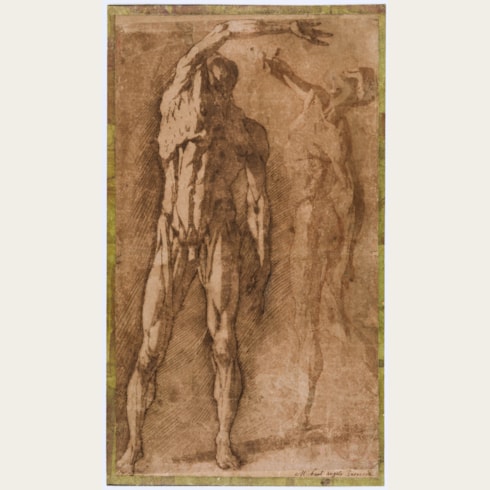
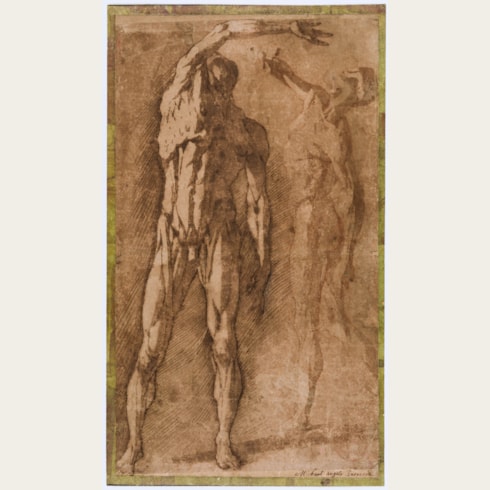
A Design for a Cartouche
Pen and brown ink and brown wash.
Laid down on a 17th century mount.
Inscribed Boscoli at the lower centre and numbered 4 at the upper right.
237 x 170 mm. (9 3/8 x 6 5/8 in.) [sheet]
Laid down on a 17th century mount.
Inscribed Boscoli at the lower centre and numbered 4 at the upper right.
237 x 170 mm. (9 3/8 x 6 5/8 in.) [sheet]
Traditionally and correctly attributed to Andrea Boscoli, this fine drawing is characteristic of the artist’s draughtsmanship in its bold use of dark brown wash and chiaroscuro effects. It has been tentatively suggested that the present sheet may have been intended as the frontispiece for a series of some twenty finished drawings by Boscoli depicting episodes from Gerusalemme Liberata, Torquato Tasso’s epic poem of the late 16th century. Datable to between 1604 and 1608, Boscoli’s Gerusalemme Liberata drawings are characterized by, as Julian Brooks has noted, ‘the rich and schematic effects of light and shade for which he was well known…it is easy to understand why the drawings in this series were recorded as storiette di chiaro scuro (‘little stories in light and shadow’) in an inventory of c.1611.’ The present sheet is of approximately the same size as Boscoli’s Tasso illustrations, the purpose of which remains unknown. They may have been intended as studies for prints that were never executed or were perhaps produced as finished works for a collector.
Few architectural or ornamental drawings by Boscoli are known, and among the rare extant examples are sheets in the Uffizi and the Biblioteca Marucelliana in Florence, the Victoria and Albert Museum in London and the Ashmolean Museum in Oxford. Among thematically and stylistically comparable drawings is a design for a decorative frame for a wall decoration, in the Ashmolean Museum. The Ashmolean drawing, which also shows an elaborate framing scheme surrounding a blank space, likewise incorporates a very similar motif of a shield with long fronds to either side, at the very top of the composition.
The English portrait painter Nathaniel Hone (1718-1784), whose collector’s mark is stamped at the lower centre of the sheet, was a founder member of the Royal Academy and a noted collector of drawings and prints. His collection was dispersed at auction in two sales in London, in 1781 and 1785. The present sheet was later part of an album of drawings belonging to the collector William Armistead (1753-1831) of Liverpool.
Few architectural or ornamental drawings by Boscoli are known, and among the rare extant examples are sheets in the Uffizi and the Biblioteca Marucelliana in Florence, the Victoria and Albert Museum in London and the Ashmolean Museum in Oxford. Among thematically and stylistically comparable drawings is a design for a decorative frame for a wall decoration, in the Ashmolean Museum. The Ashmolean drawing, which also shows an elaborate framing scheme surrounding a blank space, likewise incorporates a very similar motif of a shield with long fronds to either side, at the very top of the composition.
The English portrait painter Nathaniel Hone (1718-1784), whose collector’s mark is stamped at the lower centre of the sheet, was a founder member of the Royal Academy and a noted collector of drawings and prints. His collection was dispersed at auction in two sales in London, in 1781 and 1785. The present sheet was later part of an album of drawings belonging to the collector William Armistead (1753-1831) of Liverpool.
Andrea Boscoli trained in the Florentine studio of Santi di Tito and was admitted into the Accademia del Disegno in 1584. He visited Rome as a young man in the early 1580’s and, like many artists before him, avidly copied the frescoes of Polidoro da Caravaggio that decorated the facades of several palaces there. Between 1582 and 1600 Boscoli worked primarily in Florence, with brief stays in Siena and Pisa. His earliest known painting is the Martyrdom of Saint Bartholomew, painted in 1587 for the cloister of the Florentine church of San Pier Maggiore. He was also involved in the decorations for the apparati celebrating the marriage of the Grand Duke Ferdinando I de’ Medici to Christina of Lorraine in 1589.
In 1592 Boscoli completed a fresco cycle for the Villa di Corliano at San Giuliano Terme, near Pisa, and the following year painted an altarpiece of The Annunciation for the Chiesa del Carmine in Pisa. In 1597 Boscoli painted a Visitation for the Florentine church of Sant’ Ambrogio, followed two years later by a Crucifixion for SS. Apostoli, now lost, and an altarpiece of The Preaching of Saint John the Baptist in the church of San Giovanni Battista in Rimini, signed and dated 1599. Between 1600 and 1605 Boscoli worked mainly in the Marches, painting frescoes and altarpieces for patrons and churches in Fano, Fabriano, Macerata, Fermo and elsewhere, while the last years of his career were spent between Florence and Rome.
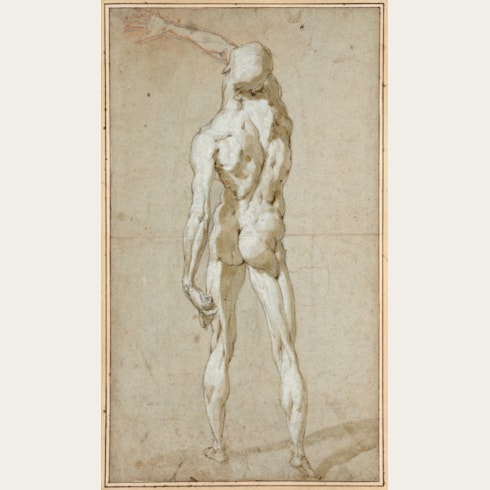
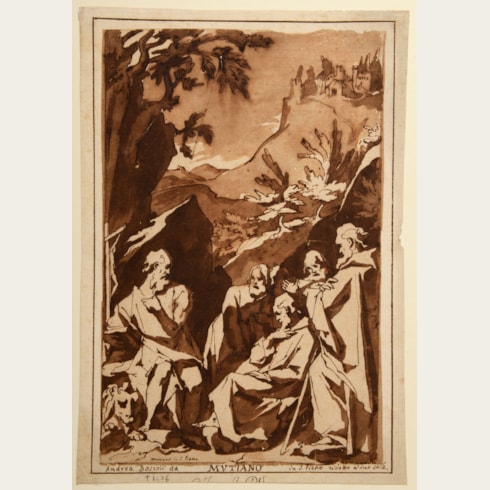
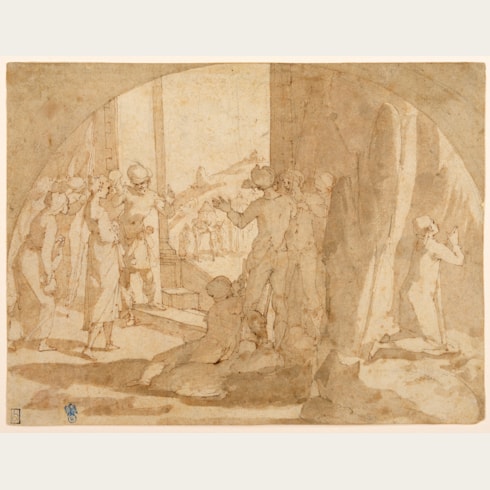
Relatively few paintings by Boscoli survive today, and it is as a draughtsman that he is best known. His drawings were highly praised by his biographer Filippo Baldinucci (who noted that ‘he drew so well...without lacking a boldness and an extraordinarily skillful touch’) and were avidly collected. Some six hundred drawings by Boscoli are known, with significant groups of drawings in the Uffizi in Florence (many of which were once part of the extensive collection formed by Cardinal Leopoldo de’ Medici), the Istituto Nazionale per la Grafica in Rome and the Louvre.
Provenance
Nathaniel Hone, London (Lugt 2793)
Probably his sales, London, Christie and Ansell, 4-7 April 1781 or London, Hutchins, 7-15 February 1785
Part of an album of drawings belonging to William Armistead, Liverpool
By inheritance to Gordon Davies, London
His sale and others, London, Christie’s, 6 July 1982, lot 11 (bt. Holland for £648)
Ralph Holland, Newcastle
Thence by descent until 2013
His posthumous sale (‘Galleria Portatile: The Ralph Holland Collection’), London, Sotheby’s, 5 July 2013, lot 246
W. M. Brady and Co., New York
Private collection.
Probably his sales, London, Christie and Ansell, 4-7 April 1781 or London, Hutchins, 7-15 February 1785
Part of an album of drawings belonging to William Armistead, Liverpool
By inheritance to Gordon Davies, London
His sale and others, London, Christie’s, 6 July 1982, lot 11 (bt. Holland for £648)
Ralph Holland, Newcastle
Thence by descent until 2013
His posthumous sale (‘Galleria Portatile: The Ralph Holland Collection’), London, Sotheby’s, 5 July 2013, lot 246
W. M. Brady and Co., New York
Private collection.
Literature
Nadia Bastogi, Andrea Boscoli, Florence, 2008, p.360, no.555 (as location unknown, not illustrated).