Aloys ZÖTL
(Freistadt 1803 - Eferding 1887)
A Cheetah (Acinonyx jubatus)
Watercolour, within framing lines in black ink
Signed and dated Al: Zötl pinx. am 7 April 1834. in the lower right margin.
Inscribed Saugethiere Tab: in the lower left margin.
Further inscribed Der Gepard. Felis Jubata. / Das heisse Afrika, verzüglich am Vorgebierge der guten Hoffnung ist sein Aufenthalt. Nach Pen- / nant ist der auch in Ostindien einheimlich, wo er gezähmt und dann zur Gazellen Jagd gebraucht / wird, dagegen hat auch er an Löwen, Tiergern und Panthern, mächtige Todfeinde. Langenmass 3 1/2 Fuss. in black ink in the lower margin.
280 x 359 mm. (11 x 14 1/8 in.) [image]
412 x 454 mm. (16 1/4 x 17 7/8 in.) [sheet]
Signed and dated Al: Zötl pinx. am 7 April 1834. in the lower right margin.
Inscribed Saugethiere Tab: in the lower left margin.
Further inscribed Der Gepard. Felis Jubata. / Das heisse Afrika, verzüglich am Vorgebierge der guten Hoffnung ist sein Aufenthalt. Nach Pen- / nant ist der auch in Ostindien einheimlich, wo er gezähmt und dann zur Gazellen Jagd gebraucht / wird, dagegen hat auch er an Löwen, Tiergern und Panthern, mächtige Todfeinde. Langenmass 3 1/2 Fuss. in black ink in the lower margin.
280 x 359 mm. (11 x 14 1/8 in.) [image]
412 x 454 mm. (16 1/4 x 17 7/8 in.) [sheet]
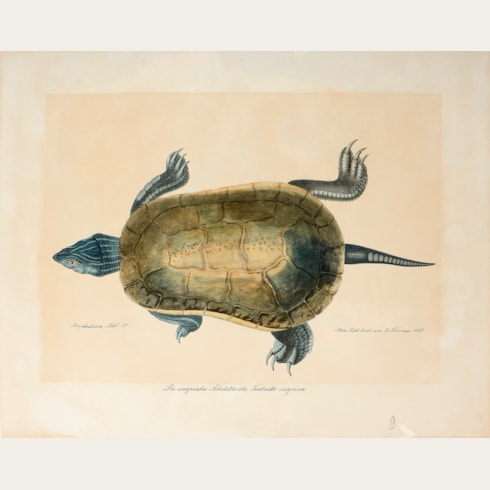
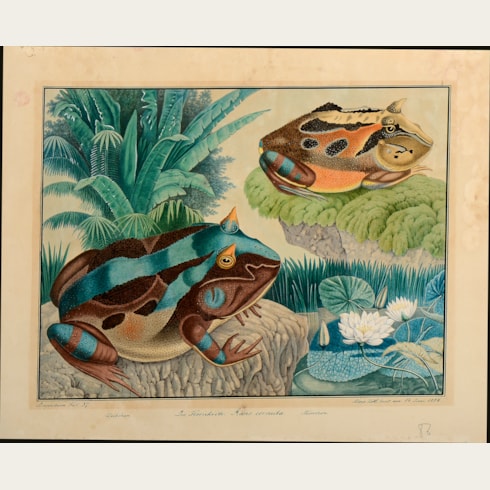
From 1831 until his death in 1887, the obscure Austrian dyer and amateur artist Aloys Zötl produced an extensive series of very large and beautifully drawn watercolours of exotic animals, known as the Bestiarium. This massive project was to be his life’s work, although its purpose remains unknown. The watercolours of the Bestiarium, characterized by a brilliant technique and rich colouring, allied to the unbridled imagination of the artist, do not seem to have ever been reproduced in Zötl’s lifetime, either as prints or in the form of a book. While the animals in Zötl’s watercolours are generally portrayed with a high degree of accuracy, they are given a sort of added symbolism in the way in which the artist has depicted them on the page. Most of the watercolours show the animals in some form of natural habitat, although this at times seems to verge on the imaginary. It is not known if these spectacular watercolours were the result of a commission or - as is perhaps most likely, given the fact that they were part of a project that seems to have lasted over fifty years - simply an astonishing, and lifelong, labour of love. Certainly, all of the watercolours of Zötl’s Bestiarium remained together for almost seventy years after the artist’s death. Perhaps best described as a combination of science and fantasy, the large watercolours by Zötl for his Bestiarium can be regarded as among the most remarkable and original works of natural history of the 19th century.
Zötl remained almost completely unknown until after the Second World War, when a large group of his animal and natural history watercolours – numbering 320 sheets in all – were sold in two highly successful auctions at the Hôtel Drouot in Paris in December 1955 and May 1956. Almost nothing is known of the earlier provenance of these works, which were consigned for sale by the Galerie Durand-Ruel.
The present sheet is one of the few works by Zötl that were not included in the two auctions held in Paris in 1955 and 1956, or in a handful of later sales at Drouot in 1957 and 1958. The first recorded owner of this watercolour was the Parisian private art dealer and artist Jean (Hans) Lenthal (1914-1983). Born Hans Wilhelm Löwenthal to Jewish parents in Vienna in 1914, he converted to Christianity and settled in Paris around 1934. Arrested by the Nazis in 1943, he survived for some two years in a series of concentration camps before the Liberation. After the war Lenthal continued working as a dealer in Paris, though he never seems to have had a public gallery. He often returned to Austria on buying trips and, according to his widow, was the first to discover the albums of Zötl’s Bestiarium watercolours at an antique shop on the Piaristengasse in Vienna. He passed then on to the Galerie Durand-Ruel in Paris, who in turn consigned them to auction. Lenthal chose to retain only two watercolours by Zötl for his own collection; this fine Cheetah, drawn on the 7th of April 1834, and a Grizzled Giant Squirrel (Ratufa macroura), dated 5 June 1838.
Zötl remained almost completely unknown until after the Second World War, when a large group of his animal and natural history watercolours – numbering 320 sheets in all – were sold in two highly successful auctions at the Hôtel Drouot in Paris in December 1955 and May 1956. Almost nothing is known of the earlier provenance of these works, which were consigned for sale by the Galerie Durand-Ruel.
The present sheet is one of the few works by Zötl that were not included in the two auctions held in Paris in 1955 and 1956, or in a handful of later sales at Drouot in 1957 and 1958. The first recorded owner of this watercolour was the Parisian private art dealer and artist Jean (Hans) Lenthal (1914-1983). Born Hans Wilhelm Löwenthal to Jewish parents in Vienna in 1914, he converted to Christianity and settled in Paris around 1934. Arrested by the Nazis in 1943, he survived for some two years in a series of concentration camps before the Liberation. After the war Lenthal continued working as a dealer in Paris, though he never seems to have had a public gallery. He often returned to Austria on buying trips and, according to his widow, was the first to discover the albums of Zötl’s Bestiarium watercolours at an antique shop on the Piaristengasse in Vienna. He passed then on to the Galerie Durand-Ruel in Paris, who in turn consigned them to auction. Lenthal chose to retain only two watercolours by Zötl for his own collection; this fine Cheetah, drawn on the 7th of April 1834, and a Grizzled Giant Squirrel (Ratufa macroura), dated 5 June 1838.
From 1831 until his death in 1887, the obscure Austrian dyer and amateur artist Aloys Zötl produced an extensive series of very large and beautifully drawn watercolours of exotic animals, known as the Bestiarium. This massive project was to be his life’s work, although its purpose remains unknown. The watercolours of the Bestiarium, characterized by a brilliant technique and rich colouring, allied to the unbridled imagination of the artist, do not seem to have ever been reproduced in Zötl’s lifetime, either as prints or in the form of a book. While the animals are generally depicted with a high degree of accuracy, they are given a sort of added symbolism in the way in which the artist has depicted them on the page. Most of the watercolours show the animals in some form of natural habitat, although this at times seems to verge on the imaginary. It is not known if these spectacular watercolours were the result of a commission or - as is perhaps most likely, given the fact that they were part of a project that seems to have lasted over fifty years - simply an astonishing, and lifelong, labour of love. Certainly all of the watercolours remained together after the artist’s death.
Hardly anything is known of the life of Zötl. The son of a master dyer, he was born in Freistadt in Upper Austria and took up his father’s profession, as did one of his brothers, while another became a bookseller. Following his marriage Zötl moved to the village of Eferding, about forty kilometres from Freistadt, where he remained for the rest of his life. He died on October 21st, 1887, after a long illness. His last watercolour, a study of exotic seashells, was dated only eighteen days earlier, on October 3rd, 1887.
As an artist, Zötl remained almost completely unknown until after the Second World War, when a large group of his animal and natural history watercolours – numbering 320 sheets – was sold in two auctions in Paris in 1955 and 1956. Nothing is known of the earlier provenance of these works, which were consigned for sale by a descendant of an Austrian family. Writing shortly after the first sale of 150 watercolours from the Bestiarium in December 1955, at which he purchased eleven works, the writer André Breton likened Zötl’s work to that of Henri Rousseau, and identified a distinct Surrealist sensibility in much of his oeuvre.
As Breton noted, ‘Lacking any biographical details about the artist, one can only indulge one’s fantasies in imagining the reasons which might have induced this workman from Upper Austria, a dyer by profession, to undertake so zealously between 1832 and 1887 the elaboration of the most sumptuous bestiary ever seen. It would almost seem as though Zötl’s vision, trained professionally to detect the most subtle colours and tones, had endowed him with a mental prism functioning as an instrument of second-sight and revealing to him in succession, back to its most distant origins, the animal kingdom which remains such an enigmatic aspect in each of our lives and which plays such an essential role in the symbolism of the unconscious mind.’
Zötl does not seem to have travelled much beyond his home in the village of Eferding in Upper Austria, and it is thought that most of his watercolours must have been derived from his close study of the extensive library of published works of zoology, natural history, ethnography and travel which he owned, which remains in the possesion of his descendants.
Provenance
Jean Lenthal, Paris and Neuilly
Private collection.
Private collection.
Literature
Julio Cortázar, Aloys Zotl (1803-1887), Parma, 1972, p.156 (incorrectly dated 1837), illustrated p.69
Julio Cortázar, Le bestiaire d’Aloys Zotl (1881-1887), Parma and Milan, 1976, illustrated p.51
Giovanni Mariotti, Das Bestiarium von Aloys Zötl (1881-1887), Milan and Geneva, 1979-1980, illustrated p.37
Franz Reitlinger, Aloys Zötl oder Die Animalsierung der Kunst, Vienna, 2004, p.31, illustrated p.20, fig.7
Victor Francès, Contrées de Aloys Zötl, Paris, 2011, illustrated pp.16-17.
Julio Cortázar, Le bestiaire d’Aloys Zotl (1881-1887), Parma and Milan, 1976, illustrated p.51
Giovanni Mariotti, Das Bestiarium von Aloys Zötl (1881-1887), Milan and Geneva, 1979-1980, illustrated p.37
Franz Reitlinger, Aloys Zötl oder Die Animalsierung der Kunst, Vienna, 2004, p.31, illustrated p.20, fig.7
Victor Francès, Contrées de Aloys Zötl, Paris, 2011, illustrated pp.16-17.