Rodolphe BRESDIN
(Montrelais 1822 - Sèvres 1885)
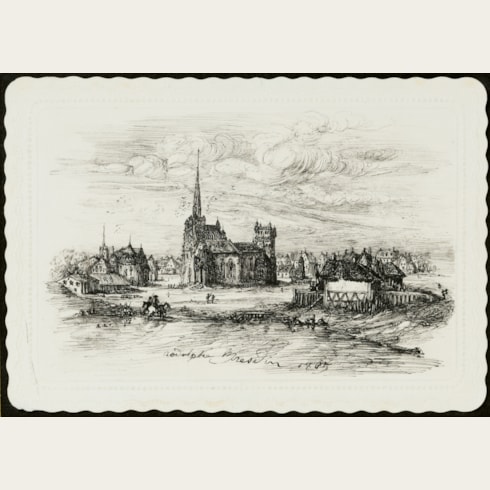
Sur le Pont du Diable (Côte de Normandie)
Sold
Pen and black ink on thick white paper.
Signed and dated Rodolphe Bresdin 1860 twice, once at the left centre, on the façade of the house, and again at the lower centre edge.
Also signed with the artist’s monogram RB on the gable of the house at the left centre.
Numbered 29-32 in pencil in the lower right margin.
Inscribed (by the artist?) S le pont du Diable / Côte de normandie in brown ink on the verso.
121 x 167 mm. (4 3/4 x 6 5/8 in.) [image]
221 x 276 mm. (8 3/4 x 10 7/8 in.) [sheet]
Signed and dated Rodolphe Bresdin 1860 twice, once at the left centre, on the façade of the house, and again at the lower centre edge.
Also signed with the artist’s monogram RB on the gable of the house at the left centre.
Numbered 29-32 in pencil in the lower right margin.
Inscribed (by the artist?) S le pont du Diable / Côte de normandie in brown ink on the verso.
121 x 167 mm. (4 3/4 x 6 5/8 in.) [image]
221 x 276 mm. (8 3/4 x 10 7/8 in.) [sheet]
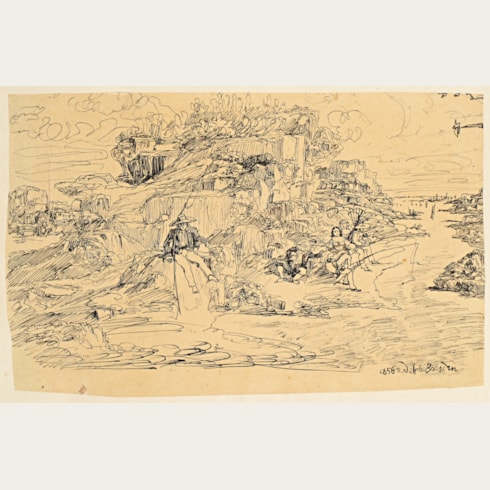
Drawn in 1860, the present sheet is a particularly highly-finished drawing by Rodolphe Bresdin. As Dirk van Gelder and John Sillevis have pointed out, ‘Cities, villages and harbours appear in many variations throughout Bresdin’s oeuvre. Several prints by Adolphe Hervier were an important source of inspiration for this, particularly his etchings of old towns and villages along the Normandy coast. Hervier’s subjects, but also his style and technique, fascinated Bresdin and he continued to work with them throughout his life. He did so in a very personal way, and Hervier’s details were increasingly transformed into his own wonderful compositions…Bresdin worked intensively on this theme until his final years. The fantastic dream cities that belong to his last works still contain clear traces of this theme, although these compositions have a monumentality and drama that has little to do with the starting point found in Hervier’s early work.’
The scholar and curator Harold Joachim has noted that ‘Because of the extremely delicate and minute detail, Bresdin’s work demands concentrated unhurried study, and above all, a poetic sensibility and mind as attuned to the mysteries of nature as his own…Many of his drawings are done with a fine pen in India ink, and though they are generally of small size, their sureness and originality of line are such that they could stand – like the drawings of Callot – any degree of magnification without needing it.’
As Odilon Redon wrote of his master, long after his death, in the catalogue of the exhibition of Bresdin’s works at the Salon d’Automne of 1908, ‘His power lay in imagination alone. He never conceived anything beforehand. He improvised with joy, completing with tenacity the entanglements of the barely perceptible vegetation of the forests he dreamt up…He adored nature. He spoke about it softly, tenderly, with a voice that suddenly became convincing and solemn, thus contrasting with the usually whimsical and playful tone of his conversation. “My drawings are real, whatever one may say!”, he frequently affirmed.’
The first known owner of the present sheet was the Parisian art dealer and auction house expert Marcel Lecomte (1914-1996), who dealt in prints, drawings and books. He also assembled a personal collection of Old Master and 19th century drawings and prints, as well as 19th and 20th century books. Lecomte owned several prints (and a copper plate) by Bresdin, as well as at least one other drawing by the artist; a study of a house in Normandy, dated 1850.
The scholar and curator Harold Joachim has noted that ‘Because of the extremely delicate and minute detail, Bresdin’s work demands concentrated unhurried study, and above all, a poetic sensibility and mind as attuned to the mysteries of nature as his own…Many of his drawings are done with a fine pen in India ink, and though they are generally of small size, their sureness and originality of line are such that they could stand – like the drawings of Callot – any degree of magnification without needing it.’
As Odilon Redon wrote of his master, long after his death, in the catalogue of the exhibition of Bresdin’s works at the Salon d’Automne of 1908, ‘His power lay in imagination alone. He never conceived anything beforehand. He improvised with joy, completing with tenacity the entanglements of the barely perceptible vegetation of the forests he dreamt up…He adored nature. He spoke about it softly, tenderly, with a voice that suddenly became convincing and solemn, thus contrasting with the usually whimsical and playful tone of his conversation. “My drawings are real, whatever one may say!”, he frequently affirmed.’
The first known owner of the present sheet was the Parisian art dealer and auction house expert Marcel Lecomte (1914-1996), who dealt in prints, drawings and books. He also assembled a personal collection of Old Master and 19th century drawings and prints, as well as 19th and 20th century books. Lecomte owned several prints (and a copper plate) by Bresdin, as well as at least one other drawing by the artist; a study of a house in Normandy, dated 1850.
A draughtsman and printmaker, Rodolphe Bresdin seems to have been entirely self-taught. His early career was spent in Paris, where he worked as an etcher. An eccentric, somewhat bohemian figure, he served as the inspiration for the impoverished artist-hero of Champfleury’s novel Chien-caillou, published in 1845; indeed, for most of his career Bresdin was also known by the nickname ‘Chien-Caillou’. He left Paris in 1849 for the town of Corrèze and by 1852 had settled in Toulouse, where he worked for several years. Despite living in abject poverty, this was a period of considerable productivity for the artist, who received several commissions and began to produce his first mature prints.
Although Bresdin exhibited in several Salons between 1848 and 1879, he failed to achieve much recognition or financial success. For most of the 1860’s he lived and worked in Bordeaux, where he briefly taught the young Odilon Redon, who was to become a devoted friend and champion. Bresdin emigrated to Canada in 1873 but struggled to make a living there and returned to France four years later, eventually working as a street-sweeper. In 1880, destitute and in ill-health, he abandoned his family and the following year moved into a garret in Sèvres, where he was found dead one day in January 1885. Although greatly admired by such writers as Champfleury, Baudelaire, Huysmans and Montesquieu, Bresdin’s work was first brought to public notice and acclaim at a retrospective exhibition held at the Salon d’Automne in 1908.
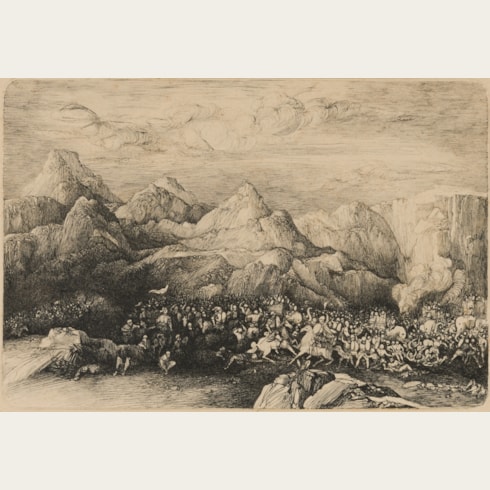
As no paintings by the artist have survived, Bresdin’s entire oeuvre consists of drawings, etchings and lithographs. While his graphic work is well-known today, Bresdin’s activity as a draughtsman is equally vital to an understanding of his art. Like his prints, his drawings were never on a very large scale, yet were always intricately drawn and minutely detailed.
Many of Bresdin’s drawings are finished works in pen and ink, and were created as independent works of art for exhibition or sale. However, from a career spanning some fifty years, only slightly more than four hundred drawings by Bresdin survive today, alongside a graphic oeuvre of around 160 prints. Only rarely do his drawings appear on the market, and they remain particularly scarce outside important groups of sheets in several public collections, notably the Bibliothèque Nationale in Paris, the Gemeentemuseum in The Hague and the Art Institute of Chicago; each based on collections formed by particular friends of the artist, to whom he presented his drawings.
Provenance
Marcel Lecomte, Paris (his bookplate ML [cf. Lugt 5684] on a label affixed to the back of the old frame).