Thomas GAINSBOROUGH
(Sudbury 1727 - London 1788)
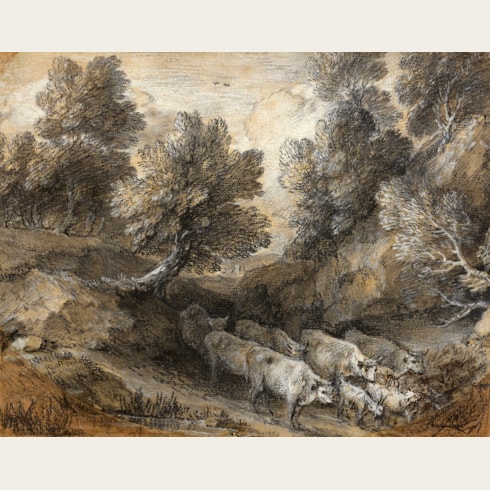
Wooded Landscape with Cattle at a Watering Place
Sold
Pencil and coloured chalks, watercolour, oil and varnish, extensively heightened with white lead, on brown prepared paper, laid down on a 19th century mount.
215 x 316 mm. (8 1/2 x 12 1/2 in.)
215 x 316 mm. (8 1/2 x 12 1/2 in.)
This large, finished drawing may be dated to the early 1770s. At this time Gainsborough was living and working in Bath, and his landscapes, previously quite rustic in spirit, began to take on a more classical air, with echoes of the paintings of Claude and Rubens that the artist would have seen in private collections in the area. It was also at this time that Gainsborough was trying various combinations of ink, chalk, watercolour and varnish in his landscape drawings. As has been noted, ‘Gainsborough was constantly experimenting with media, especially in the last decades of his life, and at this period he was trying to give some of his drawings the force of oil paintings by means of unusually dramatic chiaroscuro and the use of varnish.’ It has also been observed that ‘The practice of making varnished watercolor drawings, as Gainsborough describes it, is unusual for the 1770s; it is much more common in the first few decades of the nineteenth century…the aim of his varnishing technique was clearly to give his watercolors some of the qualities of his oil paintings.’
The use of white lead in this drawing to achieve the effect of bright sunlight would seem to reflect the advice given by Gainsborough to his friend Jackson, in a letter of January 1773, to use for highlights dry white lead pigment; ‘Bristol made white lead which you buy in lumps at any house painters; saw it the size you want for your white chalk; the Bristol is harder and more the temper of chalk that the London – when you see your Effect, dip it all over in skim’d milk…Swear now never to impart my secret to any one living.’ This opaque white heightening, which appears to lie on top of the washes, is a characteristic feature of several of Gainsborough’s drawings of the 1770s; examples are today in the collections of the Harvard University Art Museums in Cambridge, MA, the Courtauld Gallery in London, the Yale Center for British Art in New Haven, the Metropolitan Museum of Art and the Pierpont Morgan Library in New York and the Philadelphia Museum of Art.
Gainsborough produced a number of other highly finished landscape drawings in the late 1760s and early 1770s, all of about the same size, which may be seen as part of his desire to imbue his drawings with the depth and intensity of his oil paintings. Indeed, the only landscape drawings that the artist exhibited in London in his lifetime were the ‘Two Landscapes, Drawings, in imitation of oil painting’, which, together with eight smaller, varnished landscapes, were shown at the Royal Academy in 1772. These were described by Horace Walpole, in a note in his copy of the catalogue, as of ‘very great effect, but neat, like needlework’.
As John Hayes has noted of this Wooded Landscape with Cattle at a Watering Place, ‘The composition, with the motif of the sloping tree trunk filling out the left of the drawing, is closely related to the picture entitled Repose, now at Kansas City, dateable to the late 1760s or very early 1770s.’ The arrangement of the cows in the present sheet is indeed close to Gainsborough’s landscape painting Repose in the Nelson-Atkins Museum of Art in Kansas City, Missouri. As Hayes has written, ‘In the canvas known as Repose, a painting of which [the artist] was especially fond, and could never be prevailed upon to sell, he produced his first heroic cattle piece…both sky and trees form an admirable background to these splendid beasts…this [was an] evidently personal work (he reserved it as a dowry for his daughter Margaret who, in the event, never married).’
The Nelson-Atkins painting was in fact even closer in composition to the present sheet than it appears today. Sometime after he had first completed the picture, Gainsborough added a prominent tree at the left of the composition, leaning in towards the centre, such as is seen in this drawing. The appearance of Repose with this later addition by the artist is recorded in a lithograph by Richard Lane, published in 1824. Gainsborough, who only rarely made extensive later alterations to his paintings, painted the tree in a soluble medium, and it was removed when the picture was restored between 1912 and 1920.
A preparatory compositional study for the painting Repose, executed in black and white chalks on blue paper, is also in the collection of the Nelson-Atkins Museum of Art.
Elsewhere, John Hayes noted of this drawing that ‘The treatment of the foliage, the tree trunks, and the rough highlighting in oil, are closely related to the rocky landscape with a figure travelling up an incline formerly in the Northbrook collection.’
The present sheet once belonged to James Leslie Wright, JP (1862-1954), who, from the 1930s onwards, assembled a very fine collection of British drawings and watercolours of the 17th, 18th and 19th centuries which was exhibited in its entirety at the Royal Academy in 1949. Wright owned over thirty drawings and sketches by Gainsborough, along with significant groups of works by John Robert Cozens, Peter de Wint, Thomas Girtin, Thomas Rowlandson and Paul Sandby, among many others, and built a gallery in his house to display them. As Kenneth Garlick has noted, ‘J. Leslie Wright belonged to what used to be called the ‘old school’; punctilious in manner and scrupulous in appearance, he was devoted to and perceptive about his hobby – the collecting of English water-colours. He knew much about them. Anyone who visited him at his home, Haseley House, near Warwick, will remember his enjoyment in talking about the pictures, which were kept in an upstairs room that had been enlarged to make a kind of gallery. If he had a favourite it was Gainsborough. More than thirty chalk, water-colour and wash drawings by this artist hung on the walls and he lingered over them with particular pleasure.’ The vast majority of Wright’s collection of nearly four hundred drawings and watercolours were bequeathed to the Birmingham City Museum and Art Gallery in 1953. The present sheet, however, was one of a number of drawings retained by Wright’s descendants until 2013.
The use of white lead in this drawing to achieve the effect of bright sunlight would seem to reflect the advice given by Gainsborough to his friend Jackson, in a letter of January 1773, to use for highlights dry white lead pigment; ‘Bristol made white lead which you buy in lumps at any house painters; saw it the size you want for your white chalk; the Bristol is harder and more the temper of chalk that the London – when you see your Effect, dip it all over in skim’d milk…Swear now never to impart my secret to any one living.’ This opaque white heightening, which appears to lie on top of the washes, is a characteristic feature of several of Gainsborough’s drawings of the 1770s; examples are today in the collections of the Harvard University Art Museums in Cambridge, MA, the Courtauld Gallery in London, the Yale Center for British Art in New Haven, the Metropolitan Museum of Art and the Pierpont Morgan Library in New York and the Philadelphia Museum of Art.
Gainsborough produced a number of other highly finished landscape drawings in the late 1760s and early 1770s, all of about the same size, which may be seen as part of his desire to imbue his drawings with the depth and intensity of his oil paintings. Indeed, the only landscape drawings that the artist exhibited in London in his lifetime were the ‘Two Landscapes, Drawings, in imitation of oil painting’, which, together with eight smaller, varnished landscapes, were shown at the Royal Academy in 1772. These were described by Horace Walpole, in a note in his copy of the catalogue, as of ‘very great effect, but neat, like needlework’.
As John Hayes has noted of this Wooded Landscape with Cattle at a Watering Place, ‘The composition, with the motif of the sloping tree trunk filling out the left of the drawing, is closely related to the picture entitled Repose, now at Kansas City, dateable to the late 1760s or very early 1770s.’ The arrangement of the cows in the present sheet is indeed close to Gainsborough’s landscape painting Repose in the Nelson-Atkins Museum of Art in Kansas City, Missouri. As Hayes has written, ‘In the canvas known as Repose, a painting of which [the artist] was especially fond, and could never be prevailed upon to sell, he produced his first heroic cattle piece…both sky and trees form an admirable background to these splendid beasts…this [was an] evidently personal work (he reserved it as a dowry for his daughter Margaret who, in the event, never married).’
The Nelson-Atkins painting was in fact even closer in composition to the present sheet than it appears today. Sometime after he had first completed the picture, Gainsborough added a prominent tree at the left of the composition, leaning in towards the centre, such as is seen in this drawing. The appearance of Repose with this later addition by the artist is recorded in a lithograph by Richard Lane, published in 1824. Gainsborough, who only rarely made extensive later alterations to his paintings, painted the tree in a soluble medium, and it was removed when the picture was restored between 1912 and 1920.
A preparatory compositional study for the painting Repose, executed in black and white chalks on blue paper, is also in the collection of the Nelson-Atkins Museum of Art.
Elsewhere, John Hayes noted of this drawing that ‘The treatment of the foliage, the tree trunks, and the rough highlighting in oil, are closely related to the rocky landscape with a figure travelling up an incline formerly in the Northbrook collection.’
The present sheet once belonged to James Leslie Wright, JP (1862-1954), who, from the 1930s onwards, assembled a very fine collection of British drawings and watercolours of the 17th, 18th and 19th centuries which was exhibited in its entirety at the Royal Academy in 1949. Wright owned over thirty drawings and sketches by Gainsborough, along with significant groups of works by John Robert Cozens, Peter de Wint, Thomas Girtin, Thomas Rowlandson and Paul Sandby, among many others, and built a gallery in his house to display them. As Kenneth Garlick has noted, ‘J. Leslie Wright belonged to what used to be called the ‘old school’; punctilious in manner and scrupulous in appearance, he was devoted to and perceptive about his hobby – the collecting of English water-colours. He knew much about them. Anyone who visited him at his home, Haseley House, near Warwick, will remember his enjoyment in talking about the pictures, which were kept in an upstairs room that had been enlarged to make a kind of gallery. If he had a favourite it was Gainsborough. More than thirty chalk, water-colour and wash drawings by this artist hung on the walls and he lingered over them with particular pleasure.’ The vast majority of Wright’s collection of nearly four hundred drawings and watercolours were bequeathed to the Birmingham City Museum and Art Gallery in 1953. The present sheet, however, was one of a number of drawings retained by Wright’s descendants until 2013.
The musician William Jackson, a close friend of the artist and an early biographer, wrote that ‘If I were to rest his reputation upon one point; it should be on his Drawings...No man ever possessed methods so various in producing effect, and all excellent.’ A prolific draughtsman, Gainsborough apparently never sold any of his drawings, although he is thought to have given away many of them as presents. As Susan Sloman has noted, ‘During his lifetime Gainsborough’s drawings were known to an inner circle of friends, artist and connoisseurs, but not to the wider public.’
Provenance
Miss G. L. Young
R. H. Young
Anonymous sale, London, Christie’s, 11 June 1937, lot 52 (‘Cattle in a Stream’, bt. Colnaghi)
P. & D. Colnaghi, London
Sold by them to J. Leslie Wright JP, Haseley House, nr. Warwick
By descent to Col. P. L. M. Wright, London
Thence by descent
Anonymous sale (‘From the Collection of J. Leslie Wright (1862-1954)’), London, Christie’s, 2 July 2013, lot 40
Jimmy Younger, Houston
Thence by descent.
R. H. Young
Anonymous sale, London, Christie’s, 11 June 1937, lot 52 (‘Cattle in a Stream’, bt. Colnaghi)
P. & D. Colnaghi, London
Sold by them to J. Leslie Wright JP, Haseley House, nr. Warwick
By descent to Col. P. L. M. Wright, London
Thence by descent
Anonymous sale (‘From the Collection of J. Leslie Wright (1862-1954)’), London, Christie’s, 2 July 2013, lot 40
Jimmy Younger, Houston
Thence by descent.
Literature
Mary Woodall, Gainsborough’s Landscape Drawings, London, 1939, p.36, no.403 (not illustrated); London, Royal Academy, Catalogue of the Exhibition of Masters of British Water-Colour (17th-19th Centuries): The J. Leslie Wright Collection, exhibition catalogue, 1949, p.15, no.91, illustrated pl.II (as Cattle in a Stream); London, The Arts Council, Gainsborough Drawings, exhibition catalogue, York and elsewhere, 1960-1961, p.14, no.21 (where dated to the early 1770s); John Hayes, The Drawings of Thomas Gainsborough, New Haven and London, 1970, Vol.I, pp.50, 60 and 102 andp.189, no.345, Vol.II, pl.284; Jonathan P. Derow, ‘Gainsborough’s Varnished Watercolor Technique’, Master Drawings, Autumn 1988, p.271, note 26; Dena M. Woodall, Picturing Nature: The Stuart Collection of 18th- and 19th-Century British Landscapes and Beyond, exhibition catalogue, Houston, 2025, p.49, under no.9.
Exhibition
Birmingham, City of Birmingham Museum & Art Gallery, Exhibition of Early English Water-Colours from the Collections of J. Leslie Wright, Esq., J.P. and Walter Turner, Esq., 1938, no.92; London, Royal Academy of Arts, Masters of British Water-Colour (17th-19th Centuries): Exhibition of the J. Leslie Wright Collection, 1949, no.91; Aldeburgh, Aldeburgh Festival, Drawings by Thomas Gainsborough, June 1949, no.35; London, Royal Academy of Arts, European Masters of the Eighteenth Century, Winter Exhibition, 1954-1955, no.540; York, York City Art Gallery, and elsewhere, Gainsborough Drawings, 1960-1961, no.21.