François BONVIN
(Vaugirard 1817 - Saint-Germain-en-Laye 1887)
Still Life with Two Books and a Candle
Sold
Black chalk, with stumping, on buff paper.
Signed f. Bonvin. 2 at the lower right and dated 3 Xbre 1879 at the lower left.
361 x 263 mm. (14 1/4 x 10 3/8 in.)
Signed f. Bonvin. 2 at the lower right and dated 3 Xbre 1879 at the lower left.
361 x 263 mm. (14 1/4 x 10 3/8 in.)
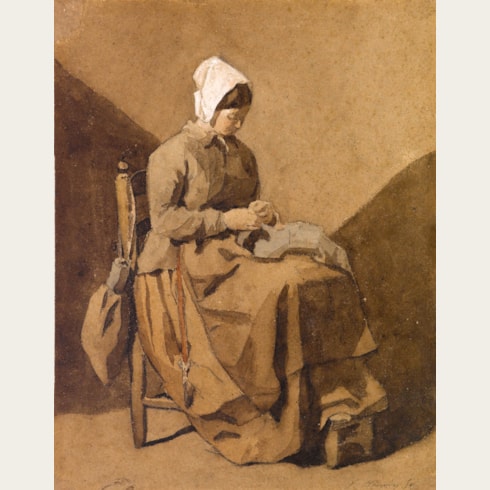
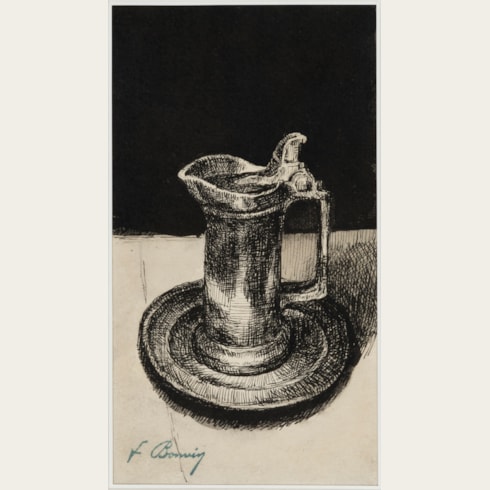
An accomplished still life painter, François Bonvin preferred to depict humble household or kitchen objects in a manner inspired by the example of the 18th century painter Jean-Baptiste Siméon Chardin, whose work he greatly admired. As a visitor to Bonvin’s studio noted, ‘When you penetrate into the interior, you think you have been transported into another world: furniture in rough wood, clay pitchers, copper cauldrons, frying pans – objects of all kinds were littered across the floor in the midst of vegetables and baskets of fruits: these were the artist’s props.’ In the last decade of his life, beset by poor health, Bonvin began to focus in particular on still life subjects, which he could do in the comfort of his home.
Drawn on what was, for Bonvin, a fairly large sheet of paper, this still life is dated the 3rd of October 1879. That year was not a particularly productive one for the artist, who was often ill and overwhelmed by physical pain. The artist remained largely confined to his home and chose to depict the mundane objects that surrounded him. Only a handful of dated paintings and drawings, almost all of still life subjects and of modest dimensions, survive from this year. One of these, a small black chalk drawing of a similar subject of a candle and a book alongside a pair of scissors, today in a private collection, was drawn three days after the present sheet.
Drawn on what was, for Bonvin, a fairly large sheet of paper, this still life is dated the 3rd of October 1879. That year was not a particularly productive one for the artist, who was often ill and overwhelmed by physical pain. The artist remained largely confined to his home and chose to depict the mundane objects that surrounded him. Only a handful of dated paintings and drawings, almost all of still life subjects and of modest dimensions, survive from this year. One of these, a small black chalk drawing of a similar subject of a candle and a book alongside a pair of scissors, today in a private collection, was drawn three days after the present sheet.
Born into poverty, François Bonvin studied at the Ecole de Dessin in Paris between 1828 and 1830, but had to abandon his studies to begin work as a typesetter and printer. His earliest known works date from the late 1830’s, by which time Bonvin was also working as a police clerk. He eventually returned to his studies at the Ecole de Dessin – a school geared primarily towards the decorative arts - and in 1843 began attending life-drawing classes at the Académie Suisse. Around this time he met his mentor, the painter François-Marius Granet, who encouraged him to study 17th century Dutch and Flemish painting as a way of refining his approach to genre subjects. Perhaps with the support of Granet, who was on the jury, Bonvin made his Salon debut in 1847, and he continued to show there until 1880, earning a particular reputation as a painter of genre and interior scenes and still-lifes.
Bonvin rose to become one of the leaders of a group of Realist painters in 19th century France who found inspiration in subjects and scenes taken from contemporary urban life. Many of the models for his drawings and paintings seem to have been habitués of the inn owned by his father in Vaugirard. In 1859 a number of his paintings were accepted for exhibition at the Salon, though Realist works by such friends and colleagues as Henri Fantin-Latour, Alphonse Legros, Théodule Ribot and James McNeill Whistler were rejected. As a result, Bonvin invited these artists to exhibit their rejected works at his studio, known as the Atelier Flamand, an offer repeated after the Salon of 1863. Later that year his wife left him, and Bonvin found it difficult to concentrate on his paintings, preferring instead to make numerous drawings. In his final years he grew blind and suffered from paralysis. Although a retrospective exhibition of his work was held in 1886, followed a few months later by a benefit auction intended to raise funds for a pension for the artist, Bonvin died in impoverished circumstances in 1887.
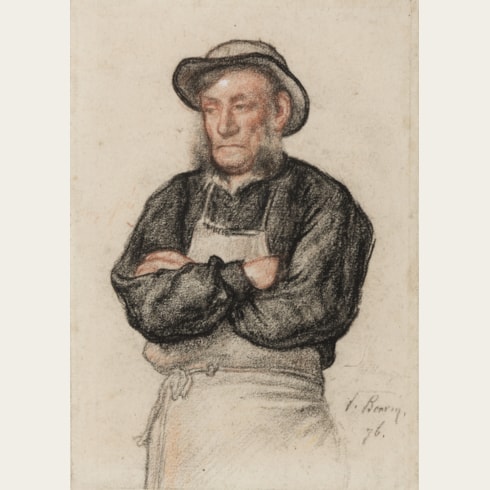
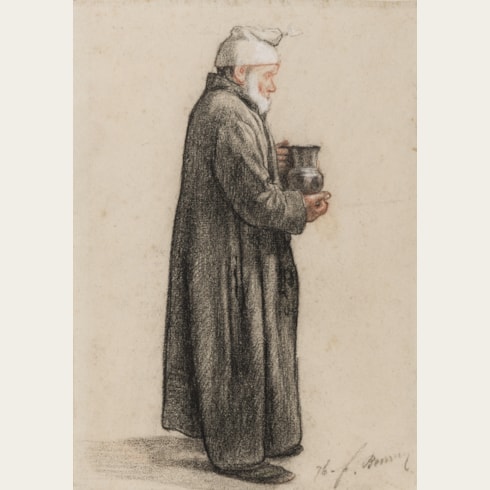
Bonvin’s modern reputation rests largely on his drawings. His first dated works were executed in 1845 and 1846, while he still worked as a civil servant. At this time he would exhibit his drawings informally under the arcades of the Institut de France, and it was there that he met his first significant patron, Louis Laperlier. At the start of his artistic career Bonvin would not be able to afford models, and would often make use of friends and their families as models, as well as washerwomen, cooks, nuns, children, peasants and beggars.