


Jean-Baptiste TAVERNIER
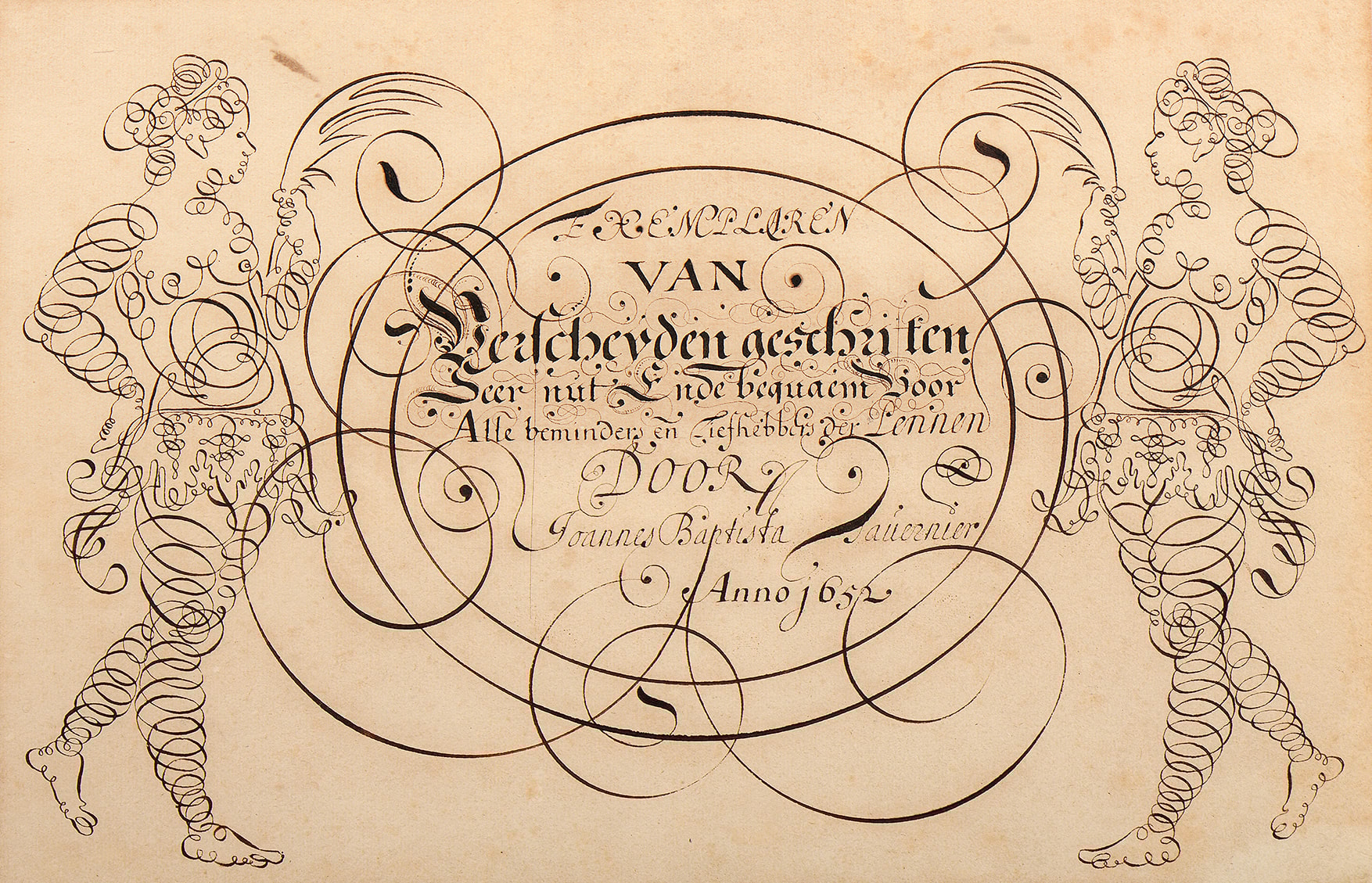
A Calligraphic Design for a Frontispiece
Pen and brown ink.
Inscribed, signed and dated 'EXEMPLAREN / VAN / Verscheyden geschriften / Seer nut in de bequaem voor / Alle beminders en Liefhebbers der Pennen / DOOR / Joannes Baptista Tavernier / Anno 1652' in the centre.
205 x 302 mm. (8 1/8 x 11 7/8 in.) [sheet]
Inscribed, signed and dated 'EXEMPLAREN / VAN / Verscheyden geschriften / Seer nut in de bequaem voor / Alle beminders en Liefhebbers der Pennen / DOOR / Joannes Baptista Tavernier / Anno 1652' in the centre.
205 x 302 mm. (8 1/8 x 11 7/8 in.) [sheet]
This drawing may have served as an unused design for the frontispiece of J. B. Tavernier’s Collection of Calligraphic Pieces, published in Bruges between 1651 and 1672. Intended as a guide to penmanship, a manuscript copy of this work is in the collection of the Newberry Library in Chicago, in the form of a vellum-bound volume of around fourteen sheets of calligraphy models - mostly signed ‘Tavernier’ - written in different languages and with various types of script, that are stylistically closely comparable to the present sheet. The Newberry album, however, has a different title page, which reads (in calligraphy) ‘Exemplaer-Boeck, inhoudende diuersche soorten ban gheschriften ... gheschrieven ende gemaeckt door J. B. Tauernier’ [see comparatibve image].
The collection of the Newberry Library also includes a further group of loose sheets of calligraphy models by different hands, some of which are signed ‘Tavernier’, which were all apparently removed from an album. (None of these can be related to the present sheet, however.) It may be, therefore, that this drawing was intended as a frontispiece for another album of calligraphic studies by Tavernier that was never printed or published.
It remains unclear whether the artist responsible for this drawing may be identified with the famous French gem merchant and traveller Jean-Baptiste Tavernier (1605-1689), who made six long voyages to Persia and India between 1630 and 1688. Tavernier was the son and nephew of cartographers, and it is thought likely that he had some practice of both cartography and engraving. In the year 1652, however, Tavernier is known to have been in the midst of the fourth of his famous voyages, to India.
The collection of the Newberry Library also includes a further group of loose sheets of calligraphy models by different hands, some of which are signed ‘Tavernier’, which were all apparently removed from an album. (None of these can be related to the present sheet, however.) It may be, therefore, that this drawing was intended as a frontispiece for another album of calligraphic studies by Tavernier that was never printed or published.
It remains unclear whether the artist responsible for this drawing may be identified with the famous French gem merchant and traveller Jean-Baptiste Tavernier (1605-1689), who made six long voyages to Persia and India between 1630 and 1688. Tavernier was the son and nephew of cartographers, and it is thought likely that he had some practice of both cartography and engraving. In the year 1652, however, Tavernier is known to have been in the midst of the fourth of his famous voyages, to India.
Provenance
Anonymous sale, Brussels, Les Nouvelles Galeries de Paris, 23-24 October 1995, lot 656
Jacques Hollander, Ohain, Belgium
Thence by descent.
Jacques Hollander, Ohain, Belgium
Thence by descent.