
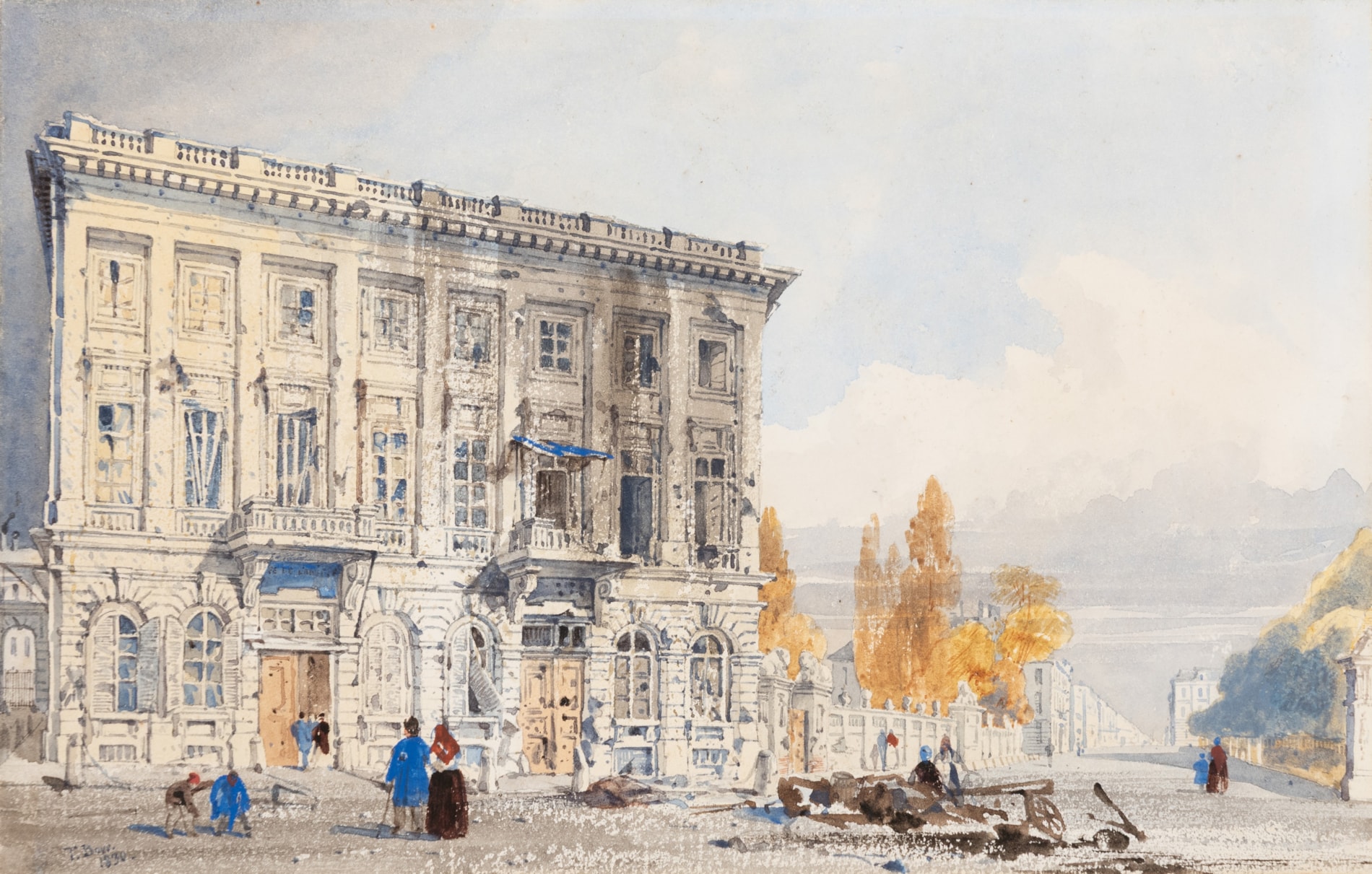

Thomas Shotter BOYS
London 1803 - London 1874
Biography
One of the finest English watercolourists of the 19th century, the artist and printmaker Thomas Shotter Boys had almost no formal academic training and was apprenticed to the line engraver George Cooke in 1817. Sometime in the early 1820s he moved to France, where he learned the art of lithography. Boys lived and worked mainly in Paris between 1823 and 1837, working as an engraver, lithographer and watercolourist. He also befriended his contemporary Richard Parkes Bonington, whose style and technique as a watercolourist, particularly in his urban views, was to be a particular influence on Boys, to the extent that their work has sometimes been confused. In 1830 Boys left France for Brussels, but the outbreak of the short-lived Belgian Revolution meant that he had to return to Paris, where he shared a studio with William Callow, who sometimes accompanied him on sketching expeditions. Some of Boys’s 1830 drawings of Belgian cities were later used for his book Picturesque Architecture in Paris, Ghent, Antwerp, Rouen &c., published in London in 1839. This was followed in 1842 by Original Views of London as it is, a masterpiece of the new method of chromolithography, and both volumes may be counted among the finest large-format albums of picturesque views of the period.
Boys’s splendid watercolours of urban views, full of incidental detail, were much admired by critics. The artist worked between Paris and London, exhibiting his work at the Paris Salon, where he made his debut in 1833, and the New Water-colour Society, of which he became a member in 1840, and where he showed five or six watercolours a year, on average, until his death. As Marcia Pointon has noted, ‘The decade of the ’thirties was the highpoint of Boys’s career…The vitality of Boys’s work during this period and the depth and thoughtfulness of his approach to the motif, his colour sense and the fine precision of his detail must ensure for him a place of honour in [the] circle of artists in Paris.’ By the later 1840s, however, Boys’s career and reputation had begun to fade. He was hardly mentioned by the prominent art critic John Ruskin in his many writings, despite the fact that Boys was employed to produce etchings for Ruskin’s Modern Painters and The Stones of Venice, and this critical neglect meant that collectors began to lose interest in his work. In his later years Boys struggled to support himself financially, trying without much success to work as a drawing master and an architectural draughtsman. In 1850 he was obliged to sell at auction his collection of works by other artists, including Bonington and François-Marius Granet, as well as Jean-Honoré Fragonard, Jean-Baptiste Greuze and Jean-Antoine Watteau. In his last years Boys suffered from a form of paralysis, and died in poverty in 1874, at the age of seventy-two.
