
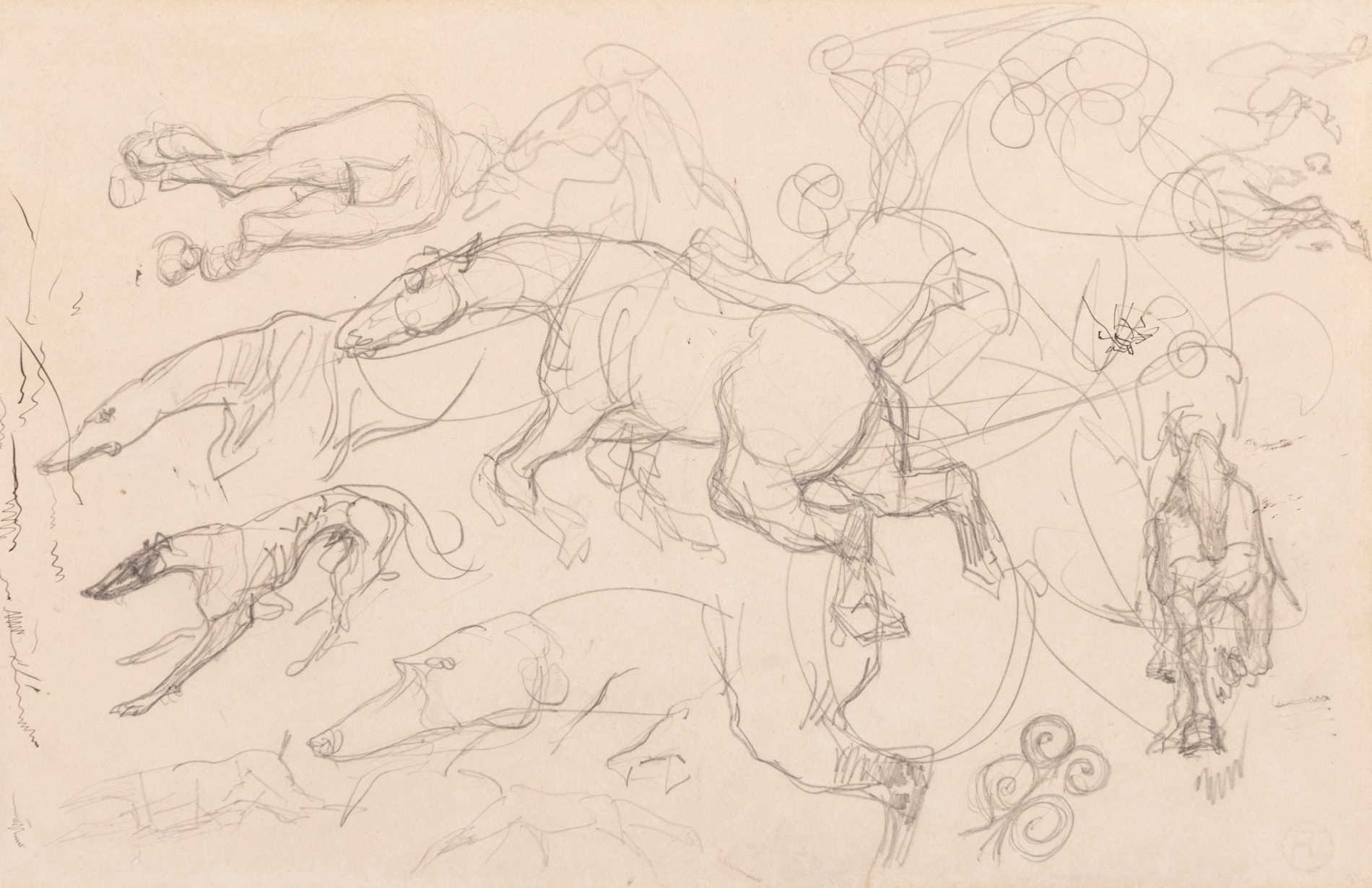

Henri de TOULOUSE-LAUTREC
Albi 1864 - Saint-André-du-Bois 1901
Biography
Born into an aristocratic family in Albi in the south of France, Henri de Toulouse-Lautrec drew from an early age. He studied in Paris with René Princeteau and Léon Bonnat before enrolling in the art school in Montmartre established by the painter Fernand Cormon, where among his fellow pupils were Vincent Van Gogh, Emile Bernard and Louis Anquetin. Although not a Parisian by birth, Lautrec became indelibly associated with the city and its inhabitants, whose days and nights he recorded in numerous amusing and expressive drawings. He was particularly drawn to the dance halls, cabarets, theatres, restaurants and cafés of Montmartre, where he lived from 1884, enjoying a decadent lifestyle. He produced lithographs for Le Mirliton, the magazine published by the performer Aristide Bruant, and portrayed many of the singers and dancers who could be found at such venues as the Moulin de la Galette and the Moulin Rouge.
Toulouse-Lautrec first established a reputation as a painter (especially of portraits) and illustrator, exhibiting at the Salon des Indépendants in 1889 and 1890. He also began producing a number of lithographic posters for the Moulin Rouge, which proved very successful. Lautrec continued to design posters for other clients, and at his first commercial exhibition at the Boussod and Valadon Gallery in 1893, half of the works shown were posters. The artist eventually produced a total of thirty-two posters, while also receiving commissions for lithographs and book illustrations. A second solo exhibition took place at the Galerie Manzi-Joyant in Paris in 1896, followed by one at the Goupil Gallery in London the next year. Prone to excessive drinking, Lautrec suffered signs of mental illness in his later life, due to alcoholism and syphilis. He was confined to a sanatorium for several weeks in 1899, during which he produced a series of drawings on circus themes. He remained very weak after his release from the hospital and suffered two strokes before his death in September 1901, at the age of thirty-six.
The significance and value of Toulouse-Lautrec’s extensive and varied output as a painter, draughtsman, lithographer and poster designer remained largely unrecognized throughout his life, outside of a small circle of friends, collectors and connoisseurs. Although an exhibition was mounted in Toulouse in 1907 and a monograph devoted to the artist appeared in 1913, his oeuvre did not receive much posthumous public recognition until the 1920s, when the artist’s mother donated a large collection of his work to establish the Musée Toulouse-Lautrec in his birthplace of Albi. A major retrospective at the Louvre in 1931 that included well over four hundred works cemented his reputation.
