
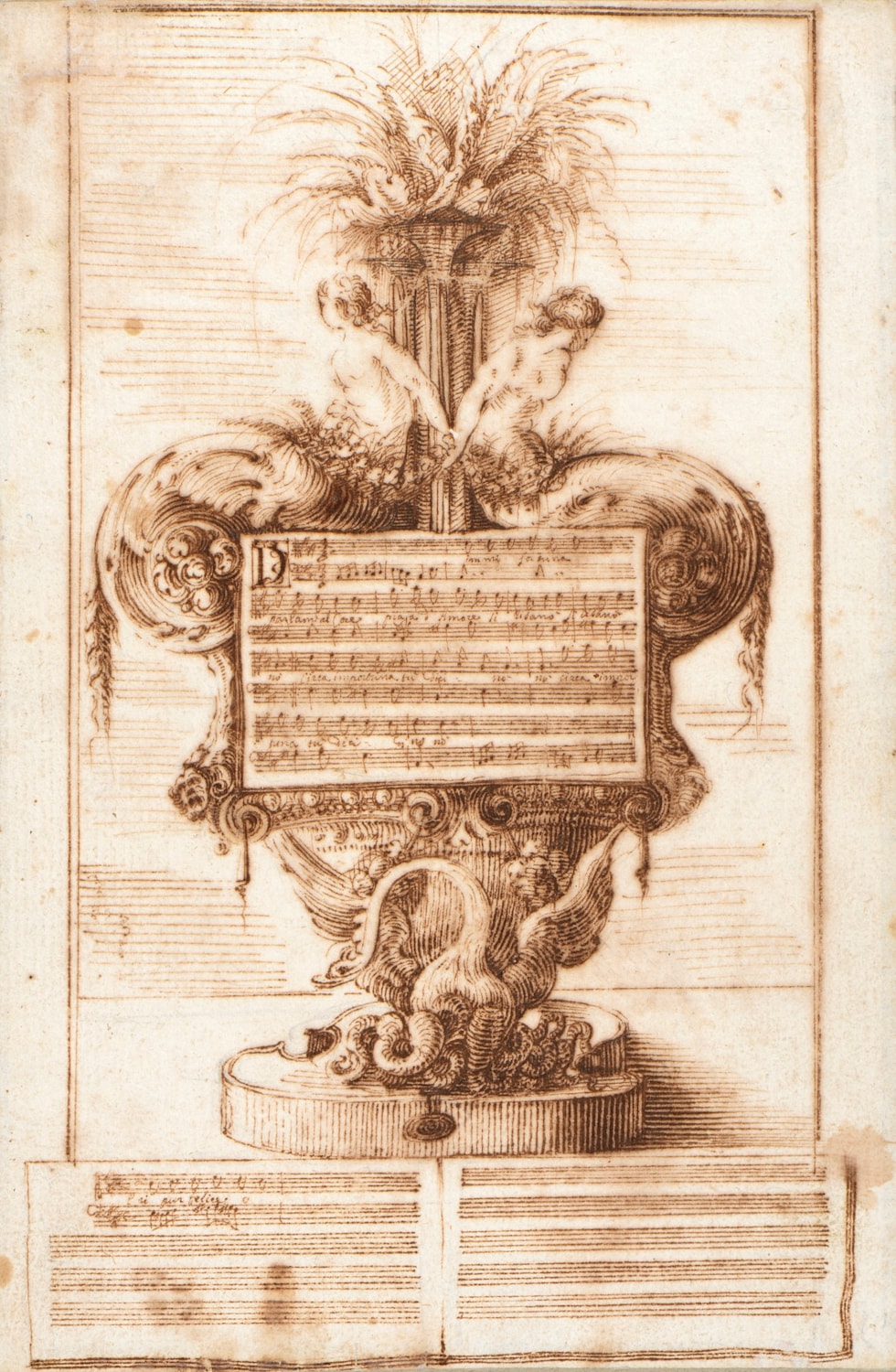

Carlo Antonio BUFFAGNOTTI
Bologna 1660 - Turin c.1717
Biography
The late 17th century Bolognese printmaker, theatre designer and musician Carlo Antonio Buffagnotti received his training in the Bolognese studio of the painter and quadraturista Domenico Santi, known as Il Mengazzino, who provided the young artist with a grounding in ornamental design and illusionistic architecture. Buffagnotti came to be particularly known as a decorator of printed music, particularly in the early part of his career. Between 1680 and 1695 he provided engraved illustrations for a significant number of musical works, including the 'Concertino per violino e violoncello op.IV' by Giuseppe Torelli, two collections of songs by Bolognese and Emilian composers, as well as Giuseppe Iacchini’s 'Sonate a violino e violoncello…opera prima' and manuscripts of secular cantatas set to music by Giovanni Paolo Colonna and presented as gifts to such important patrons as Francesco II d’Este, Duke of Modena and Reggio, and Cosimo III de’ Medici, Grand Duke of Tuscany. Another work extensively illustrated with engravings by Buffagnotti was a 'Sonate per camera a violino e violoncello di vari autori', containing twelve sonatas for violin and cello by ten different Bolognese composers, including Torelli, Iacchini and Giuseppe Aldovrandini. Buffagnotti was himself an accomplished musician and composer. He became a member of the Accademia Filarmonica in 1695 and, also in the 1690s, published a number of original musical compositions as 'Menuetti, sarabande et varij caprici di Carlo Buffagnotti', illustrated by his drawings.
Towards the end of the 17th century Buffagnotti began working more as a scenographer, notably for a staging of Conte Pirro Albergati’s pastoral opera 'Gli amici' in Bologna in 1699, and well as a designer of ornament, as can be seen in such works as the 'Soffiti inventati intagliati p. Carlo Buffagnotti' of c.1694 and the 'Vari capricii di Carlo Buffagnotti dedicato al merito del si.re Filippo Pirotti', which appeared at around the same time. He worked closely with the architect and stage designer Ferdinando Galli Bibiena, and between 1703 and 1708 etched most of the seventy plates in Bibiena’s seminal 'Varie opere di prospettive'. He is said to have worked as a painter and stage designer in Genoa and Ferrara and was also active as a drawing master to members of the Bolognese nobility. Buffagnotti is not documented after 1717. Only a handful of drawings by the artist, all in pen and ink, are known; examples are in the collections of the Metropolitan Museum of Art and the Pierpont Morgan Library in New York, as well as the Fondazione Giorgio Cini in Venice.
