
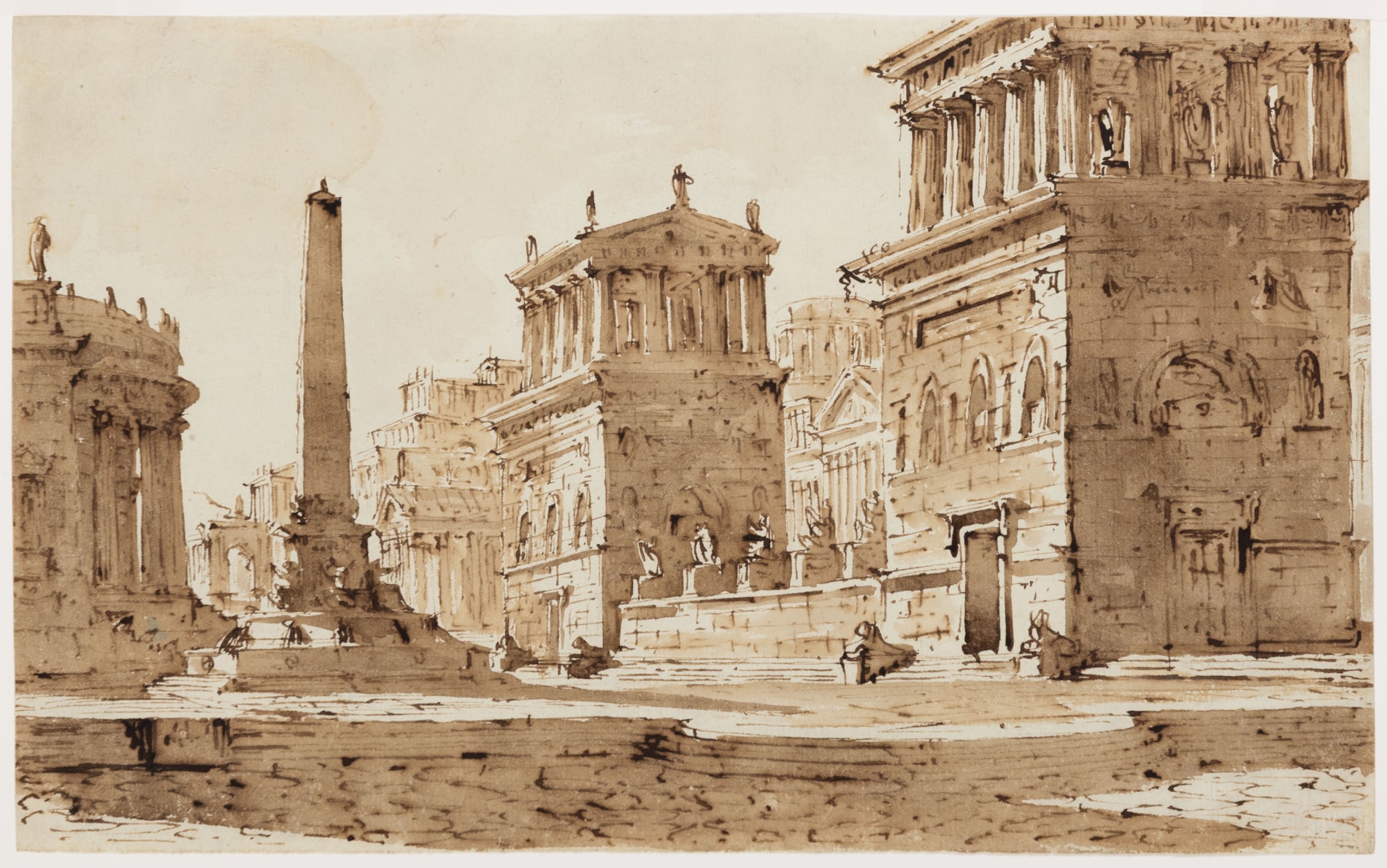

Pietro GONZAGA
Longarone 1751 - St. Petersburg 1831
Biography
Born in a town near Belluno, north of Venice, Pietro di Gottardo Gonzaga moved to Treviso in 1767 to study with Carlo Galli Bibbiena, one of the last members of a famous dynasty of scenographers. Two years later he was in Venice, where he trained with Antonio Visentini and Giuseppe Moretti, before completing his apprenticeship in Milan, between 1772 and 1778, with the Galliari family of stage designers. As an independent artist, Gonzaga produced numerous designs for stage sets for theatres throughout Italy, notably La Scala in Milan and La Fenice in Venice, as well as in Mantua, Parma, and Rome, and became one of the leading artists in this field. Indeed, as one modern scholar has opined, ‘the real initiators of neo-classical stage-design, free from all echoes of Baroque or Rococo, were Giacomo Quarenghi, Pietro Gonzaga and Paolo Landriani.’
While Gonzaga also painted landscapes and architectural perspectives, it was as a stage designer that he came to the attention of Prince Nicolai Yusupov, the Russian ambassador, who in 1792 brought the artist to the court of Catherine the Great in St. Petersburg. Gonzaga enjoyed a highly successful career in Russia, working in St. Petersburg and Moscow as chief scenographer for the State theatres as well as decorating several palaces with landscape and architectural paintings and creating designs for temporary ceremonial structures. He also collaborated with Giacomo Quarenghi on the design of the theatre at the Hermitage. Gonzaga worked occasionally as an architect, and was named court architect in 1827. It was also in Russia that Gonzaga published two treatises on scenographic matters; La musique des yeux et l’optique théâtrale in 1800, and the more autobiographical Information à mon chef ou éclaircissement convenable du décorateur théâtral in 1807. Gonzaga was largely responsible for launching a new school of Russian stage design, and a large number of his drawings are today in museum collections in Russia.
