
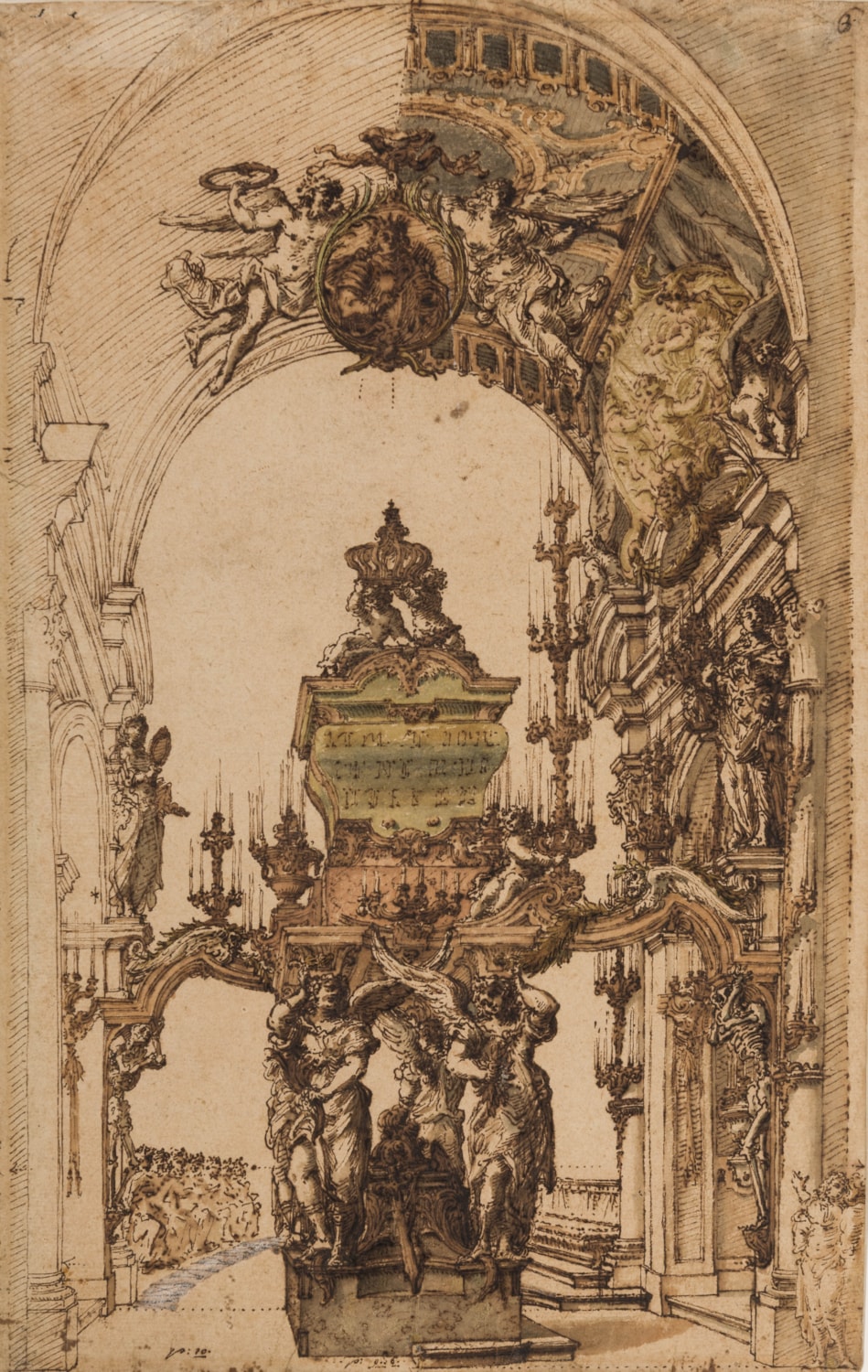

Attributed to Thomas BLANCHET
Paris c.1614 - Lyon 1689
Biography
Active as an architect, sculptor and painter, Thomas Blanchet was trained in the Parisian studio of Simon Vouet between 1637 and 1645. He spent a number of years in Rome, between 1647 and 1653, and there produced designs for funeral monuments and decorations for festivals and important public events. He met numerous artists, including Alessandro Algardi in Bologna, and Nicolas Poussin and Andrea Sacchi in Rome. On his return to France, Blanchet settled not in Paris but in his native Lyon, where he was soon established as one of the leading painters in the city. Between 1655 and 1672 he directed the extensive decoration of the town hall in Lyon, unfortunately destroyed by fire in 1674. In later years Blanchet contributed to the adornment of several Lyonnais buildings, notably the Abbey of the Dames de Saint-Pierre, on which he worked between 1675 and 1684, and the Palais de Justice, completed in 1687. He painted canvases for several churches in Lyon and also designed ephemeral decorations for festivals and ceremonial occasions, such as for the visit of Louis XIV to Lyon in 1658-1659. A founder member of the Académie de Peinture et de Sculpture in Lyon in 1676, he remained the most prominent artist in the city until his death.
As Jennifer Montagu has aptly noted, ‘It is [the] frankly baroque character of his work that makes Blanchet so interesting a phenomenon in the French art of the seventeenth century. In the provinces, in a city which had long served as a meeting-place on the route between Paris and Italy, a member of the Académie Royale de Peinture et de Sculpture could practise a style far removed from the orthodoxy of the capital. Provincial artists tend to sink into obscurity, and, lacking the constant informed criticism which would have been unavoidable in Paris, they may all too easily slip into that carelessness which is evident in much of Blanchet’s very uneven production. But this provincial existence at the same time allowed them a greater freedom to develop in their individual ways, and their originality adds a variety and richness to the texture of French seventeenth century art.’
