

Richard de LALONDE
Paris 1735 - Paris 1808
Biography
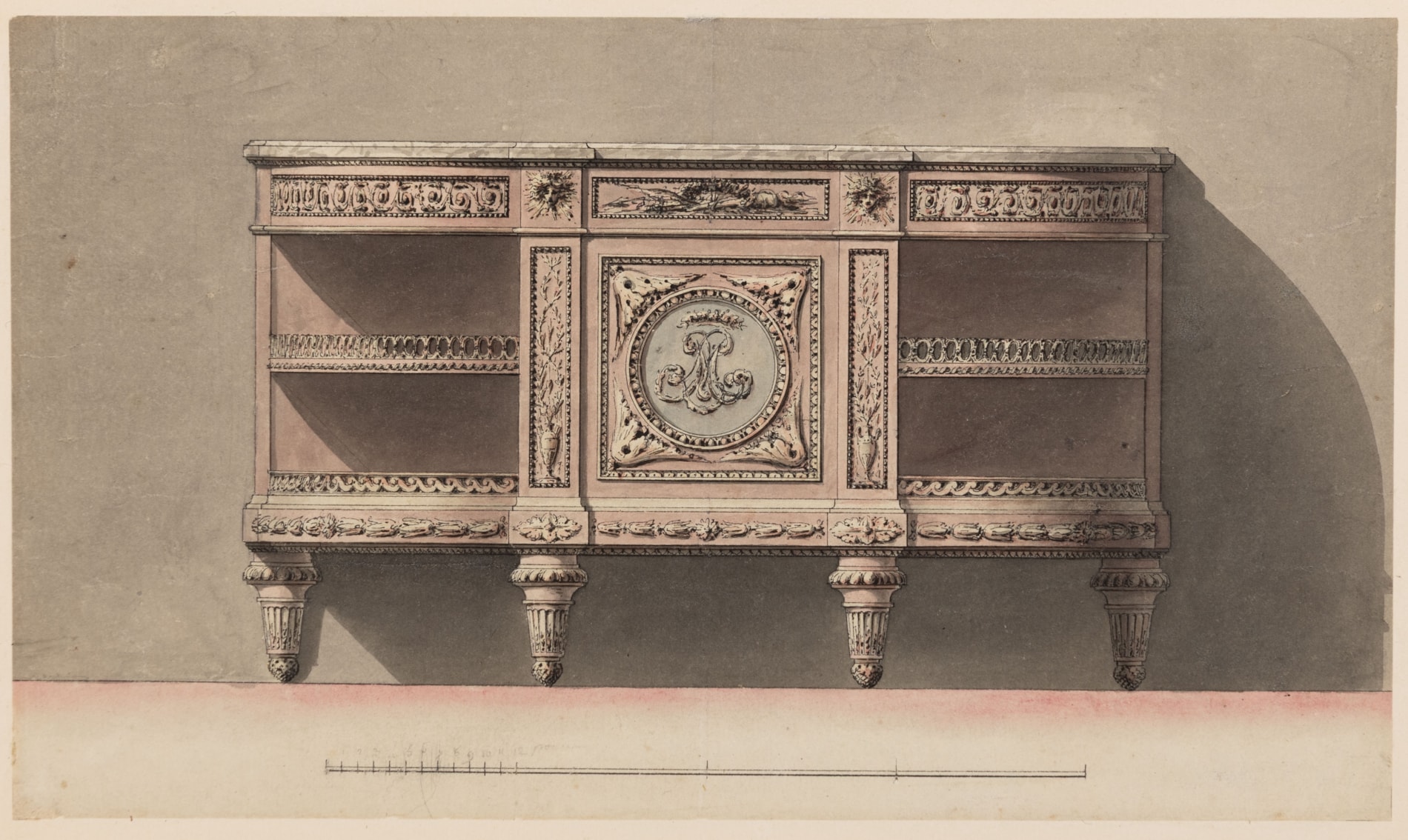
Relatively little is known of the life and career of Richard de Lalonde, who was active as an architect, furniture designer, ornamental draughtsman and decorator in the late 18th century. Although a significant figure in the history of Neoclassicism in France, his work is known mainly through engravings and he remains little-studied today. Active between about 1760, when his name is first recorded in the accounts of the Menus-plaisirs du roi, and 1796, Lalonde was firmly established by the 1780s. (As early as 1781, the Parisian colour merchant and varnishmaker Jean-Félix Watin, in his L’art du peintre, doreur, vernisseur published that year, praised Lalonde for his ‘perfect and modern taste.’) Lalonde also enjoyed some Royal patronage. Among his clients was the brother of the King, the Comte de Provence, for whom he designed a chest of drawers in 1786 that was later acquired by Louis XVI, while in 1788 he was commissioned to design two mahogany console tables for the Château de Saint-Cloud.
Lalonde worked at the Garde Meuble de la Couronne and also for such Parisian marchands-merciers as Simon-Philippe Poirier and Dominique Daguerre, producing numerous designs for furniture, ornament and silver. (An album of nearly a hundred watercolour designs for furniture and various decorative elements by Lalonde, perhaps intended for a marchand-mercier, is today in the Musée des Arts Décoratifs in Paris.) The range of the artist’s extensive oeuvre is thoroughly documented in two volumes of engravings after his designs, the Oeuvres diverses de Lalonde, décorateur et dessinateur, contenant un grand nombre de dessins pour la décoration intérieur des appartements à l’usage de la peinture et de la sculpture en ornement des meubles de plus nouveau genre, published between 1776 and 1788. The Oeuvres diverses was made up of twenty-six cahiers, each containing six plates, and its purpose was stated clearly on the title page: ‘This collection is useful for artists and anyone wishing to decorate with good taste.’ (‘Ce Recueil utile aux Artistes et aux personnes qui veulent décorer avec goût.’) The drawings provided a large number of designs, including for such items of furniture as commodes and secrétaires, which were used and adapted by cabinetmakers such as Guillaume Beneman, Martin Carlin, Joseph Stockel and Adam Weisweiler. The wide dissemination of the Oeuvres diverses spread Lalonde’s reputation as a designer throughout France and the rest of Europe, notably in Austria and Hungary. After the French Revolution he continued to provide drawings and designs for furniture to several print publishers.
