

Jean-Guillaume MOITTE
Paris 1746 - Paris 1810
Biography
Born into a family of engravers, the Neoclassical sculptor and draughtsman Jean-Guillaume Moitte was trained in the studios of the sculptors Jean-Baptiste Pigalle and Jean-Baptiste Lemoyne and won the Prix de Rome for sculpture in 1768. After a period of study at the Ecole Royale des Elèves Protégés, he arrived in Rome in 1771, although his stay was cut short, after about a year and a half, for reasons of ill health. Nevertheless, his study of ancient sculpture in Rome, and of Roman reliefs, vases and urns, was to be of great importance in his later work. One of Moitte’s first commissions upon his return to France was the decoration of the château of the Prince de Conti at L’Isle-Adam. Although he was admitted (agrée) to the Académie Royale in 1783, the year that he first exhibited at the Salon, he was never reçu as a full Academician. In 1784 he produced a number of sculptures and reliefs for the Hotel de Salm, and in the succeeding years worked on the decoration of the barrières or toll-houses of Paris, built by the architect Claude-Nicolas Ledoux. During the Revolution, Moitte took part in the decorations for the Fête de la Fédération in 1791, and the following year designed a new pediment for the Panthéon, since destroyed. Other public commissions included a pediment in the old Palais du Louvre and a bas relief in the Luxembourg Palace, as well as a handful of monuments. In 1795 Moitte was made a member of the Institut de France and later received several important Imperial commissions from Napoleon. Moitte’s wife Adélaïde-Marie-Anne, née Castellas, was an amateur painter and draughtsman.
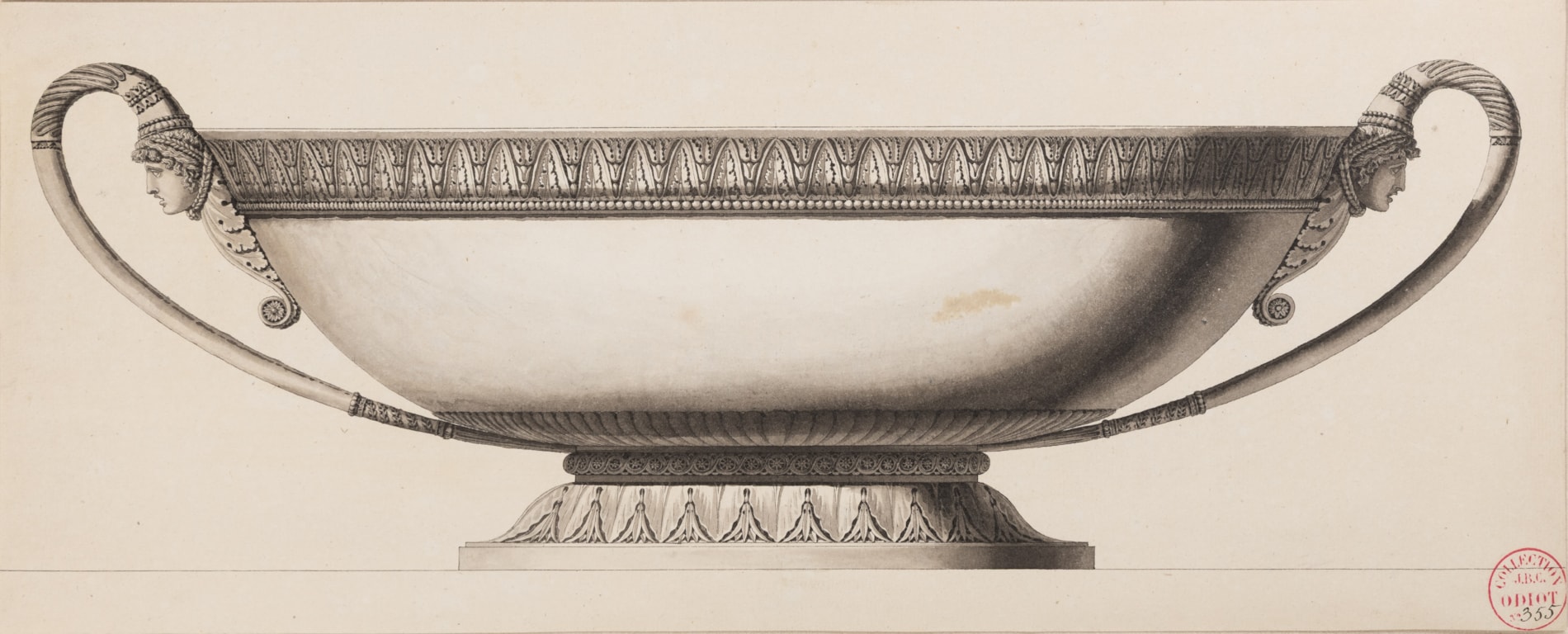
Moitte was an exceptional draughtsman and produced drawings for sculptural projects and decorative arts, as well as finished compositions of narrative subjects and book illustrations. In the middle of the 1780s he began designing projects for the noted Parisian gold and silversmith Henri Auguste, including designs for dinner services and candelabra, in a collaboration that lasted for several years. Moitte was recognized as among the most gifted draughtsmen employed by Auguste, for whom he is said to have produced over a thousand drawings. As one contemporary author recorded, after his return to Paris from Italy, Moitte ‘drew in pen many large friezes in a beautiful style, that were much admired among artists. Although he had not been able to model and work marble in Rome, his head was full of ideas and his folders filled with drawings. M. Auguste, goldsmith to the King, employed him to make drawings that served as designs for his best works. Thus he obtained an enormous advantage over all the other goldsmiths. M. Moitte made perhaps over a thousand drawings of this kind, and he obtained a special reputation in this field, which he perhaps dismissed too much later on; he gave to a luxury genre a degree of merit which had not existed in France for over a century. The great masters did not hesitate to depict his designs.’
