
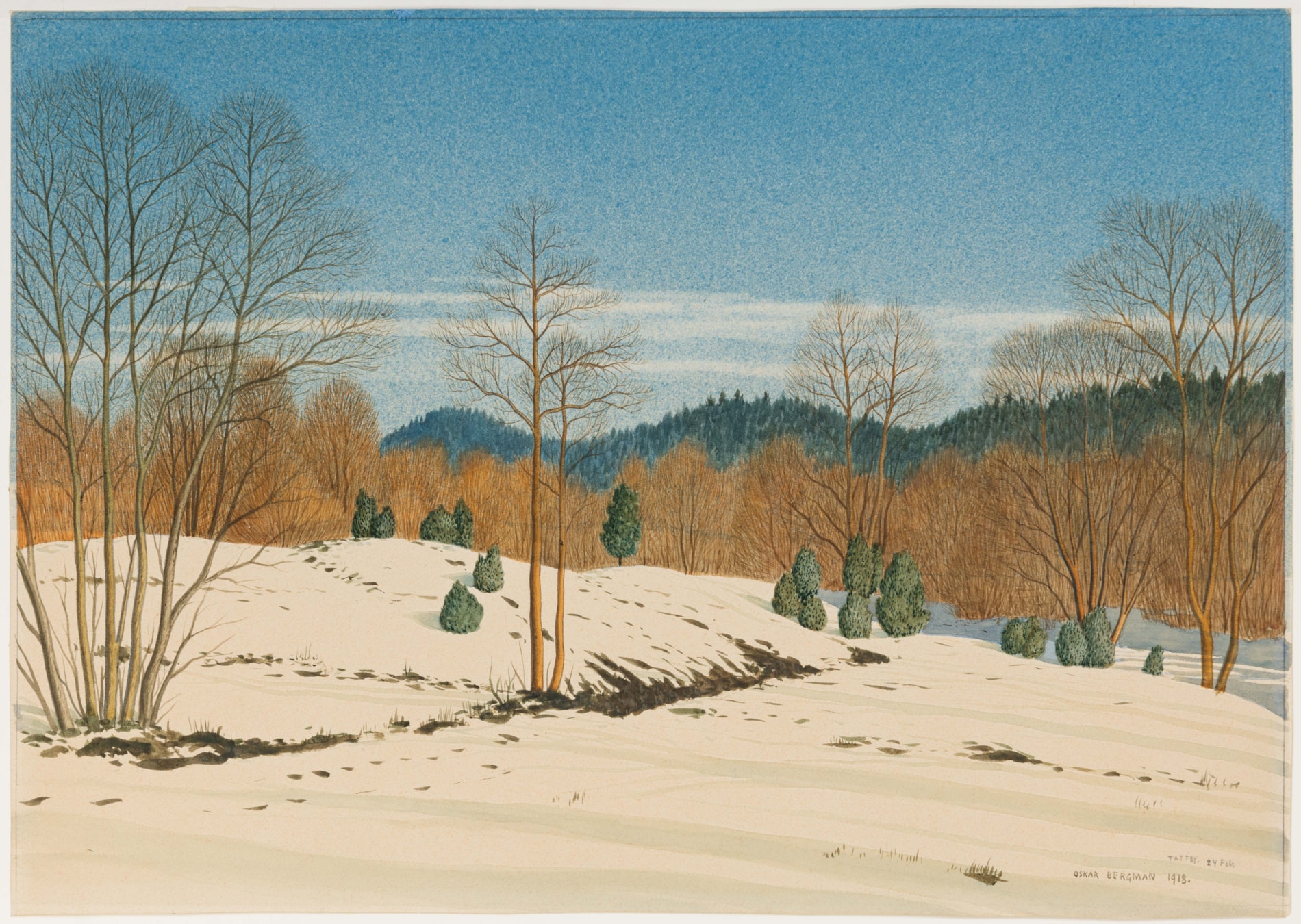

Oskar BERGMAN
Stockholm 1879 - Saltsjöbaden 1963
Biography
Arguably one of the most significant Swedish landscape artists of the 20th century, Oskar Bergman remains little known outside his native country. The majority of his works are today in museums and private collections in Sweden, and most of the literature on Bergman, including two biographies by close friends of the artist, is in Swedish. It has only been very recently that his remarkable oeuvre as a draughtsman and painter has been rediscovered and appreciated by a wider international audience.
Born in the working-class district of Östermalm in central Stockholm, Bergman was the son of a tinsmith whose sudden death when he was still a child plunged the family into financial distress, so that at the age of thirteen he began working as a tailor’s assistant. It was during this time that Bergman started visiting the Nationalmuseum every Sunday, and there was particularly attracted by the works of the local Romantic painters Marcus Larsson and August Malmström. By the time he was sixteen, he was attending the evening art classes, although he never enrolled at the Academy of Fine Arts and was, in effect, an autodidact. Bergman’s earliest known works date from 1901, the same year that the artist was introduced to the banker Ernest Thiel and his wife Signe, who were among the most prominent patrons of the arts in Sweden. Thiel took Bergman under his wing, allowing him to stay in the ‘artist’s house’ he owned at Neglinge in the town of Saltsjöbaden, where he spent three successive summers. Thiel also introduced him to the French Symbolist painter Armand Point, who was to be a strong influence on the young artist. By 1904 the quality of Bergman’s early work – largely in the form of works on paper in graphite, watercolour and coloured pencils – had progressed to the extent that Point, recognizing his potential, invited him to study in his art school in Florence. The trip was entirely funded by the Thiels, who bought a thousand kroner’s worth of Bergman’s work. He set off for Florence at the beginning of 1905, stopping in Berlin, Munich and Verona on the way. While in Italy, he also spent some time in Rome. Apparently fearing that he might lose some of his originality, however, the Thiels ended their financial support of the artist’s European sojourn, and Bergman travelled back to Sweden, via a few days in Paris. In October 1905 he took part in a group show, with three other artists, at the Konstnärshuset (Artist’s House) in Stockholm. This exhibition, at which he showed around a hundred works, established Bergman’s career and earned him significant critical praise.
The succeeding years proved to be particularly prolific for the artist, who exhibited in a number of Swedish venues. His work also began to be shown outside the country; in Helsinki in 1908, Vienna in 1910 and Brighton in 1911, eventually culminating in an exhibition of twenty of his works at the Panama-Pacific International Exposition in San Francisco in 1915, when he was awarded a gold medal. With growing success, Bergman’s financial situation improved, and he was able to return to Italy in 1912 and 1914, just before the start of the First World War. He also took up printmaking, producing just over eighty engravings between 1914 and 1919. In 1917 the Nationalmuseum purchased its first work by the artist, a large watercolour entitled The Sea Shore, Sandhamn. Bergman began to travel by train or boat around Sweden and the Stockholm archipelago, painting landscapes and offering them for sale at local exhibitions, and it from these trips that many of his most visually stunning works were created. As the artist once stated, ‘In this country the subjects literally flow over me. All you have to do is notice them.’
Despite some financial struggles and the political turmoil in Europe between the two World Wars, Bergman enjoyed a great deal of success, with numerous solo exhibitions. In 1940 a biography by the Swedish artist and art critic Otto Carlsund was published and the same year a major retrospective exhibition of Bergman’s work opened at the Svensk-Franska Konstgalleriet (Franco-Swedish Gallery), a leading modern art gallery in Stockholm. Nevertheless, he continued to remain well apart from contemporary artistic trends in Scandinavia. As Vibeke Röstorp has written, ‘Impervious to modernism and abstraction, his work conveys a sense of timelessness. Bergman did not shun the art world, but he became involved in practically no art movements over the course of his career. This independence led to his omission from the narratives of Swedish art history.’ A retrospective of Bergman’s work was held at the Stockholm Academy in 1953, and four years later he was honored with the Egron Lundgren Medal, awarded to the country’s outstanding watercolourists, which King Gustaf VI Adolf – a longtime admirer of the artist who often visited his exhibitions – bestowed on him in person. Bergman died in 1963, at the height of his success, and nine years later a major commemorative exhibition of paintings, drawings, engravings and tapestries was mounted at the Konstakademien in Stockholm. Today the most significant group of works by Bergman is held by the Thielska Galleriet in Stockholm, founded in 1907 to house Ernest Thiel’s impressive collection of late 19th and early 20th century Swedish art. Other works by the artist are in public and private collections in Sweden.
A true original, Oskar Bergman absorbed a variety of artistic trends but never pledged allegiance to any single artistic movement and always remained on the outskirts of Swedish Modernism. In a career that spanned over sixty years, the artist hovered between the influences of German Romanticism (in particular the work of Caspar David Friedrich), Symbolism, Japonisme and a penchant for the masters of the Italian and German Renaissance. Condensing all these influences into a coherent artistic language, Bergman created a unique and remarkable body of work. His paintings, watercolours and prints, almost entirely void of people and human interaction, celebrate nature and evoke an eternal and timeless quality.
