

Francesco FURINI
Florence 1603 - Florence 1646
Biography
Born into a family of artists, Francesco Furini was a student of his father, the portrait painter Filippo Furini (known as ‘Pippo Sciamerone’). A precocious artist, the younger Furini also worked in the Florentine studios of Domenico Passignano, Giovanni Bilivert, Cristofano Allori and, in later years, Matteo Rosselli. By the end of 1619 he was in Rome, where within a few years he was assisting Giovanni da San Giovanni on a fresco of a Chariot of Night for the Palazzo Pallavicino-Rospigliosi and paintings for the church of the Quattro Santi Coronati. Furini’s first known autonomous work is an altarpiece of The Crucifixion with Saints Mary Magdalene, Bartholomew and John the Baptist, signed and dated 1623, for a church in the Umbrian town of Todi. The following year he returned to Florence to embark on his independent career, while a brief visit to Venice in 1629 led to a lightening of his palette.
Furini developed a distinctive style, characterized by a vaporous, sfumato handling of paint and a dreamy quality that is readily evident in paintings of such subjects as The Death of Adonis and Cephalus and Aurora. He was particularly admired for his sensual depictions of languid female nudes and, according to the 17th century Florentine biographer Filippo Baldinucci, the artist incurred significant debts by his insistence on employing only the most beautiful, and expensive, female models, as well as his use of such costly pigments as ultramarine. One of Furini’s important patrons was Prince Don Lorenzo de’ Medici, an avid collector of paintings and drawings at whose Villa La Petraia, outside Florence, the artist worked and often stayed, while other Florentine patrons included Jacopo Salviati, Alessandro del Nero and Agnolo Galli. In 1629 Furini spent a period of six months in Venice, where he had been commissioned to paint a Thetis as a pendant to a Europa by Guido Reni. A few years later he joined the priesthood, moving to a parish church in the Mugello region in northern Tuscany and foreswearing female nudes and profane subjects in favour of religious pictures and altarpieces. By the end of the decade, however, Furini had renounced his vows, and in 1639 was commissioned by the Grand Duke Ferdinando II de’ Medici to complete the fresco decoration of the Sala degli Argenti of the Palazzo Pitti, left unfinished by Giovanni da San Giovanni. Unveiled in 1642, the large frescoes in the Sala degli Argenti were to be Furini’s crowning achievement as a mural painter. Among the artist’s disciples were Vincenzo Manozzi and Simone Pignoni, whose paintings are sometimes confused with his.
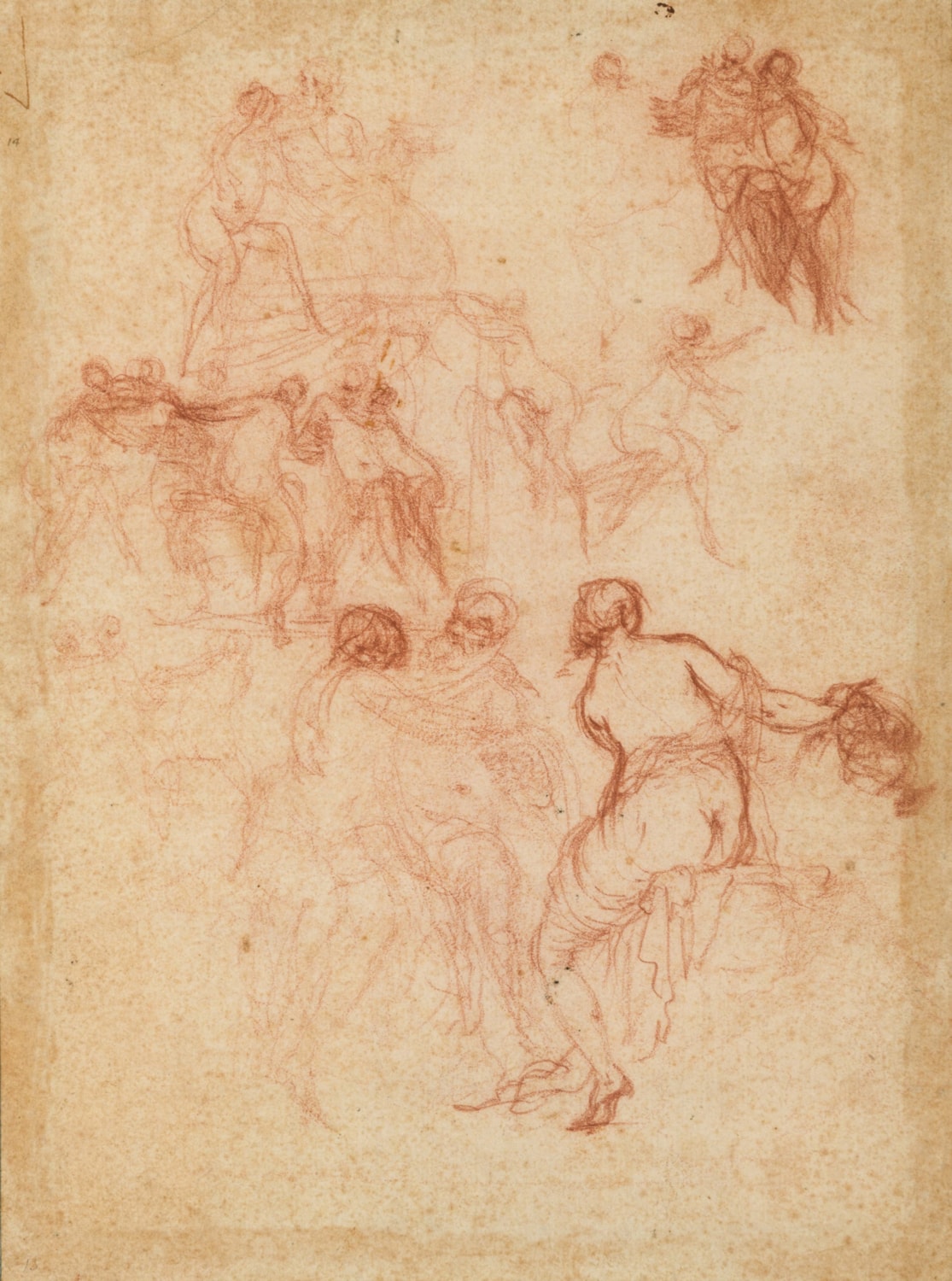
Drawings by Francesco Furini are very rare outside of the large group of some seventy studies in the collection of the Uffizi in Florence, which had been acquired by Filippo Baldinucci for Cardinal Leopoldo de’ Medici. As has been noted by one modern scholar, ‘drawings were for Furini the most demanding and important phase in the creation of a work of art. From letters…we have Furini’s own description of his dependence on life drawings from the nude model.’ Indeed, perhaps the artist’s best-known drawings are studies of female nudes, invariably drawn from the posed model in red chalk, although he also worked occasionally in pen and ink. Outside of the Uffizi, individual drawings by Furini are to be found in the collections of the Harvard University Art Museums in Cambridge (MA), the Museum Kunst Palast in Düsseldorf, the British Museum in London, the Metropolitan Museum of Art in New York, the Ashmolean Museum and Christ Church Picture Gallery in Oxford, the Louvre in Paris, and elsewhere.
