
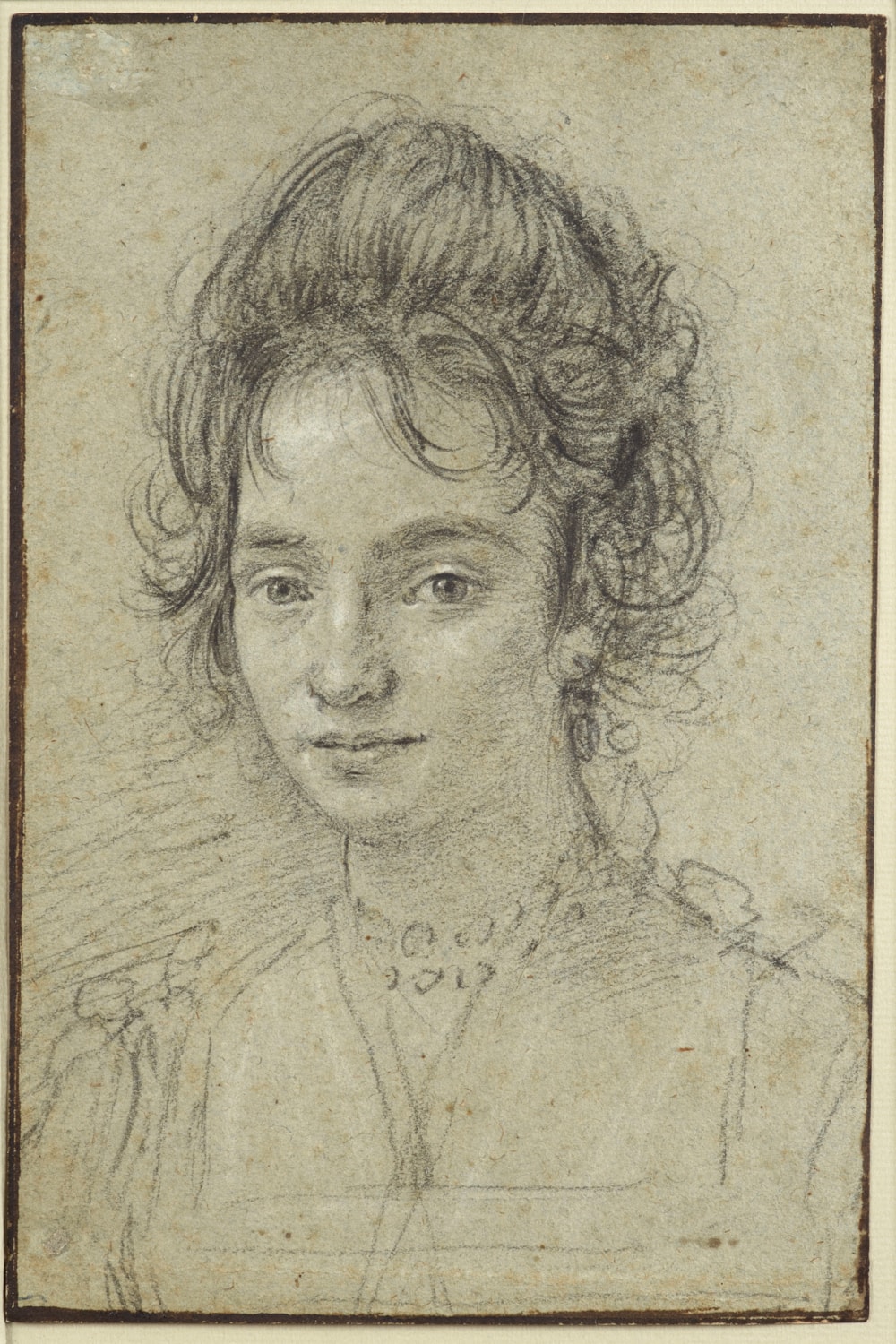

Ottavio LEONI
Rome c.1578 - Rome 1630
Biography
Although he painted a number of works for Roman churches, as well as small-scale cabinet pictures of mythological or allegorical subjects, Ottavio Maria Leoni is best known as a portrait painter and draughtsman, described by his fellow artist Federico Zuccaro in a letter of 1606 as an ‘eccellente miniator di ritratti’. He was the son of a miniaturist and medallist from Padua, and despite the fact that he himself was born in Rome he was often known as ‘Il Padovano’ in later life. While he painted at least two altarpieces for Roman churches and also produced a number of easel pictures, Leoni developed a particular reputation as a specialist in portraiture. However, while his biographer Giovanni Baglione states that the artist drew as many portraits as he painted, very few examples of his painted portraits are known today, and these are, on the whole, relatively modest in quality. Indeed, as one recent scholar has noted, ‘Had Leoni limited his career to painting, he would now be considered a mediocre artist. However, as a draftsman he was astonishing. His drawings possess all the complexity, refinement and exquisiteness that his paintings lack.’
Leoni produced over seven hundred finished portrait drawings of his contemporaries in Rome, including not only members of the aristocratic and noble families of the city and leading figures of the papal court, but also writers, artists and scientists. As Baglione wrote, ‘He portrayed not only the Supreme Pontiffs of his time, but also the Cardinal Princes, and titled Lords, and others of quality, no matter how famous they were, both religious and secular alike, were at various times drawn by him…There is no Prince, Princess, Gentleman, or Lady, as much as private individual, who has not been portrayed by Ottavio.’ Among Leoni’s patrons were members of such prominent Roman families as the Aldobrandini, Altemps, Borghese, Cesi, Colonna, Ludovisi, Medici and Montalto.
Indeed, Leoni’s drawings present a fascinating record of Roman society in the first three decades of the 17th century. As Xavier Salomon has noted, ‘The artist recorded on his sheets the features of the personalities of his city: influential cardinals and aristocrats, attractive ladies, children, artists, and literary figures. Leoni’s work is a unique description of the human topography of Rome, thousands of sheets recording, in accurate detail and with extraordinary psychological acumen, the characters that inhabited papal Rome.’ Elected principe of the Accademia di San Luca in Rome in 1614, Leoni also drew many portraits of contemporary artists working in the city, including Bernini, the Carracci, Caravaggio, Guercino, Guido Reni and Simon Vouet. Leoni began numbering his portrait drawings sequentially from January 1615 onwards, inscribing the month and year of execution on each sheet, and from around 1618 often drew in a combination of red, black and white chalks on blue paper.
In his will of 1630, drawn up shortly before his death, Leoni left all his drawings to his stepson and pupil, Ippolito, who he hoped would find them useful in his own work: ‘I leave to Ippolito...all my drawings, which he may use to learn my profession.’ Ippolito Leoni, however, seems to have sold the drawings almost immediately to Cardinal Scipione Borghese, one of the leading collectors in Rome and a longtime patron of Leoni’s. At the cardinal’s death in 1633 his collection was inherited by his cousin Marcantonio Borghese, Prince of Sulmona. The group of portrait drawings by Leoni is first mentioned by Baglione in 1642 and 1649 as being in the Borghese collection: ‘And now the drawings are in the possession of Signor Principe Borghese, most of which are in black pencil on blue paper with very graceful touches of chalk, and very similar, and some have touches of red pencil, which appear coloured and flesh-toned; they are so natural and lifelike that nothing better could be done in that genre.’ This large group is probably identical with an album of some four hundred portrait drawings by Leoni that were later in the collection of a M. d’Aubigny before being sold and dispersed at auction in Paris in 1747, when they were commented upon by the collector Pierre-Jean Mariette. Significant groups of portrait drawings by Ottavio Leoni are today in the collections of the Kupferstichkabinett in Berlin, the Fitzwilliam Museum in Cambridge, the Accademia Toscana di Scienze e Lettere ‘La Colombaria’ and the Biblioteca Marucelliana in Florence, the Palazzo Rosso in Genoa, the Metropolitan Museum of Art and the Pierpont Morgan Library in New York, the Ashmolean Museum in Oxford, the Louvre in Paris, and the Albertina in Vienna.
