
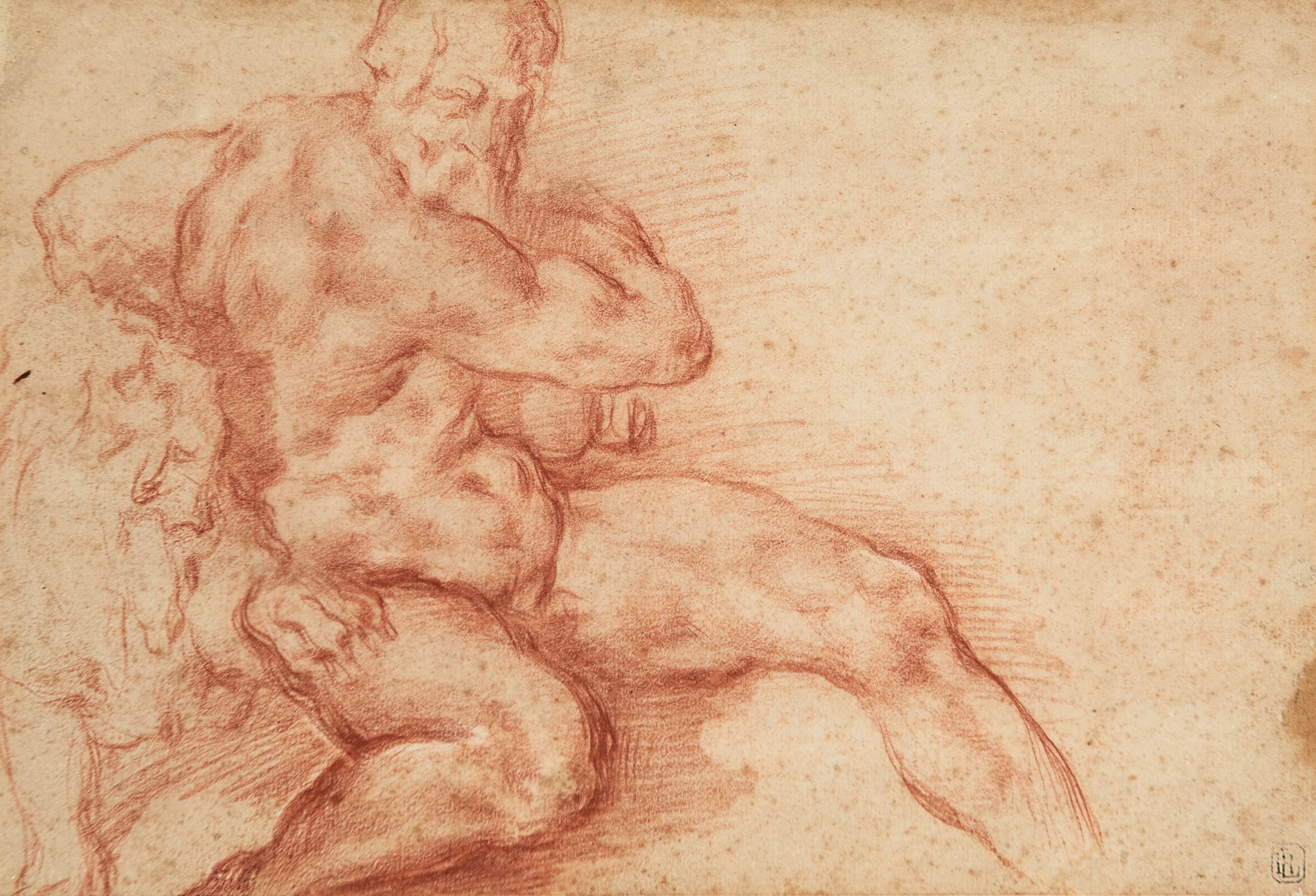

Giovanni Battista NALDINI
Fiesole 1535 - Florence 1591
Biography
A pupil and assistant of Jacopo Pontormo, Giambattista Naldini inherited his master’s drawings after his death, according to the 17th century biographer Filippo Baldinucci, although opposition from Pontormo’s heirs meant that he never actually received them. Naldini is recorded in Rome between 1560 and 1561, when he produced a sketchbook containing drawings of views of the city and copies of ancient sculptures, now divided among several museum collections. Soon after his return to Florence he became a founder member of the Accademia del Disegno and was employed as one of the artists assisting Vasari on the decoration of the Salone dei Cinquecento and the Studiolo of Francesco I in the Palazzo Vecchio. In 1571 Naldini took over a commission for an altarpiece for the church of Santa Maria del Carmine, originally given to Maso da San Friano, after the death of the latter, and this was followed some years later by two further paintings in the same church; unfortunately, all three works were destroyed in a fire in 1771. During the 1570s Naldini painted four altarpieces for Santa Maria Novella and Santa Croce as part of Vasari’s renovation of these two Florentine churches, while in 1578 he completed a frescoed Pietà for the tomb of Michelangelo in Santa Croce, commissioned several years earlier. In the late 1570s he returned to Rome, where he worked with Giovanni Balducci on the fresco decoration of the Altoviti chapel in the church of Santa Trinità dei Monti. The two artists also worked together in the cathedral of Volterra, where in 1590 Naldini painted an altarpiece of The Presentation of the Virgin. Naldini’s influence on later generations of Florentine artists was expressed through the work of such pupils as Giovanni Balducci, Domenico Passignano and Francesco Curradi.
In his seminal survey of Florentine drawing, first published in 1903, the art historian Bernard Berenson wrote that ‘drawings by Naldini are numerous, and so full of spirit, so pictorial, so lively in execution that an hour spent looking over his albums at the Uffizi must count among the pleasures of the student of Cinquecento Florentine draughtsmanship.’ Like many of his Florentine contemporaries, Naldini was a committed draughtsman, whose paintings were developed with figure studies (often using studio assistants, or garzoni) and compositional drawings leading to finished modelli. In his drawings, Naldini was steeped in the Pontormismo of his master, as Baldinucci notes: ‘[Naldini] disegnò bravamente, ed alquanto in sul gusto del suo gran maestro Jacopo da Pontormo, ma con un tocco più replicato, con matita sputata, e in sull’appiccature fortemente aggravata’. Naldini’s drawings also reflect his study of the work of Pontormo’s own teacher, Andrea del Sarto. As the scholar Annamaria Petrioli Tofani has further noted of the artist, ‘drawing formed the bedrock of Naldini’s figurative expression. He seems to have applied himself to this discipline with determination throughout his career, leaving an immense corpus of drawings…Naldini executed copies of works by the masters as well as drawings from live models, studies of individual figures and details thereof, and projects of entire compositions. This corpus, perhaps to an even greater extent than his pictorial output, has enabled us to chart his stylistic choices and the complex network of influences that combined to produce an expressive vocabulary that is assured, formally correct and often vividly brilliant.’
