
Paul Albert BESNARD
Paris 1849 - Paris 1934
Biography
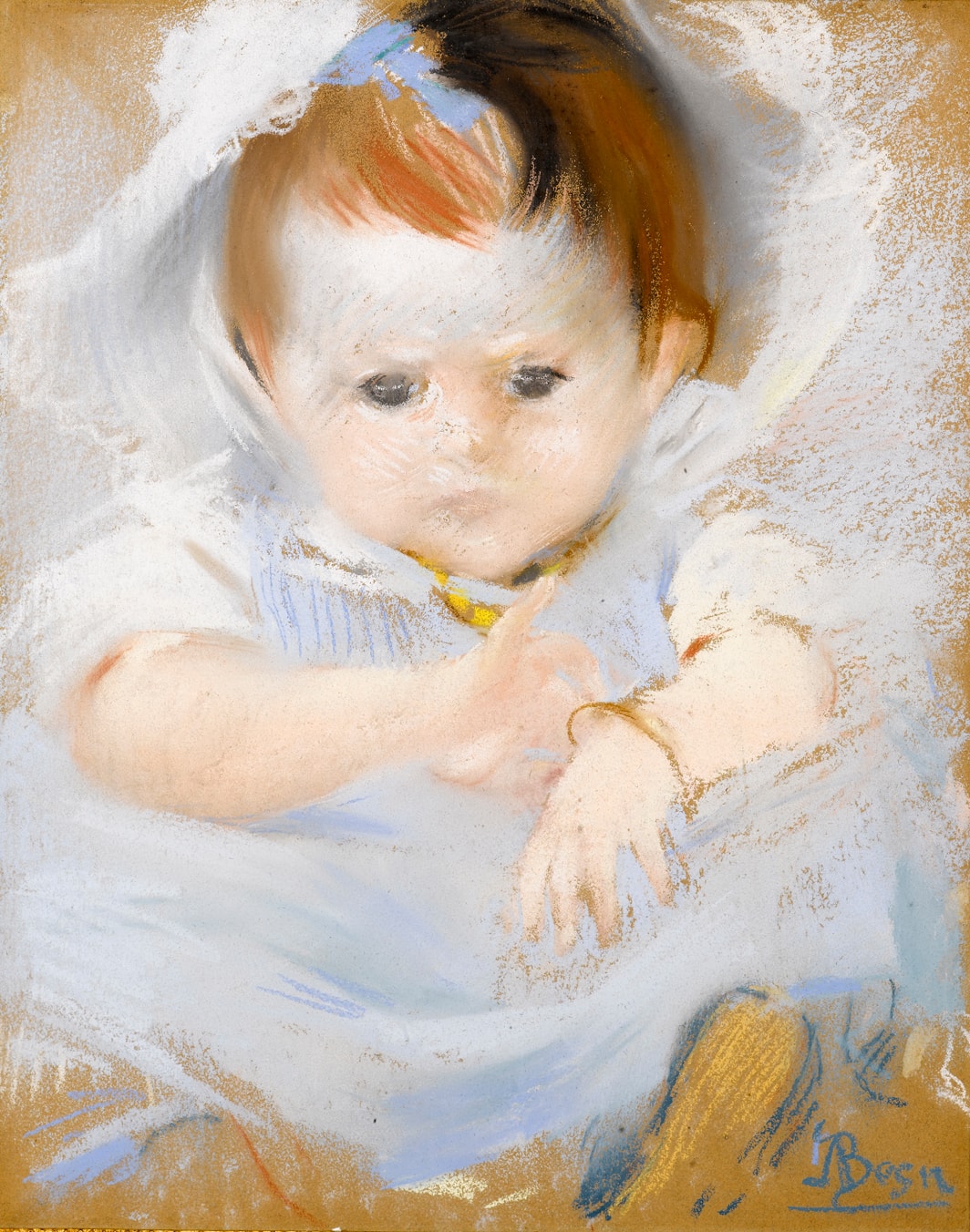
Albert Besnard entered the École des Beaux-Arts in 1866, studying with Alexandre Cabanel, before making his debut at the Salon of 1868. Six years later, in 1874, he won the Prix de Rome with a painting of The Death of Timophanes, Tyrant of Corinth. His five years at the Villa Medici in Rome were followed by four years in London, where he obtained several important portrait commissions. By the middle of the 1880s Besnard was one of the most highly regarded and fashionable society portrait painters in Paris. He developed a particularly evocative manner of depicting his sitters that relied on luminous, vibrant colours, dramatic (and at times artificial) lighting, and bold brushwork. These elements also found their way into the artist’s other main activity; his work as a mural painter. Besnard painted large decorative schemes for several public buildings in Paris, including the Sorbonne, the Ecole de Pharmacie and the Pavillon des Arts Décoratifs at the Exposition Universelle of 1900, as well as ceiling decorations for the Comédie Française, the Salon des Sciences of the Hôtel de Ville and the central hall of the Petit Palais, newly-built for the Exposition Universelle. He also created mural decorations for L’Art Nouveau Bing, the shop of the dealer and collector Siegfried Bing on the rue de Provence in Paris, and the villa of the financier Baron Joseph Vitta at Evian. In addition, Besnard produced designs for stained glass and worked as a printmaker.
Although Besnard was strongly influenced by the works and techniques of the Impressionists, he never exhibited with them, leading Edgar Degas to complain that ‘Besnard is flying with our wings’. He did, however, exhibit regularly at the Salons, and also at the Societé Nationale des Beaux-Arts from 1890 onwards. In 1910-1911 he travelled extensively for several months throughout India and Ceylon. The paintings from this trip were shown to critical acclaim at the Galerie Georges Petit in Paris in 1912 and also at the Venice Biennale, and in 1913 Besnard published an account of his travels with the title L’homme en rose. The following year Besnard was appointed director of the French Academy in Rome, where he remained until 1921, and in 1925 he published Sous le ciel de Rome, a memoir of his time in the city. From 1923 until his death in 1934 Besnard was the director of the Ecole des Beaux-Arts in Paris; as such, his influence on a later generation of artists was considerable. Although he was the first French artist to be granted an official state funeral, his fame and reputation had faded considerably within a decade or two of his death.


